By Bruno Rukavina
In this analysis, research associate Bruno Rukavina, M.A. in Political Science, examines how numerous ongoing wars have become so easily acceptable over the past decade and why diplomacy struggles to resolve them. The analysis also explores the latest crisis of liberalism and why the idea of peace has become unacceptable to certain political elites—who are far from few.
The Latest Crisis of Liberalism
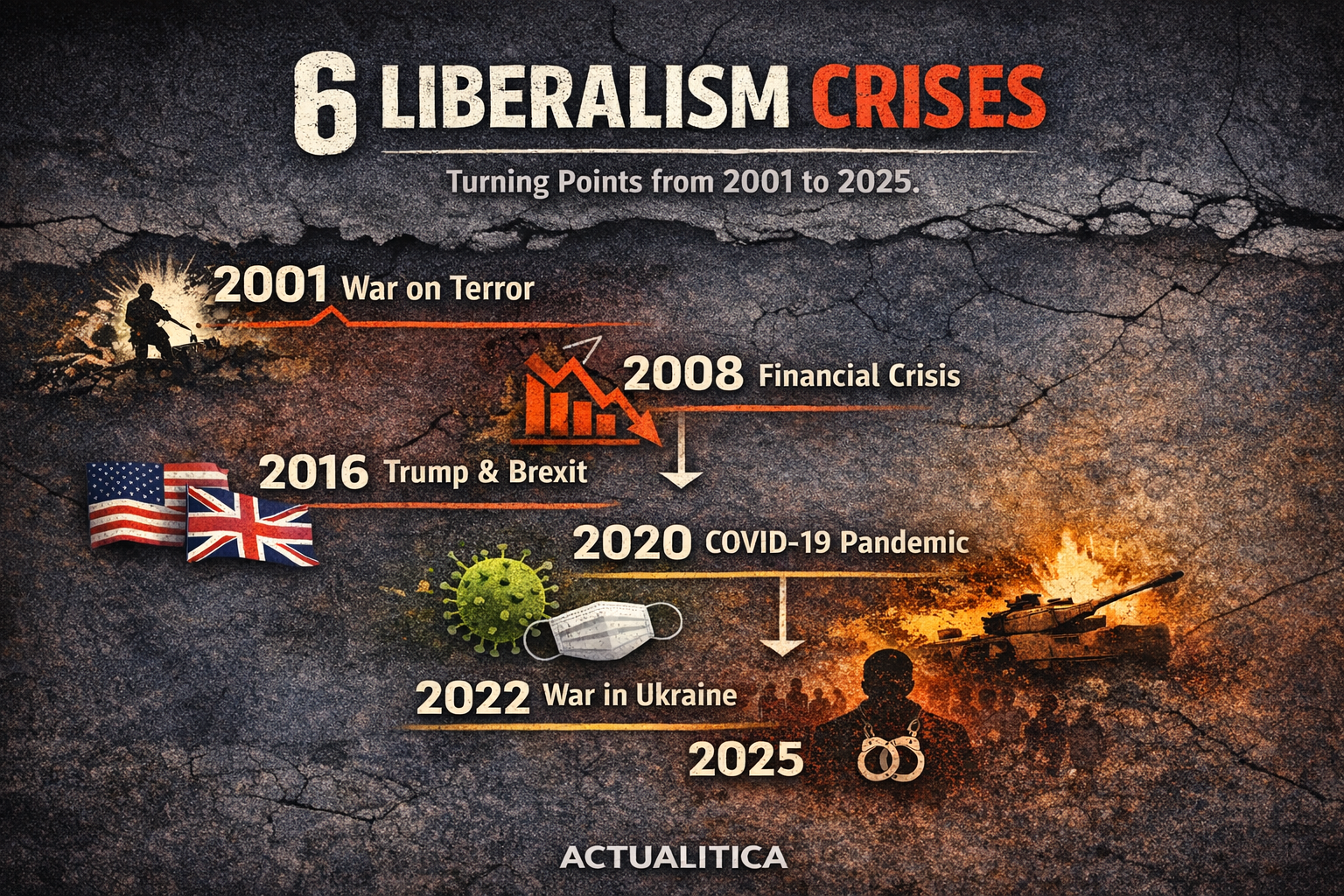
I have previously written about the crises of liberalism, and since 2025 we have had the opportunity to witness yet another one—the sixth (or fifth, depending on whether the COVID-19 crisis is separated from the war in Ukraine). Due to these crises, we may now be witnessing a new “1989,” a turning point in which the prevailing liberal paradigm—dominant over the past 25 years—is undergoing transformation. This paradigm has been challenged by several key events:
- The security crisis of 2001 and the War on Terror.
- The economic crisis and recession of 2008.
- The political crisis of 2016 following Trump’s victory and Brexit, along with the emergence of the concept of “post-truth” (a problematic term, as it implies that before 2016 there existed some universally accepted “truth,” which in turn suggests a kind of blind faith in the post–Cold War liberal order that should not be questioned—even when it fails to respond adequately to crises and challenges).
Following these three crises came two more, which cumulatively incorporate elements of security, economic, and political crises:
4. The global crisis caused by the COVID-19 pandemic.
5. The interstate Russian-Ukrainian conflict since 2022 (Rukavina, 2025b).
Last year brought the sixth crisis of liberalism—one concerning the very carriers and embodiments of liberalism (and related concepts such as globalism and Americanism), namely the Jeffrey Epstein files. This sixth crisis has called into question many individuals who, for decades, have been prominent in media and admired by millions worldwide.
The Jeffrey Epstein case is often not discussed in its entirety (as not all related documents have been released), or several key aspects are overlooked. The first concerns the past: political elites have engaged in decadent behavior throughout history, with few exceptions—it is only a matter of exposure. Such processes are not limited to distant violent pasts, such as the era of Genghis Khan, nor exclusively to the 20th century, for instance the crimes of Lavrentiy Pavlovich Beria. They are also characteristic of the contemporary era, demonstrating that human beings have remained anthropologically similar for tens of thousands of years.
“Anthropologically, humans have not changed significantly over the past several thousand years, which means we are essentially the same as before—irrational, driven by emotions such as fear, envy, greed, and the desire for domination. Does that mean people are not oriented toward rational relationships, harmony, cooperation, and mutual respect? Of course not. Humans are both—within them coexist both the pessimistic and optimistic views of human nature” (Rukavina, 2023).
Thus, the notion of a distinct “liberal human” of the 21st century does not truly exist; and if it does, it is no less decadent than its predecessors.
The second aspect concerns the present and the future: who can guarantee that the Western “occult oligarchy” repented after the Epstein case came to light? The disappearance of Jeffrey Epstein does not mean that decadent processes have ceased or that crimes no longer occur. Epstein was merely a cog in a broader decadent and criminal structure that continues to operate without him—much like Adolf Eichmann was a cog in the Nazi system, as described by Hannah Arendt. Just as the Nazi system ended with the collapse of its leadership in Berlin in May 1945—not with Eichmann’s fall—so too it is unlikely that this structure ends with Epstein’s death.
The third and most concerning aspect is political: the holistic nature and strength of Epstein’s network, which encompassed nearly all wings of political elites—from socio-liberal (even Marxist) left to conservative-national right. Figures such as Noam Chomsky and Steve Bannon, despite their opposing worldviews, had contact with Epstein, as did numerous Republicans and Democrats, celebrities from film, music, and other arts, as well as athletes, scientists, entrepreneurs, and others.
Although it is impossible to link all individuals from this network, it appears they shared a common organizer or facilitator of their decadent—and potentially criminal—activities. Despite awareness of Epstein’s past, including his conviction for organizing prostitution involving minors, many continued to associate with him as a nexus for the wealthy and influential.
In short, a significant portion of the political, cultural, economic, and broader social elite of the victorious (militant) liberal order over the past 30 years appears to be connected, at least partially, to this “occult oligarchy.” Those who warned about such structures were often ridiculed, labeled as “conspiracy theorists,” and dismissed outright. Films such as Eyes Wide Shut by Stanley Kubrick increasingly resemble documentaries. Many potential perpetrators remain hidden and protected, with names redacted in Epstein-related documents, while victims’ identities have often been exposed without protection. For most involved, the only consequence so far has been moral condemnation—but whether there will ever be legal accountability remains an open question.
Peace and Coexistence – The Antithesis of the “Newest Normal”
Finally, in the Easter season, it is important to emphasize that for Christians—regardless of denomination—the “newest normal” (conflicts and wars) is not unimaginable, but it must be repulsive. The ontological being of a Christian exists more easily in a world where diplomats lose their nerves than where people lose their lives. It is better to have a hundred years of diplomatic disputes than a single minute of war.
Therefore, the absurdity of this conflict must be ended immediately through peace (or at least a ceasefire), even if some malicious or tendentious actors consider such a solution unrealistic at this moment. For rational diplomacy—so far unsuccessful—to halt warfare, leadership must be encouraged, activated, and guided to recognize that the struggle is not against some abstract evil forces, but against people just like ourselves, with their own interests and desires.
Precisely because we are the same, it is necessary to sit at the table and talk—to at least try to understand the other side, even if it is currently impossible to forgive the irreversible crimes committed. The absurdity of war lies in the fact that it does not determine who is right, but who remains alive. If this war is not ended, there is a fear that it could escalate to a (nuclear) outcome that would end humanity as we know it (Rukavina, 2023).
“Let us therefore make every effort to do what leads to peace and to mutual edification” (Romans 14:19).
“Blessed are the peacemakers, for they shall be called children of God” (Matthew 5:9).