By Matija Šerić
The current President of the United States, Donald Trump, has introduced major novelties into global politics, one of which is an aggressive (verbal and nonverbal) style of communication. This style involves expressing thoughts, ideas, and emotions in a socially unconventional and manipulative manner, generating feelings of ecstasy and/or anger among the masses. The communication style that Trump regularly and passionately employs primarily serves him to demonstrate power and influence, establish control over voters, and secure a stronger position in the ruthless political arena. The 45th and 47th U.S. President is certainly the most prominent politician and statesman who uses aggressive communication.
Appealing to the Audience
Trump’s verbal communication is highly distinctive. He uses aggressive language often described as a “double-edged sword.” It is evident that Trump has studied the theories of Aristotle, which emphasize that “a speaker should first identify the emotions that the audience already possesses and then use vivid language that resonates with the audience to amplify those emotions.”
Trump has perfected this communication style from the 2016 election campaign to the present day. He often uses street-level language, labeling journalists as incompetent (liars) or purveyors of fake news—language that his supporters easily understand. This is one side of the “blade” that brings him popularity, while the other side is condemnation from a significant portion of the public, who describe his rhetoric as “racist, xenophobic, sexist, and authoritarian.” Aggressive verbal expression enables Trump to connect with his voter base on a deeply emotional level, while simultaneously alienating a large part of American society.
Awakening the Strongest Emotions
Trump frequently employs strategies such as exaggeration, selective acceptance of truth, spreading half-truths and disinformation, and dividing Americans into “good” and “bad.” For example, he exaggerates Republican successes in elections and government achievements in trade, the economy, and the fight against COVID-19. At the same time, he deliberately ignores aspects of reality that do not favor him, such as Republican losses in certain regions, FBI investigations, pandemic shortcomings, electoral controversies, and poor personnel choices.
He portrays Democrats as a threat to American society, accusing them of being “soft on crime.” Although not explicitly stated, his rhetoric implies that Republicans represent “good” while Democrats represent “evil.” Through simple and often crude language, Trump deliberately divides America into two opposing camps.
Dressing Like a Classic Businessman
Communication theorist Paul Watzlawick famously stated that “one cannot not communicate.” According to him, communication is not only verbal but also expressed through paraverbal and nonverbal cues such as eye contact, tone of voice, gestures, facial expressions, posture, and even clothing style.
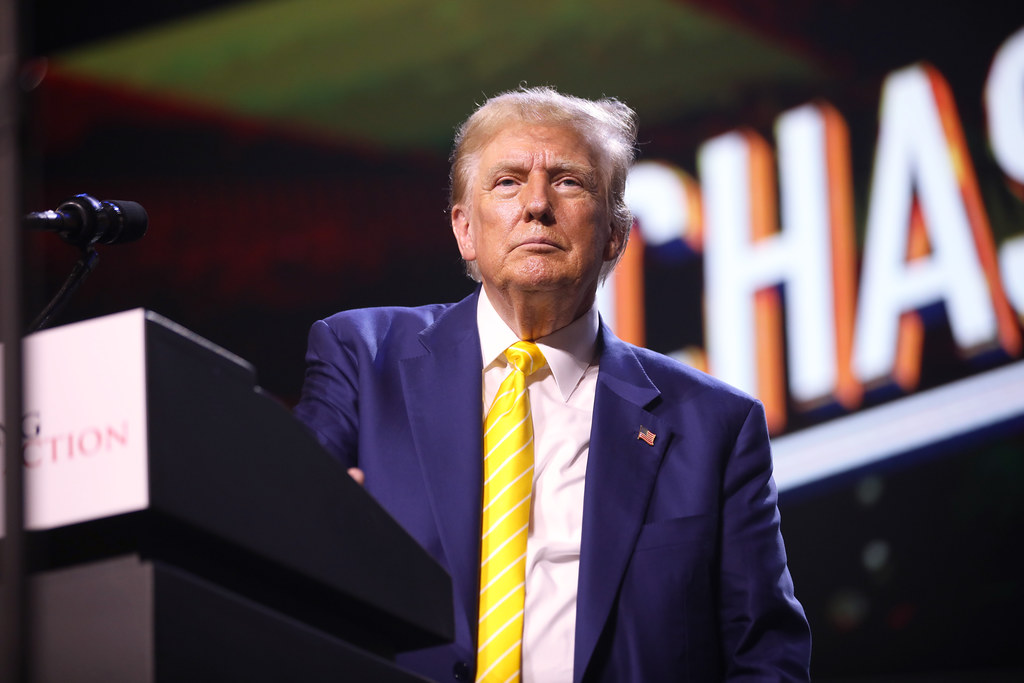
Trump skillfully uses aggressive nonverbal communication. According to Time magazine editor Ryan Teague Beckwith, the American president communicates through his clothing style. In many public appearances, Trump dresses like a powerful Wall Street businessman from the Reagan era of the 1980s. This is no coincidence, as Trump admires Ronald Reagan and the conservative America that existed before the rise of political liberalism and economic globalization.
Political Fashion Styling
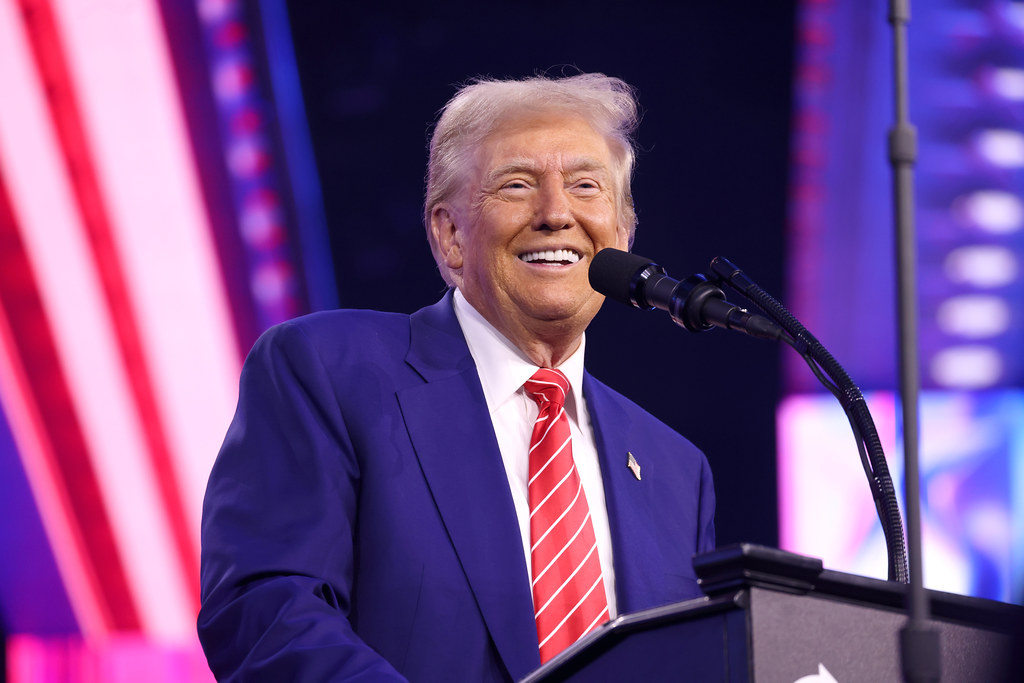
Trump almost always wears a suit and tie in public appearances, signaling high political credibility. Since the 2016 campaign, this attire has become his “uniform”—a recognizable symbol for his political base. Observers note that Trump aims to resemble a traditional businessman in sectors he promised to revitalize, such as manufacturing.
He prefers tailored suits that emphasize vitality and height—traits valued by American voters. His frequent use of a red tie symbolizes his connection to the Republican Party, whose signature color is red and from which the modern political term “red pill” originates.
The “OK” and “L” Signs
Hand gestures are central to Trump’s nonverbal communication. Active hand movements reinforce his verbal messages. Trump often uses the “OK” gesture (thumb and index finger forming a circle), which communication expert Geoff Beattie interprets as emphasizing precision and control.
He also uses the “L” gesture (forming a right angle with thumb and index finger), referring to “labour.” Through this, Trump presents himself as a defender of American workers and the middle class. Unlike the “OK” sign, the “L” gesture is considered his own invention.
Pointing the Finger
Trump frequently points at individuals in the audience to praise or criticize them. Although generally considered impolite, this gesture reinforces authority and aggression. He also uses the “wall” gesture—placing both hands parallel—to visually represent his plan to build a wall on the U.S.-Mexico border.
Breaking Political Etiquette
Etiquette represents a code of behavior expected in society. In politics, it includes professionalism, ethical conduct, and serving the public good. According to experts from Harvard University, politicians should be polite, articulate, approachable, and morally responsible.
Donald Trump stands out as the U.S. president who least adheres to traditional political etiquette. He has distanced himself from norms more than any of his predecessors. This is unsurprising given that Trump is not a conventional politician but primarily a showman. His public performances resemble those of rock stars, religious preachers, or stand-up comedians more than those of a traditional statesman.
A Harsh Style of Expression
Trump uses simple, accessible language. Humor is often present, but so are harsh insults, which strengthen his bond with supporters while alienating opponents. He labels opponents with terms like “idiots,” “disgusting,” “rapists,” and “drug addicts.”
This raw style reinforces his image as a “man of the people.” By rejecting conventional norms, he attracts diverse groups and turns them into loyal supporters. In his case, how something is said often matters more than what is said—presentation outweighs content.
Unrepeatable Charisma
One of Trump’s greatest communication tools is his charisma. His ability to captivate audiences enabled his political rise and fuels emotional reactions ranging from enthusiasm to outrage. People either love him or hate him—rarely remain indifferent.
He often avoids scripted speeches, speaking spontaneously and shifting topics rapidly—from promoting his books to discussing military action, economic revival, or international relations within minutes.
The Spin Doctor
Trump frequently demonstrates the ability to shift focus to irrelevant issues—a hallmark of a spin doctor. When confronted with uncomfortable questions, he often responds with provocative statements on platforms like X, diverting public attention.
He understands media dynamics and continuously generates headlines, using controversy as a strategic tool to maintain dominance in the news cycle.
Trump – A Figure of Division
Based on this analysis, Donald Trump represents a unique phenomenon in communication, politics, and society. Through his aggressive style, he has become globally recognizable and a dominant presence in international media.
His unconventional communication style has brought him both immense popularity and deep polarization. One part of the public admires him, while another strongly rejects him—reflecting the broader division between liberal and conservative America.
Interestingly, Trump embodies both the success and failure of aggressive communication. On one hand, he rose from a political outsider to the most powerful political position in the world. On the other, his excessive reliance on this style contributed to his defeat in the 2020 election and led to numerous controversies, including social media bans and political scandals.