By Matija Šerić
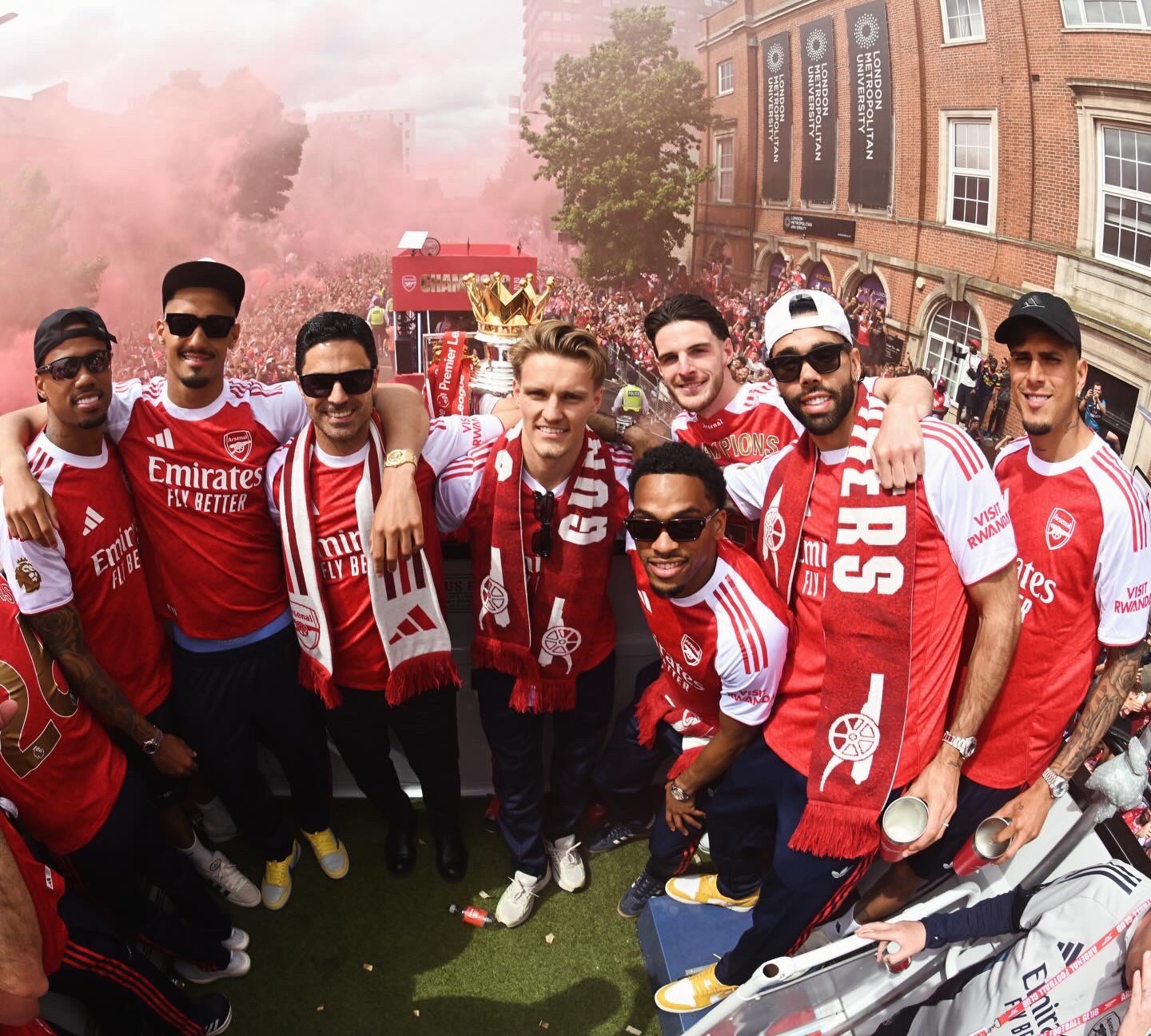
May 2026 will forever be remembered in football history, as it was the month when Arsenal F.C. finally won the English Premier League after a 22-year wait. Once again, patience proved to be worthwhile. After Liverpool ended their own 30-year title drought, Arsenal’s suffering was somewhat shorter.
Manager Mikel Arteta, his coaching staff, and the players lifted English football’s most prestigious trophy after recording 26 wins, seven draws, and five defeats, finishing with 85 points—seven more than second-placed Manchester City. Arsenal also benefited from unusually disappointing campaigns by the other traditional English giants. Manchester City, Manchester United, Liverpool, Chelsea, and Tottenham all fell below expectations, with Spurs narrowly avoiding disaster altogether.
A closer look at the statistics reveals exactly what allowed the Gunners to pull away from the competition and finally see captain Martin Ødegaard lift the Premier League trophy.
The Best Defence in the League
It is often said—not only in football but in many sports—that championships are won by defence. In Arsenal’s case, that old saying proved absolutely true.
Over 38 league matches, the Emirates side conceded only 27 goals. For comparison, runners-up Manchester City allowed 35, while Aston Villa, the next best defensive team, conceded 49.
This achievement was the result of a collective effort. Arsenal’s aggressive pressing game made them the second-best team in the league, behind Brighton, in terms of winning possession back in the attacking third. The forwards and wingers were effectively the first line of defence. Bukayo Saka alone recovered possession 27 times in the opposition’s final third.
The Gunners allowed the fewest shots on target against them—just 90—and the fewest touches by opponents inside their own penalty area, only 618. Nevertheless, much of the credit belongs to goalkeeper David Raya, centre-backs William Saliba and Gabriel Magalhães, and defensive midfielder Declan Rice. Together, they formed the backbone of Arsenal’s defensive structure.
Raya produced a series of magnificent saves and kept 19 clean sheets. Saliba and Gabriel dominated key duels and ruled the penalty area in the air, while Rice provided exceptional balance and protection in midfield. Gabriel alone blocked 34 opposition shots.
Remarkably, Arsenal conceded just one goal from a fast break throughout the entire season, a testament to their superb positioning and tactical organisation during transitions.
Mastery from Set Pieces and Crosses
From corners, free kicks, and crosses, Arteta’s side operated at a level above everyone else.
Arsenal scored 19 goals directly from corners, setting a new Premier League record. Thanks to their accurate deliveries into the box, 35 percent of their total goals came from crosses. The Gunners scored 16 headed goals from corners or open-play crosses.
Part of this success came from the team’s physical profile. Arsenal fielded one of the tallest squads in the league, allowing them to dominate aerial battles.
They were equally effective defensively from set pieces, conceding only seven goals from dead-ball situations, matching the league record.
Fair Play Worth Admiring
No Premier League champion has ever displayed greater discipline than this Arsenal side: zero red cards and zero penalties conceded throughout the entire campaign.
Such a statistic is almost unheard of.
This was not because Arsenal’s players avoided making tactical fouls or simply relied on the “all-powerful” David Raya to rescue them. Rather, their intelligent positioning and anticipation prevented opponents from putting them in situations where desperate challenges became necessary.
That is what true football intelligence looks like.
Arsenal also finished the season with the fewest yellow cards in the division, making their campaign a model of sporting fair play.
Elite Efficiency in Attack
Many observers argued that Arsenal would have secured the title much earlier if they had possessed a more prolific striker, often pointing to Viktor Gyökeres and claiming that he was not quite at the level expected of a club from North London.
At times, that criticism appeared justified, as the Swedish forward scored “only” 14 goals.
However, when efficiency is taken into account, Gyökeres posted an impressive 25 percent conversion rate, bettered only by Brentford striker Igor Thiago.
His teammates were equally clinical. Deep-lying midfielders Martin Zubimendi and Mikel Merino both recorded excellent conversion rates of 18 percent. On the wings, Bukayo Saka and Eberechi Eze each contributed seven goals.
Saka, meanwhile, produced 49 key passes and completed 50 successful dribbles.
The Irreplaceable Declan Rice
Rice’s influence on every aspect of Arsenal’s game is difficult to measure.
According to SofaScore statistics, he finished the season with the highest average rating in the squad: 7.46. Arsenal simply were not the same team without him, both defensively and offensively.
Although 27 of his 63 key passes came from set pieces, Rice still finished the campaign joint-second in the squad for chances created from open play, level with Martin Ødegaard and Leandro Trossard.
He also led the team in possession recoveries with an astonishing 180, ahead of Saka (117) and Zubimendi (116). Defensively, he blocked 12 shots.
A Collective Effort Brought Success
Behind Rice, the highest-rated Arsenal players were Gabriel (7.27), Saka (7.24), Zubimendi (7.04), Saliba (7.02), and Ødegaard (6.99).
In terms of assists, Gyökeres and Trossard led the team with six each. Rice followed closely with five assists, matching the tallies of Jurrien Timber and Saka.
It is also important to highlight the impact of Arsenal’s substitutes. No other Premier League club received greater contributions from players coming off the bench.
Arsenal’s substitutes combined for 23 goals and assists, while Brighton ranked second with 18. The statistic illustrates how the squad’s depth frequently proved decisive.
Much of the credit belongs to Arteta and his coaching staff, including Albert Stuivenberg, Miguel Molina, Gabriel Heinze, and the rest of the backroom team.
More Than 200 Days at the Top
Although some performances lacked sparkle, Arsenal spent an incredible 238 days at the top of the Premier League table.
From October until April, the Gunners led the standings for exactly 200 consecutive days before briefly surrendering first place to Manchester City. Liverpool topped the table for only 34 days, while City managed just nine.
Such prolonged control demonstrates that Arsenal were the league’s best and most consistent team.
The pressure from fans and media was immense, but the players handled it superbly, remaining fully focused on football.
Masters of Protecting a Lead
Arsenal’s winning formula was simple: score first, defend resolutely, and preserve the advantage through organised counter-attacking football.
It is a recipe that once made Chelsea champions.
In the 27 matches where Arsenal scored first, they lost only once and drew twice, winning the remaining 24.
A remarkably effective strategy.
Tactical Intelligence
Arteta and his players were able to establish and protect leads thanks to excellent tactical flexibility.
Unlike many coaches from Southern Europe, the Spanish manager did not stubbornly cling to his preferred 4-3-3 formation. Although he used various versions of that system in 24 matches, he also deployed a 4-2-3-1 shape on 14 occasions, accounting for 37 percent of the season.
This adaptability made Arsenal far less predictable and caused significant problems for their opponents.
In both systems, Declan Rice remained the central figure. In the 4-3-3, he operated as the lone holding midfielder, while in the 4-2-3-1 he formed a double pivot alongside Martin Zubimendi or, more recently, Myles Lewis-Skelly.
The arrival of Eberechi Eze last summer, a player who naturally prefers the number ten role, made the 4-2-3-1 an increasingly attractive option—something Arteta did not truly possess in previous seasons.
Interestingly, the Spanish coach never once opted for a classic 4-4-2 formation, despite its recent resurgence across European football. Should he have tried it?
It is difficult to say.
Winning the Premier League suggests it was hardly necessary.
A Dream Finally Realised
All Arsenal supporters can now savour a success they had dreamed about for more than two decades. The so-called “curse of failure” has finally been lifted.
Two and a half months of rest now await before attention turns to defending the title.
But that is another story.