By Ivo Kokić
This article addresses the question of whether the widespread image of Croats in relation to violence is an unfounded myth or one rooted in historical reality. Every nation is surrounded by stereotypes, and those concerning Croats are often linked to cruelty and warfare. This is not accidental. Few European peoples, like the Croats, fought in such large numbers and in so many major conflicts on opposing sides. Not only did they fight, but Croats in these opposing armies often rose to high-ranking positions. Since Croatian soldiers, as part of larger armies, reached many different parts of Europe, it is unsurprising that stories about Croats remained remembered across numerous regions of the continent. These stories were often heavily embellished by imagination (for example, claims that Croats eat small children), yet even such perceptions had to be grounded in something originating from reality.
The question of how other nations perceive us has already been the subject of several exhibitions in Zagreb, such as Who Are Those Terrifying Croats? and Croats – The People Behind the Myth (both exhibitions from 2020). Thus, the topic is intellectually relevant because there is evidently sufficient public interest in it. This text continues in that direction, with one difference. Here, stereotypes, myths, and half-true legends are not merely listed (as in the aforementioned exhibitions). More precisely, that is reserved for the first chapter of the article. Afterward follows an analysis of the possible causes and foundations of such claims.
Stereotypes About Croats
It is entirely reasonable to ask why Croats throughout Europe became synonymous with war crimes, plunder, murder, and other forms of violence. Moreover, in Scandinavian countries parents long frightened their children by saying that a Croat would come for them if they misbehaved. Furthermore, Johann Wolfgang von Goethe popularized the myth that Croats killed the Swedish king Gustavus Adolphus II.
It should be noted that an Austrian military unit created in the 17th century bore the name Croate, although not all its soldiers were Croats. On one hand, the formation clearly received its name from the Croats, while on the other such a title further contributed to associating Croats with savagery because the unit was known for operating like an armed band. Specifically, Gustavus Adolphus II truly was killed in a battle in which the Croate participated. There is no doubt that the crimes committed by the “Croates” in German villages remained remembered as Croatian crimes, regardless of who among the multinational members of the unit had actually committed them.
An interesting English illustration bears the inscription “Croats eate Children,” which may either mean that Croats eat children or refer to the military formation itself, but it certainly contributed to the image of Croats. One example of the cruelty associated with Croatian violence concerns the Belgian city of Liège, where stories are still remembered of rivers of blood after Croats entered and burned the city in 1636.
Since war crimes and killings were not unique to Croats (although theirs evidently remained the most remembered), it is necessary to examine why Croats, among all peoples, became symbols of banditry. One reason is that few nations fought in so many foreign armies and on so many battlefields throughout Europe, thereby coming into contact with a far greater number of territories and states.
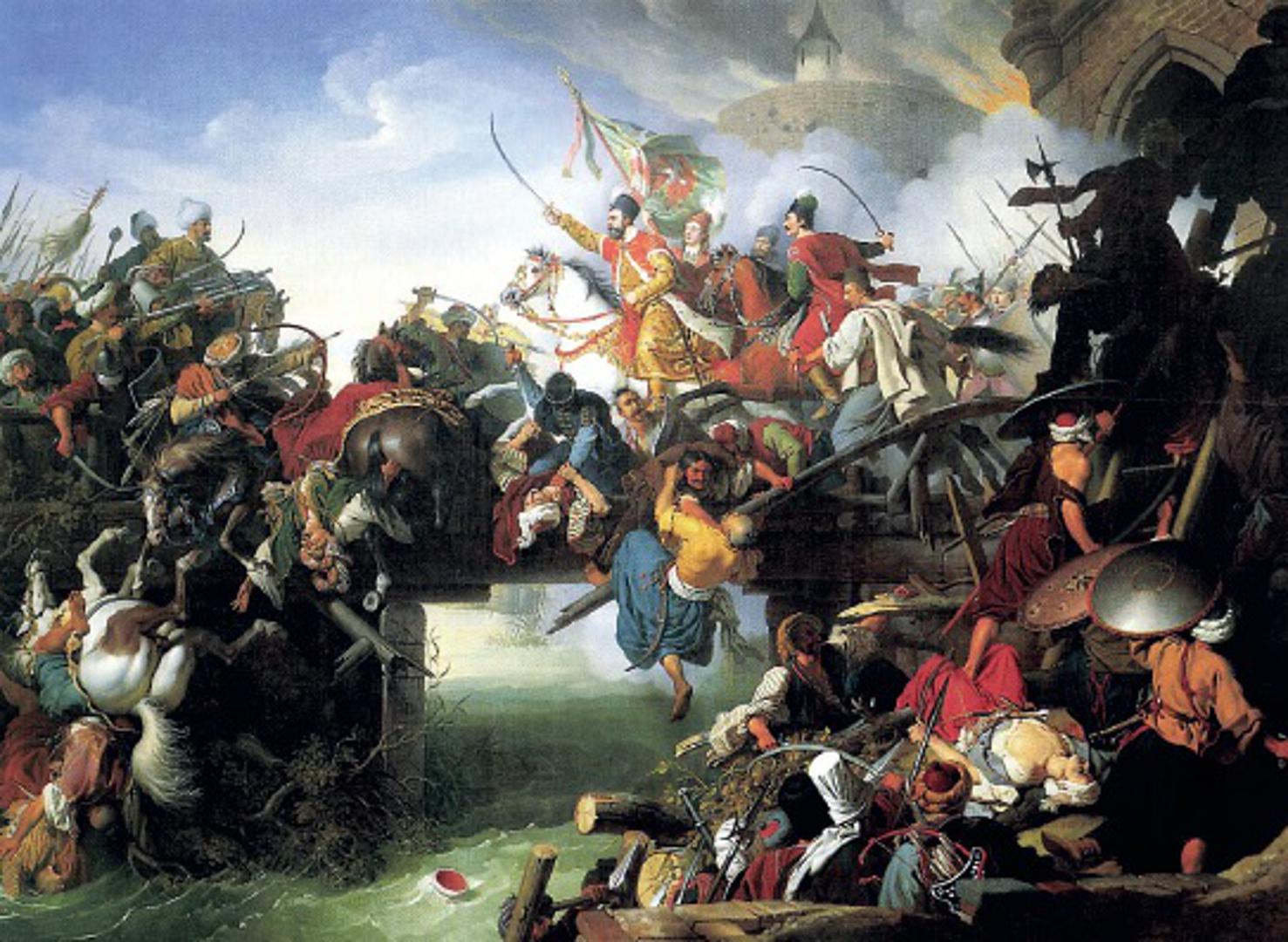
Alongside Croats who served as ordinary soldiers, there were also those who rose to the highest commands in foreign armies, such as Rustem Pasha Opuković. Although fictional stories and complicated historical circumstances contributed to shaping the myth of Croats as criminals, one must still consider what made the environment of Croatian lands objectively more violent and warlike than much of the rest of Europe. The history of violence is a relatively young historical discipline, yet Croatian territory is exceptionally fertile ground for its study. Ivo Rendić Miočević, for example, viewed much of the history of Croats and other South Slavs through the prism of conflict and war. Particularly insightful is his thought:
“Destruction and crime loomed over Southeastern Europe and assumed the form of a valid test.”
The Military Revolution
The Military Frontier system and its understanding are inseparable from military history, and it is essential to keep in mind the process of the military revolution. The first layer of these changes was the emergence of mercenaries who signed contracts to serve in armies, an example being the Battle of Pavia in 1525. The next stage involved the complete professionalization of armies and the development of new weapons, especially mobile artillery that replaced the previous massive and immobile cannons, enabling the Swedish king Gustavus Adolphus to secure victory at the Battle of Breitenfeld in 1631. Finally, the Battle of Valmy in 1792 was important because French volunteers defended ideals, becoming a symbol of warfare fought for ideas and higher causes.
Still, one should not assume that these developments were automatically mirrored in Croatian history or that they instantly transformed the defense system against the Ottomans.
Border Warfare
In speaking about the Military Frontier system, war can be divided into “real” or “high” war and “small” war, meaning high-intensity versus low-intensity conflict. This “small war,” although the official term would emerge only in the 19th century during the Spanish resistance against Napoleon, was everyday life for the Frontier soldiers (Krajišnici). This form of warfare developed by Croatian Frontier troops was known as četovanje (raiding warfare).
Here lies the main difference between the Frontier soldiers and the rest of Europe: an ordinary Frenchman did not live in a constant environment of armed conflict, nor did he continually expect incursions by enemy armies. Even when Western states went to war, there was usually a clearly defined front line, rather than constant raiding deep inside territories.
Sources confirm that the Frontier soldiers used the word “war” only for enemy attacks on their fortresses, while they did not perceive everyday violence as war at all. One may reasonably ask whether it was even possible to commit a civilian crime within such a frontier system, where the atmosphere of war was constant and society completely militarized. Perhaps the most important point regarding the mechanisms of power in such an environment is this: in the Military Frontier there were effectively no male civilians; all men were Frontier soldiers, while even their families were fully integrated into the system as logistical support.
The Uskoks also contributed to maintaining frontier authority over the territory of the Military Frontier by adopting Ottoman-style akindži warfare, which involved frequent raids and devastation across borders. The tactics of četovanje, reminiscent of Tatar-style invasions, certainly contributed to Croats across Europe becoming synonymous with terrifying and savage warriors whom one definitely did not want as enemies.
Naturally, another important reason was that these small and mobile Croatian units participated in numerous wars throughout Europe as part of larger armies, exposing other peoples to a style of combat unfamiliar to them.
Comparison With the Rest of Europe
When considering other parts of Europe that might somewhat resemble the Military Frontier system, one can point to 18th-century Prussia and territories controlled by Russian Cossacks. However, Prussia based its system more on iron discipline and order and did not suffer constant incursions by foreign armies. Likewise, the Military Frontier was more specific than Cossack territories because it represented a state within a state (Croatia) inside another state (the Habsburg Monarchy).
Functioning of the Military Frontier
By the early modern period many European states had begun forming professional armies and even early forms of gendarmerie intended to preserve order among civilians. The Military Frontier, however, was the exact inversion of this. Every individual was incorporated into the maintenance of frontier authority. Thus, there was no need for a separate repressive apparatus to preserve peace and stability. The first reason was that peace did not truly exist, while the second was that the Frontier soldiers — meaning practically all able-bodied men — were responsible not only for military duties but also for protecting the entire territory, not merely the border.
The frontier system greatly simplified defense against the Ottomans because there was no need for a separate force to preserve authority when everyone was already integrated into the mechanism.
Types of Weapons
During the early modern era, alongside cold weapons, firearms were increasingly perfected. This was highly significant because it enabled combat to be conducted from physical distance rather than exclusively face-to-face. Pistols and rifles played a major role for infantry. As previously noted regarding the military revolution, massive immobile cannons were replaced by smaller, faster, and more maneuverable artillery pieces. This meant artillery targets no longer had to be fixed but could instead be any mobile or stationary target as needed.
For example, Maja Šercer writes concerning the Battle of Sisak:
“Hasan Pasha arrived before Sisak at the beginning of August 1591. He fired upon the city using small cannons that launched projectiles the size of goose eggs.”
She further states:
“Part of the Christian army under the command of the Ban and commander of the Slavonian Frontier, Stjepan Grasswein, arrived before the Moslavina fortress. They captured it on August 15 and seized, among other things, three cannons mounted on wheels.”
Thus, the process of military revolution also affected the Ottoman military.
A particularly interesting case concerns rifles in Dalmatia. There exists a well-founded thesis that these rifles were produced in Bosnia and Herzegovina. However, because of the predominantly Muslim population, they were decorated with Islamic symbols. Consequently, the symbols on weapons intended for Christians, both within and beyond the region, were adapted to their religion.
Bandits and Heroes
It is impossible to avoid mentioning that military leaders and war heroes are always portrayed through their weapons. This is evident in depictions of Nikola Šubić Zrinski in numerous illustrations. His weaponry also became a literary motif, for example in The Saber of Nikola IV Zrinski of Sziget.
However, alongside war heroes there exists another specific form of myth-building surrounding those outside the law. It is well known that there is no banditry without legend. The formation of bands was greatly encouraged by the rural crisis, urbanization, and peasant resistance to the state. Weak and ineffective state control significantly facilitated the development of highway robbery, in which weapons naturally played a major role.
There are three main stereotypes regarding bandits. The first portrays the outlaw as a righteous avenger whose actions are not perceived as criminal but as resistance against an unjust system. Famous examples include Robin Hood, Diego Corrientes Mateos, and Rob Roy. In the Kingdom of Naples, the well-known rebel Angiolillo was not a classic bandit but rather, like Matija Gubec, a political opponent of authority.
The second stereotype, which is likely closest to reality for most outlaws, depicts the bandit as a ruthless plunderer motivated primarily by personal enrichment. The final image portrays bandits as tricksters — cunning, clever, and potentially dangerous.
It should also be noted that organized crime, meaning coordinated banditry, began developing only toward the end of the 18th century.
The Cult of Weapons Today
The omnipresence of weapons has left an indelible mark upon Croatian lands, especially Dalmatia. This provides excellent material for psychohistory because it allows the study of mentality in militarized environments, as well as the history of clothing. Certain weapons became inseparable from traditional costumes and eventually part of cultural heritage. Particularly notable is the Alka procession in Sinj, where the Alka riders carry two pistols and a flintlock rifle resting upon the left shoulder.
Furthermore, the ceremonial units of the Klis Uskoks still carry rifles, pistols, swords, large knives, maces, and other weapons as part of their attire. Likewise, throughout the Mediterranean — including on the Croatian island of Korčula — the martial sword dance known as the moreška became deeply rooted.
Conclusion
Based on the above facts, one may conclude that weapons played a crucial role in shaping society during the early modern era. By analyzing the prevalence of weaponry in Croatian lands situated along the Ottoman frontier, it becomes easy to understand why old houses and fortresses still contain large collections of antique arms today.
Regarding Croatian territory, an important legacy of the cult of weapons can still be found in numerous traditional uniforms accompanied by cold or firearms. Particularly prominent are the young men of the Sinj Alka and the Klis Uskoks, while weaponry also appears in the moreška dance. Although these costumes today belong exclusively to folklore, they clearly testify to how important weapons once were to the people who wore these garments daily, just as they wore uniforms.