By Matija Šerić
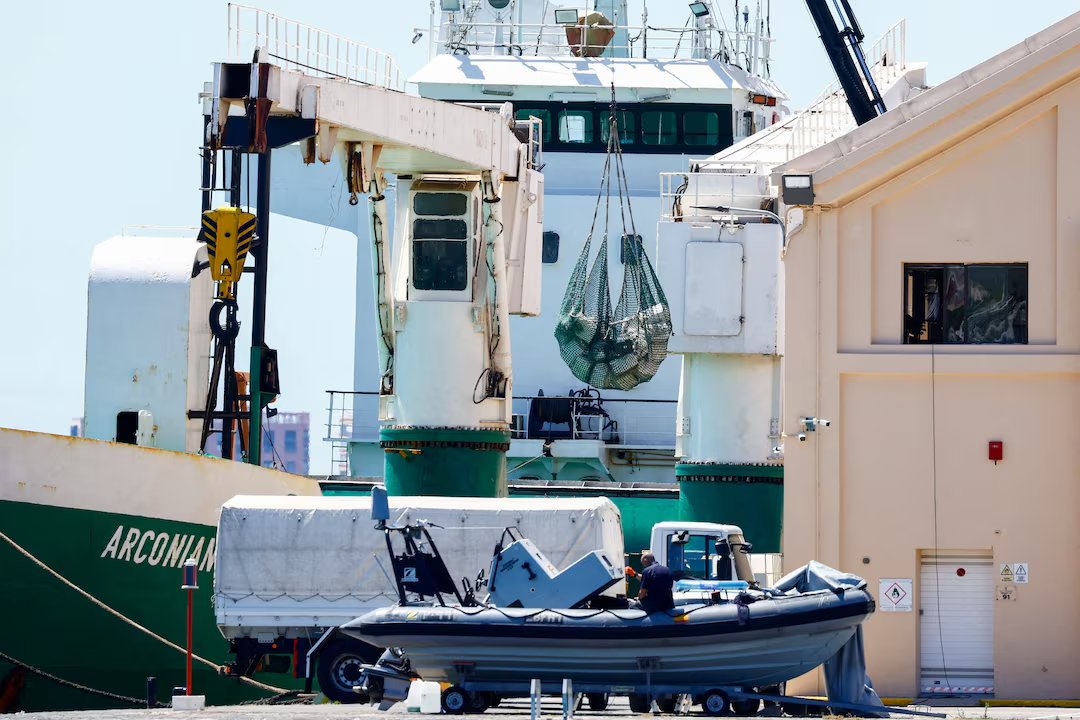
Illegal drug trafficking, especially cocaine trafficking, is a massive global problem that is not discussed or written about enough. That is, everyone is aware of the problem, but it is not being solved. On the contrary, spectacular incidents occur every now and then. Just how lucrative, widespread, and meticulously organized the drug trade is was once again confirmed at the beginning of May. Namely, the Spanish coastal police intercepted the ship “Arconian” flying the flag of Comoros in international waters near the Canary Islands on May 1. The smugglers did not spare space, as the cargo hold was packed with drug shipments. On board were between 35 and 40 tons of cocaine!
Record cocaine seizure in Europe
The scale of the seizure is illustrated by the fact that the previous maximum amount of cocaine seized in a single operation in Spain was 13 tons. Specifically, two years ago, Spanish police confiscated that shipment in the southern port of Algeciras from a container ship that had arrived from Ecuador. The quantities seized this month are almost three times larger. Moreover, this is the largest amount of drugs ever seized in Europe. The record from June 2024 was broken, when German authorities seized 25 tons of cocaine in the largest German port, Hamburg.
Cocaine worth nearly a billion dollars
In other words, the May seizure is unprecedented. The estimated value of the goods, i.e., the cocaine, is at least 812 million euros, and possibly more if sold to higher-paying buyers. That amount of money is roughly equivalent to the annual nominal GDP of the Caribbean state of Saint Kitts and Nevis. The intercepted ship was traveling on a route between Freetown, the capital of Sierra Leone, and the Libyan port of Benghazi.
All 23 crew members (17 Filipinos, and the rest Dutch and Surinamese) were arrested. The crew was not an innocent bystander. Weapons and ammunition were found on board, and six crew members were hiding during the police raid. Due to the seriousness of the crime, the risk of flight, and the risk of reoffending, the court ordered pre-trial detention without bail while the investigation is ongoing. It appears that Spanish authorities did an excellent job in cooperation with Dutch and American authorities.
Massive operation – Libya–Spain
Although the ship was supposed to dock in Libya, that African country was only a transit point in the drug supply chain. Spain was the intended final destination, where around 30 tons of cocaine were to be unloaded. According to investigators, the cocaine was to be transferred onto fast boats which, departing from Libya, would cross the Mediterranean Sea and transport the high-value cargo to the Spanish Mediterranean coast. This was an enormous logistical operation.
Such vast quantities of cocaine would not be unloaded using just a few speedboats in a single operation, but across multiple ports. Estimates suggest that between 25 and 75 speedboats would be involved, with destination ports including Algeciras, Valencia, Barcelona, Cartagena, and Málaga. It is therefore logical to conclude that transnational criminal networks are behind the operation.
Two reasons Spain has become a drug hub
Spain has become an increasingly important point in international narcotics trafficking. In other words, the Iberian country has become a kind of gateway through which drugs are imported into Europe. There are two main reasons for this.
The first is linguistic, cultural, and evidently also criminal connections between Spain and Latin America. Most cocaine is produced in Latin American countries (Colombia, Peru, Bolivia, Brazil). In terms of Europe, much of that cocaine passes through Spain, which lies across the Atlantic.
The second reason Spain has become a drug hub is its proximity to Morocco. That Maghreb country is the world’s largest producer of hashish.
The geographical position of the Canary Islands is also important; this archipelago in the Atlantic Ocean lies about 100 km west of the Moroccan coast. Last year as well, Spanish authorities repeatedly arrested traffickers on boats in the Canary Islands area. It was found that the drugs came from Colombia, Brazil, and similar South American countries, with the aim of entering Spain and the European Union. Fast boats were again used as transport.
The “cocaine road”
In addition to the Canary Islands–mainland Spain route, there is also the so-called “cocaine road,” a transatlantic smuggling corridor between the Canary and Azores Islands. On May 18, it was announced that an anti-crime operation by Spain’s Guardia Civil and Europol resulted in 54 arrests on eight vessels. All those arrested intended to transport cocaine or hashish in complex maritime operations from the Canaries to the Azores in order to avoid major European ports.
The Azores are a Portuguese archipelago in the Atlantic Ocean, about 1,500 km from mainland Portugal. The cocaine road model is based on “mother ships” from Latin America carrying multi-ton shipments of cocaine, after which the drugs are transferred at sea onto fast boats and then smaller vessels for final delivery to isolated beaches and marinas in Spain and Portugal.
The vast waters between the Canary Islands and the Azores (about 1,400 km apart) are increasingly becoming a key smuggling corridor, where distance and the vastness of the ocean make surveillance difficult and allow the uninterrupted movement of illegal shipments. It can be seen that criminals have adapted and now deliver drugs far from major ports, in smaller ports, marinas, or even remote coves. This is, unfortunately, an “achievement” of the other side of the law.
International criminal network
Europol and Spanish authorities link drug trafficking on the Iberian Peninsula to the “Mocro Maffia,” a Dutch network of criminal clans that has in recent years expanded operations into Latin America to negotiate drug distribution directly with producers. Much of the cocaine in Colombia is cultivated under the protection of remnants of FARC and the National Liberation Army (ELN).
The Spanish government identified the involvement of more than 30 organized crime groups in drug seizures in 2023. Clearly, the transnational criminal network is strong and highly developed.
Spain’s internal problems (political instability, corruption scandals, housing crisis, youth unemployment, pressure from illegal migration) strongly contribute to the development of organized crime. This is something Spanish authorities will have to deal with in the future, as well as Spanish society as a whole. Prime Minister Pedro Sánchez, who has been in power for eight years, has not risen to the challenge.