By Ivo Kokić
Despite all Russian attempts to prevent an escalation of the war, the Ukrainian side opted for a military scenario. In the second half of February 2022, the escalation of the war in Donbas began irreversibly. It is necessary to look back at the reports of the Special Monitoring Mission of the Organization for Security and Co-operation in Europe (OSCE), whose task was to record violations of the ceasefire (which was supposed to be in force under the Minsk II agreement).
February 2022
It is true that the OSCE did not specify which side violated the ceasefire and to what extent. However, even if we cannot determine this with certainty, three facts are nevertheless highly indicative. First, Western countries were the ones that for years worked to undermine the Minsk II agreement and inflame the war in Ukraine. From Western states, hundreds of tons of weapons began arriving in Ukraine in late 2021 and early 2022. Second, Russia was the only actor that showed concern about the escalation of the conflict and attempted, through all diplomatic channels, to preserve hope for peace. Third—and crucial for answering the question of which side violated the ceasefire—concerns the already mentioned UN report from January 2022. According to that document, more than 80% of civilians killed in Donbas (from 2018 to the end of 2021) were killed by the Ukrainian army. Every killing of civilians necessarily implied a violation of the ceasefire. If such a ratio existed until January 2022, it is difficult to imagine that the situation changed significantly in February of that year.
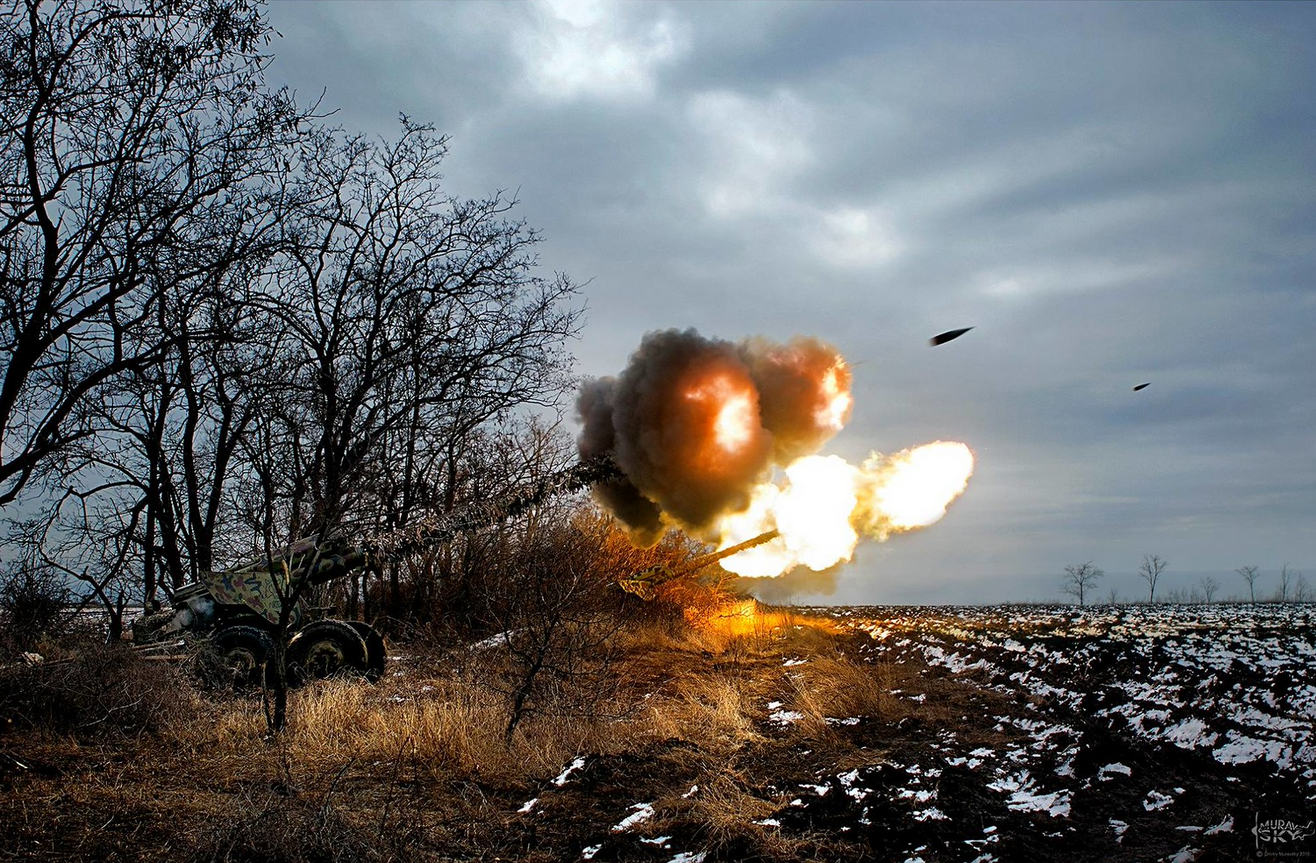
On 18 February, the OSCE recorded more than 1,500 ceasefire violations in Donbas, of which more than 1,400 were explosions (OSCE.org, 2022a). From 18 to 20 February, the OSCE recorded more than 3,200 ceasefire violations in Donbas, of which over 2,000 were explosions (OSCE.org, 2022b). The following day, 21 February, more than 1,900 ceasefire violations were recorded, of which almost 1,500 were explosions (OSCE.org, 2022c).
At that point, it was already completely clear to Russia that the war was heading toward escalation. Yet even then, the Russian side attempted to seize the last opportunity to prevent a wider war. On 21 February, Putin issued an order for the army to go on a mission to Donetsk and Luhansk (Child and Allahoum, 2022). The plan was very simple and logical. The Russian army would enter Donbas from its eastern side, meaning there would be no conflict between Russian and Ukrainian soldiers. Russian troops would cross the border at locations not under Ukrainian control and would remain exclusively in the territory of Donbas controlled by the rebels. In other words, the Russian army would not move to the front lines to confront the Ukrainian army. The goal was that the mere presence of Russian troops would deter the Ukrainian army from further attacks on Donbas.
Such a plan was intended to prevent war by relying on the presumption that the Ukrainian government would show at least a minimum of prudence in its further decisions—if not toward the opposing side, then at least toward itself. In other words, there was hope that the Ukrainian army would not fire on territory it knew was occupied by Russian troops (who were not conducting combat operations).
However, all such hopes proved futile. On 22 February, more than 1,700 ceasefire violations were recorded in Donbas, of which over 1,400 were explosions (OSCE.org, 2022d).
There is a very strong argument that Russia invoked in its desire to prevent, at all costs, the complete trampling of what Ukraine committed to under the Minsk II agreement. That argument is the fact that Russia signed on as a guarantor that the agreement would not be violated. One might rightly ask whether Germany and France should also have taken concrete steps to preserve Minsk II. The answer is absolutely yes. It should be emphasized, however, that such steps could not have been in Ukraine’s favor, but rather directed against it, because Ukraine was the one violating the agreement. However, as already stated, the goal of the German and French governments was not the implementation of Minsk II, but its violation, which would lead to a total war.
Consequences of the Escalation
The entire previous subsection could be summarized in the reflections of journalist Boris Rašeta from one of his columns:
“And when one day—which is not that far off—the causes of this conflict begin to be analyzed, we will hopefully also get answers to the questions of why Volodymyr Zelensky did not implement Minsk II, which guaranteed him a peaceful exit to Ukraine’s borders with Russia, in exchange for granting (restoring) rights to Russians and the Russian-speaking population in Ukraine. Was Minsk II (Croatian: ‘peaceful reintegration’) prevented by Biden’s Washington, which preferred a Ukrainian ‘Operation Storm’ (the expulsion of several million Russians from Donbas), or by Azov, Right Sector, and similar domestic radicals?” (Rašeta, 2022).
Rašeta’s quote provides a high-quality analysis of the real reasons for the escalation of the war in Donbas at the macro level. This essay further sharpens that picture by focusing on a specific short (but intense and important) period. We must return to the data from the previous subsection. If we sum all the figures from 18 to 22 February, we can see how turbulent those five days were. During that period, more than 6,800 ceasefire violations were recorded, of which over 4,900 were explosions. Thus, during those five days, Donbas echoed with nearly five thousand explosions—around one thousand explosions per day.
Therefore, this is precisely the period in which we can conclude that the war had already escalated. And not only did it escalate compared to periods when the ceasefire was more or less maintained, but also compared to intervals that were themselves marked by above-average fighting intensity. For example, throughout the entire month of January, around three thousand ceasefire violations were recorded. Then, in just those five days, the number was more than double that amount. The ratio would be several times higher if we compared January with February starting from the first day of February, rather than only from 18 February.
What is indisputable is that the war in Donbas irreversibly escalated at the beginning of the second half of February 2022. When we add to this the enormous inflow of Western weapons into Ukraine, it becomes clear that everything was aimed at the complete undermining of the Minsk II agreement. Yet the media do not present this or speak of it as an escalation of the conflict. Instead, the media focus exclusively on the consequence of that escalation—without stating that it is a consequence—and present that consequence as the escalation itself.
The consequence was that on 24 February, after all diplomatic efforts failed and after three major escalations of the conflict in just ten months, Russia launched what immediately became known in the Western narrative as an invasion of Ukraine, while in the Russian narrative it was termed a Special Military Operation (SMO) (Rukavina, 2024). In the next subsection, we will discuss how problematic it is when the power of the media entrenches one narrative as correct, leading the public to accept it without the need for scientific validation of the term’s legitimacy. But before that, something more must be said about the escalation itself.
It is tragicomic when someone decides that the war began on the day that best suits them. In this specific case, such a person ignores the fact that this is territory where, in the week before 24 February, a thousand explosions were heard daily.
Furthermore, let us assume that the SMO (according to the Russian narrative) / invasion (according to the Western narrative) did not occur on 24 February. Would that mean there was no escalation of the war? The key reason the answer is negative lies not only in the fact that the war had already intensified, but also in the fact that this would not have saved Donbas itself from further escalation. Namely, the Ukrainian launch of a ground offensive (unacceptable under the Minsk II agreement), which would soon have occurred (because all those tons of weapons were sent to Ukraine for a reason), would certainly have ignited the war further. Once one side (the government in Kyiv) decided on war, hope for peace unfortunately ceased. It ceased on the ground as well, which is mathematically easy to prove.
The Problem of Terminology
What is for Russia a Special Military Operation (SMO) is for the West an invasion of Ukraine. Something should be said about these different perceptions. The basic point is that we live in a society where an alternative narrative is not considered a perception at all, but objective truth. Thus, it is not seen as one of two offered narratives, but as the only possible one. This is a classic case of a discourse establishing hegemony. When that happens, the public no longer views such a narrative as one interpretation, but as the only possible version of reality. The fact that “everyone says so” has the power to lead most people to stop questioning such theses.
The word “invasion” has multiple definitions, so it is not a great achievement if someone finds an alternative meaning. According to one common definition, an invasion is carried out with the aim of occupying territory (regardless of whether it is liberation or conquest) (Enciklopedija.hr, 2013). That definition simply cannot be reconciled with Russian objectives in late February 2022. It must be repeated once more—if one wants to determine whether something is an invasion, it is crucial to define the goals.
In February 2025, Jeffrey Sachs (one of the most respected economists and geopolitical analysts in the world) gave a lecture at the European Parliament. In that speech, Sachs scientifically deconstructed all Western myths about the war in Ukraine. Most importantly, he demolished the narrative of some alleged Russian desire to conquer Ukraine. He destroyed all pseudo-arguments about Russia’s supposed territorial ambitions in Ukraine. The annexation of Ukrainian territory definitively did not belong to Russian motives, and Sachs professionally and objectively clarified Russia’s real goals from February 2022 (e.g., preventing NATO expansion), which are not connected to changing borders between the two states (Pilić, 2025).
Unlike an invasion, where the goal is territorial occupation, the Russian goal was not only not to retain Ukrainian territories, but quite the opposite—to withdraw Russian troops from them as soon as possible. This is very clear from the goals and conditions set by Russian negotiators in Istanbul in March 2022. According to the plan offered by Russia, Ukraine would only need to implement what it had already committed to in 2015 under the Minsk II agreement, and not make any territorial concessions of its own. That plan would not only have preserved Ukraine’s eastern borders, but the Ukrainian army would even have regained control over all parts of Donetsk and Luhansk that it had not controlled for years (Pilić, 2023).
Here, something positive should be said about the Ukrainian side. Their negotiators indeed accepted (and initialed) such a draft agreement. David Arakhamia (head of the Ukrainian negotiating team) even boasted about it on Ukrainian television. The deal was reached, but not implemented. After Russian troops withdrew from the vicinity of Kyiv and the entire north of Ukraine (due to achieved objectives in the war), the then British Prime Minister Boris Johnson arrived in Kyiv. It was he who persuaded Zelensky to abandon the already accepted agreement and continue fighting Russia, with the West continuing to arm Ukraine. Thus, by a decision of the West (and not the Ukrainian government), a war that could have ended in April 2022 was continued—if Ukraine had only decided to implement the agreement it had just reached, which required nothing beyond what it had already committed to under Minsk II (Pilić, 2023). If the public were aware of this, there would be no need for Jeffrey Sachs to give lectures on whether this was an invasion.
Conclusion
The war in Ukraine began in 2014, but for years remained localized in the Donbas region (the Donetsk and Luhansk regions). The Minsk I and II agreements (from 2014 and 2015) were supposed to end this conflict. Minsk II was far more detailed and provided concrete steps for Ukraine to peacefully end the conflict in the east of the country. The agreement envisaged decentralization of the state, granting autonomy to Donbas, etc.
The Ukrainian government never implemented this agreement, while the Western co-signatories (Germany and France) actively worked to prevent its realization. It was about buying time to arm Ukraine and prepare it for war with Russia. The war in Donbas continued, and much about the nature of that conflict is revealed by the fact that from 2018 to the end of 2021, over 80% of crimes against civilians were committed by the Ukrainian army.
After Biden came to power, the war in Donbas intensified three times in less than a year: in April and November 2021, and in early 2022. In parallel, the United States, the United Kingdom, and other Western countries began in 2021 and early 2022 to send Ukraine military equipment worth hundreds of millions of dollars, as well as hundreds of tons of weapons. Russia responded by intensifying diplomatic efforts for a peaceful resolution. Russia’s goal was to prevent Ukraine from completely trampling Minsk II through a ground offensive in Donbas. Therefore, it also prepared an alternative (military) solution, but its primary mode of action was always through diplomatic channels.
These efforts were unsuccessful, and the conflict began to intensify further. From 18 to 22 February 2022 alone, over 6,800 ceasefire violations and nearly five thousand explosions were recorded in Donbas. This was the trigger for Russia’s launch of what it calls a Special Military Operation (SMO), while in the West it is called an invasion of Ukraine. However, a detailed and in-depth comparison of the dictionary definition of “invasion” with Russia’s actual objectives shows that this term is linguistically invalid in the context of this conflict. The absurd propaganda about some alleged Russian desire to conquer Ukraine is so unrealistic that such a level of non-objectivity is not even worth commenting on in an academic paper.
Beyond dictionaries of foreign words, something else powerfully demonstrates that much is seriously wrong with the Western perception of the war in Ukraine. If we examine the reactions of Russia and Ukraine to Trump’s peace plan from November 2025, those reactions best reveal which government wants peace and which benefits from the continuation of war.
However, that is no longer the topic of this essay. What is important—because it is the research objective—is that this paper has shed light on what happened in Donbas in February 2022 and placed it into a broader context according to two criteria: the geopolitical situation and the preceding several-year period.