By Ivan Toth
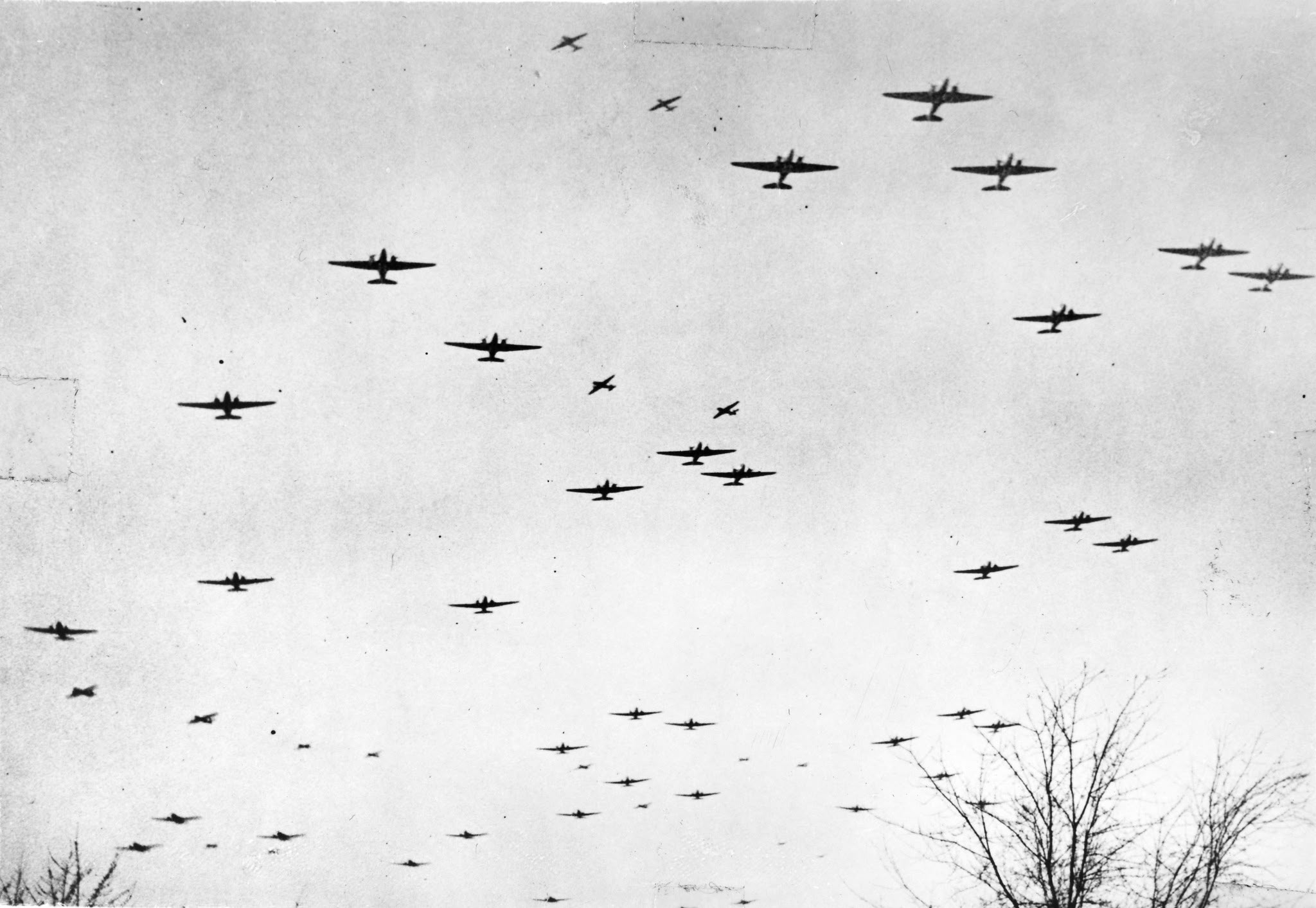
Operation Market Garden, which included the Battle of Arnhem in September 1944, was the largest airborne operation in military history, surpassing even Operation Mercury, the German airborne invasion of Crete in 1941, which is generally regarded as the only successful strategic airborne operation of the Second World War. At the same time, Market Garden represented the only genuine Allied attempt to employ airborne forces as a strategic instrument in Europe.
The operation was enormous in scale, pitting the Allied 21st Army Group under the command of Field Marshal Bernard Montgomery against the German Army Group B, commanded by Field Marshal Walter Model. More than a thousand armored vehicles and hundreds of thousands of soldiers took part in the campaign, which is widely regarded as the only major Allied defeat during the liberation of northwestern Europe.
The Origins of the Plan
The idea behind Operation Market Garden stemmed from the unexpected success of Operation Overlord and the D-Day landings on 6 June 1944, followed by the Battle of Normandy. The Allies had initially expected a slow but steady advance inland once the invasion began, and it was assumed that General Dwight D. Eisenhower, Supreme Commander of the Allied Expeditionary Force, would take over command of subsequent ground operations from Montgomery after only a few weeks.
Eisenhower would then exercise authority over all three Allied army groups: the 21st Army Group under Montgomery, the 12th Army Group commanded by General Omar Bradley, and the 6th Army Group under General Jacob Devers, which was advancing from southern France where German resistance remained strong.
What actually happened, however, was that the Allies gained a decisive advantage within weeks of the landings, while the German defensive system virtually collapsed overnight. German forces were trapped in the Falaise Pocket, creating a catastrophe for Germany comparable in scale to the disaster at Stalingrad on the Eastern Front.
Ironically, the magnitude of this victory was partly due to Montgomery’s inaction, while overall success depended heavily on the coordination between Allied commanders and their forces. As many believed that the war was nearing its end—with some even expecting victory before Christmas 1944—many senior officers had already begun thinking about the future development of their military careers.
Montgomery Changes the Allied Strategy
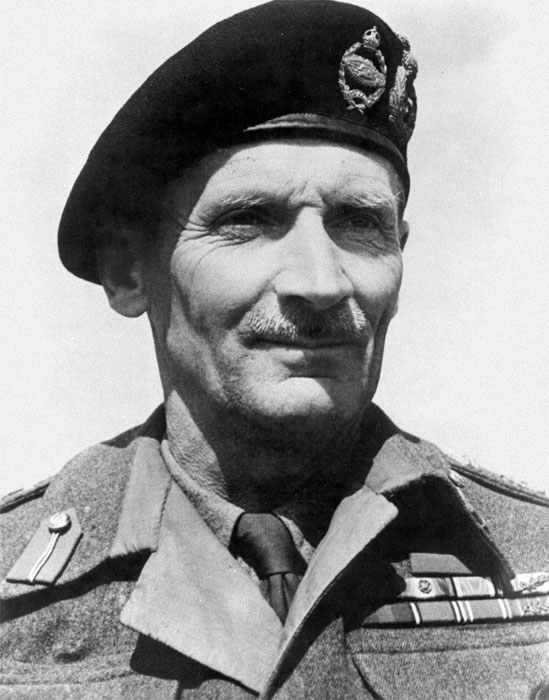
In mid-August, Montgomery was the first to propose a fundamental shift in Allied strategy. He advocated concentrating the main striking force in the hands of his 21st Army Group, supported by the American First Army under Lieutenant General Courtney Hodges. This force would advance through northern France, across the Low Countries, and ultimately into Germany.
Montgomery argued that there were simply not enough transport vehicles available to provide logistical support and supplies for all three Allied army groups advancing simultaneously along a broad front. Even the fleet of Allied transport aircraft, which had originally been reserved for airborne operations, was already being used elsewhere.
Since German resistance against the 21st Army Group had largely weakened, it made strategic sense to prioritize Montgomery’s forces. Such an advance would also eliminate the launch sites of the German V-1 flying bombs targeting southern England and secure the ports along the northern French coast, greatly improving Allied supply lines.
Montgomery even declared that he would be willing to serve under Bradley’s command, provided that his army group received priority in the allocation of supplies.
Eisenhower Agrees to the Plan
Bradley strongly opposed the plan. He believed that the Battle of Normandy had been won despite Montgomery, not because of him. With victory in the war now in sight, it was considered time for the Americans to assume greater leadership. Moreover, Montgomery’s proposal would slow down the American forces that had advanced the furthest from the Normandy beaches—most notably the U.S. Third Army under Lieutenant General George S. Patton Jr., Montgomery’s long-time rival.
Nevertheless, Montgomery succeeded in convincing Eisenhower that his 21st Army Group should be given priority in supplies and supported by Bradley’s First Army, which would advance north of Aachen.
In a letter to General George C. Marshall, Eisenhower admitted that he had “changed the original plan of attacks from the north and east in order to assist Montgomery in seizing extremely important objectives in the northeast.” At the same time, Bradley was quietly cooperating with Patton to allow his army to continue eastward toward Germany.
Formation of the Allied First Airborne Army
Allied heavy bombers had returned from their strategic bombing campaigns against German cities, and the tactical air forces (RAF and USAAF) were reorganized along national lines, even though Luftwaffe resistance in the West had become minimal.
After the arrival of Air Chief Marshal Sir Trafford Leigh-Mallory at the headquarters of the Allied Expeditionary Air Forces, Eisenhower decided on 2 August to establish a unified airborne command under the leadership of the former controversial commander of the 9th Air Force, Lieutenant General Lewis Brereton. By 16 August, this structure became the Allied First Airborne Army, forming part of a broader Allied deception plan based around the fictitious First United States Army Group.
It consisted of the American XVIII Airborne Corps (the 82nd, 101st, and 17th Airborne Divisions under Major General Matthew Ridgway) and the British I Airborne Corps (the 1st and 6th Airborne Divisions, as well as the 1st Polish Independent Parachute Brigade under Lieutenant General F.A.M. Browning).
Conflicting Allied Interests Lead to Market Garden
Eisenhower was under constant pressure from Washington to launch a major airborne operation before the end of the war in Europe. As a result, he placed the Allied First Airborne Army under the command of the 21st Army Group.
As the Allied supply situation worsened and competing strategic interests emerged, the idea of a large airborne strike—Operation Market Garden—began to take shape. As Allied forces advanced through northern France and Belgium, these factors, combined with determined German resistance, particularly from Army Group B, created a growing operational stalemate.
German resistance also allowed the escape of the German 15th Army under Field Marshal Von Zangen across the Scheldt estuary. Army Group B later came under the command of Field Marshal Walter Model, who undertook a major reorganization of German forces to counter further Allied advances.
Optimism-Shaped Planning
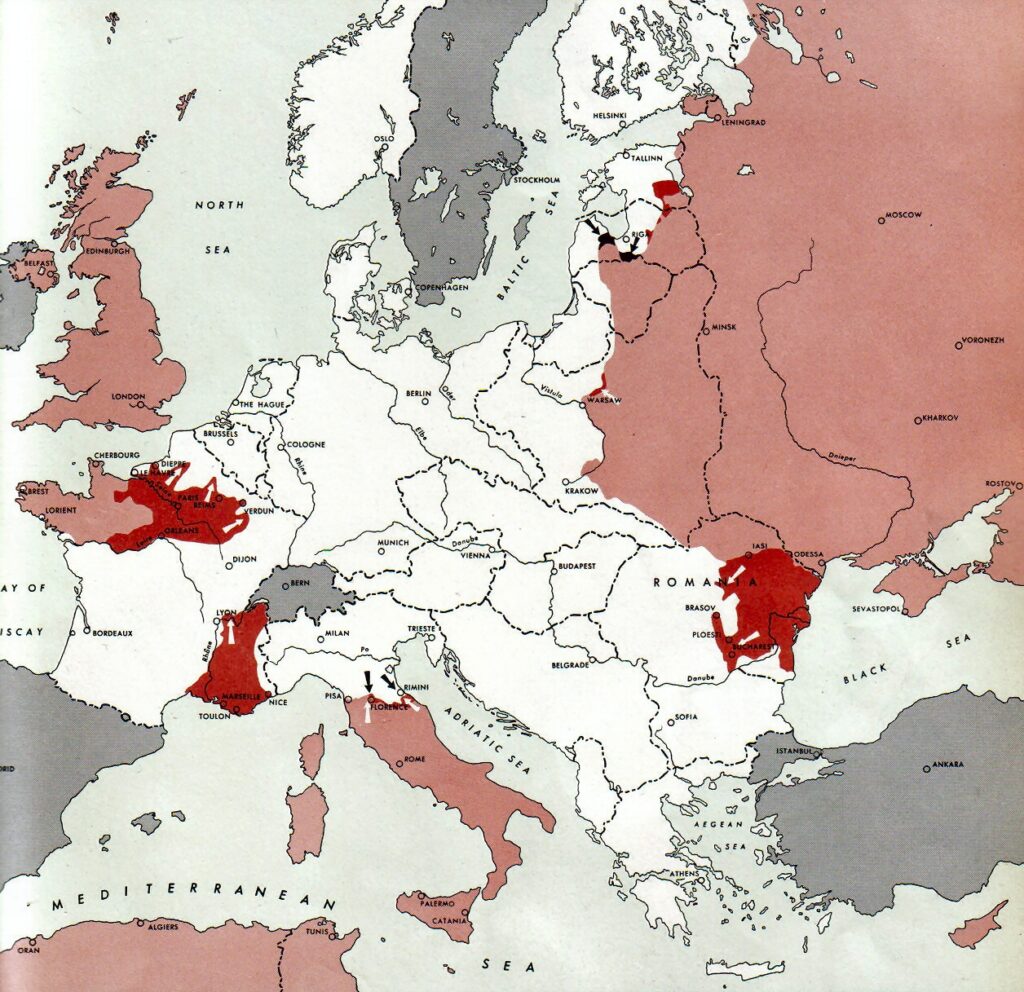
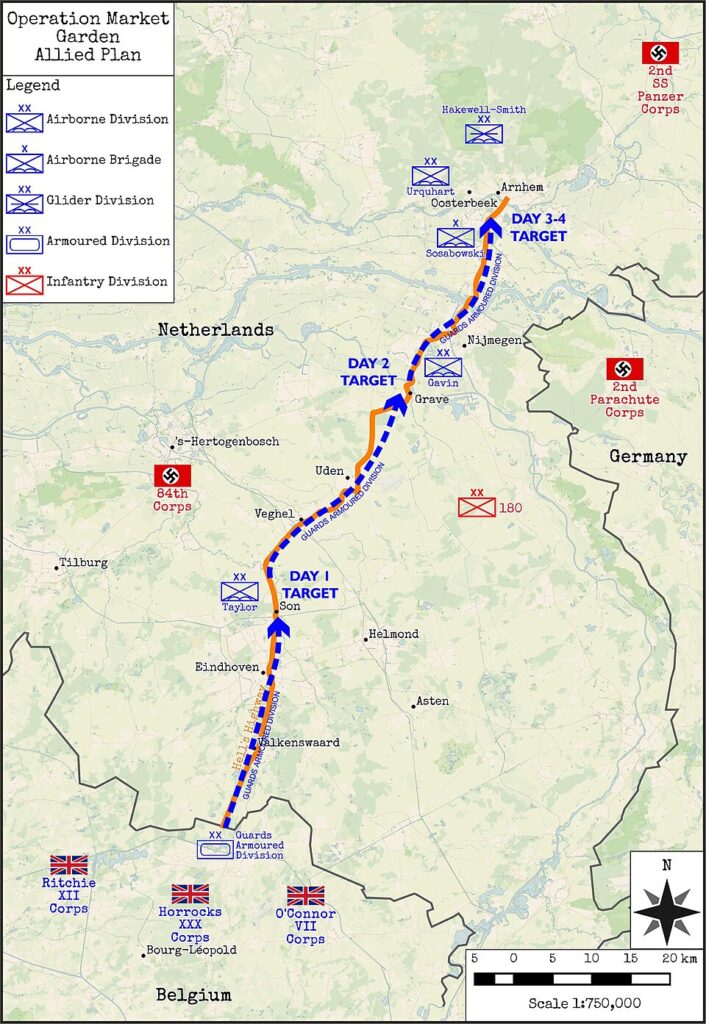
The overall plan for Operation Market Garden required the Allied First Airborne Army to support the British Second Army’s advance toward the Meuse–Escaut Canal up to Nunspeet on the Zuider Zee, a distance of approximately 160 kilometers. The force would then turn east toward Germany and the industrial Ruhr region.
Airborne troops were to seize key bridges over major rivers and canals along the route at Eindhoven (about 20 km from the start line), Nijmegen (85 km), and Arnhem (100 km). Additional smaller bridges at Veghel and Grave were also to be secured between Eindhoven and Nijmegen.
The route for XXX Corps, commanded by Lieutenant General Brian Horrocks (the ground component of “Garden”), consisted of a single narrow two-lane road running through flat terrain of sand and polder land, cut by trees, small forests, streams, and ditches—conditions that would severely slow the advance.
For the airborne phase (“Market”), American aircraft would transport paratroopers while RAF aircraft towed gliders. General Lewis Brereton sought to prove that an operation of such scale was feasible.
Opposing him was Major General Paul Williams, commander of the 9th Troop Carrier Command, who warned that due to reduced daylight hours and long distances, only one parachute drop per day would be possible, and that fatigue would cause casualties among aircrews. This meant that the full deployment of airborne forces would require three days, with an additional day for resupply operations, while the 52nd (Lowland) Division would be flown to airfields north of Arnhem over the following two days.
Meteorologists predicted at least two days of good weather beginning Sunday, 17 September, when the operation was scheduled to begin.
Planners Do Not Take Into Account Intelligence and Resistance Movement Information
Lieutenant General F.A.M. Browning and his British I Airborne Corps were to command and direct part of the operation codenamed Market. The first wave of men from each division would land as a single formation within a 10-kilometre radius of their objectives and would then advance toward them. The three divisions were expected to land by the end of the third day, and each was to hold an area within a 40-kilometre radius in order to allow ground forces to advance past them. Such a timetable and dispersion would only make sense if there were indications that the Germans would offer little or virtually no resistance. There are the well-known words of Captain Brian Urquhart, head of intelligence for the British I Airborne Corps, who said that he “simply did not believe that the Germans would collapse and surrender.”
In addition to this, it is important to mention poor communication between the Allied Supreme Headquarters, the 21st Army Group, and the Allied First Airborne Army. All of this meant that the Allies, although their estimates of German strength may have been roughly accurate, failed to account for the II SS Panzer Corps approaching the Arnhem area. Most commanders preferred to assume that the corps had been moved east rather than remaining in close proximity to Arnhem. According to Captain Brian Urquhart, “reports from the Dutch Resistance and the latest aerial photographs indicated the presence of an armoured formation. The images clearly showed tanks, if not within the actual drop zone at Arnhem, then in its immediate vicinity.” However, these reports and pieces of information were not seriously considered, with the explanation within the chain of command that the “assessment of intelligence regarding the Panzer corps in the Arnhem area was exaggerated.” Shortly thereafter, Major Urquhart was advised to take leave.
Task of the 101st Airborne Division
The initial phase of the Allied plan, according to Browning’s assurances, involved the landing of the U.S. 101st Airborne Division, under the command of Major General Maxwell Taylor, north of Eindhoven in order to seize bridges over the River Aa, the Willems Canal, the River Dommel (St. Oedenrode), and the Wilhelmina Canal (Son), and then Eindhoven itself. Securing the roads leading from Eindhoven to Grave meant that the 101st Division had to cover an area with a radius of 65 kilometres. Dempsey ignored Browning and allowed the 101st to halt at Veghel, which left a gap of about 20 kilometres between the 101st and 82nd Divisions.
Task of the 82nd Airborne Division
The U.S. 82nd Airborne Division, under the command of Brigadier General James Gavin, also had to defend a large area. As the threat was expected from the Kleve region, Browning tasked Gavin with first capturing the Groesbeek Heights, an area covered with hills and forests stretching about 12 kilometres east of Nijmegen; they were also to seize the bridges over the River Maas (Grave), the Maas–Waal Canal, and the road bridge in the centre of Nijmegen.
Task of the 1st Airborne Division
The 1st Airborne Division (also referred to as the British division, as both names were used in the operation) was to land on the hills west of Arnhem. Their objectives were the road bridge in the centre of the city, the railway bridge to the west on the Lower Rhine, and the pontoon bridge (the latter was discovered to have been dismantled at the height of the operation).
Tasks of XXX, XII, and other Corps
The ground forces, which were to link up with the airborne troops, were under the command of XXX Corps (2nd Household Cavalry, Guards Armoured Division, 43rd Wessex Division, 8th Armoured Brigade, 50th Northumbrian Division, and the Dutch Royal Brigade “Princess Irene”) and were to advance north along the “Club Route”, with XII Corps (7th Armoured Division, 15th Scottish Division, and 53rd Welsh Division) supporting their left flank, and VIII Corps (11th Armoured Division, 3rd Division, 4th Armoured Brigade, and the Belgian 1st Brigade) supporting their right flank. The Guards Armoured Division would be ahead of XXX Corps and, as it linked up with each airborne division, would assume command of them and pass forces further south toward VIII Corps. If any of the bridges were destroyed, the Guards would secure the bank while the Wessex 43rd Division would launch an assault across the river. Opposing them was Kampfgruppe “Walther,” consisting of ten weak battalions and ten artillery guns. Once this “pocket” was broken, the advance would continue.
The Germans had no counter-plan for Market Garden
The Germans did not have an operational plan to counter the Allied Operation Market Garden. They expected an advance from the direction of the Meuse–Escaut Canal, but had very little reliable information about where such an advance would take place or what forces would be involved. Their defensive planning included two possibilities: the first was an amphibious landing by the British Fourth Army (a non-existent formation) on the Dutch coast in order to cut off the remaining elements of the German Fifteenth Army. The second was a north-western breakthrough by the 21st Army Group toward Wesel, with the aim of encircling the area and pushing toward the Ruhr. The Germans also expected a landing by the Allied First Airborne Army, which would support either of these scenarios, and therefore Model deployed what few reserves he had available from Student’s airborne First Army in central Netherlands to resist such an attack. As Student stated, “this was grotesque improvisation on a grand scale.”
Unfortunately, the area where German forces were deployed was precisely where Operation Market Garden was to take place. Model was based in the Hotel Hartenstein, located slightly east of the British drop zone. The II SS Panzer Corps was not officially part of Model’s forces and was under the command of Armed Forces Command Netherlands. Obergruppenführer Bittrich had his headquarters in Doetinchem, 25 kilometres east of Arnhem, and his forces were spread between Arnhem and Deventer. The SS Kampfgruppe “Hohenstaufen” (in reality the remnants of the 9th SS Panzer Division Hohenstaufen) was scheduled to be moved to Siegen, near Koblenz, on 12 September for resupply, while SS Kampfgruppe “Frundsberg” (remnants of the 10th SS Panzer Division Frundsberg) was to be moved to Aachen thereafter. The situation was such that on 16 September Bittrich sent Brigadeführer Harmel to the SS headquarters in Berlin to personally plead for reinforcements. The shortage of troops had already been noted earlier by Rundstedt, who stated in a letter sent to the OKW that “new failures can only be prevented by the urgent sending of repeatedly requested reinforcements.” Meanwhile, Obersturmbannführer Harzer continued organizing the relocation of troops toward the east. The landing that began the following day completely surprised the Germans.