By Matija Šerić
One of the more unusual alliances of the Second World War was the pact between Nazi Germany and radical Sunni Islamist groups, most notably the Muslim Brotherhood and the Grand Mufti of Jerusalem, Amin al-Husseini. These two radical movements—Nazis and jihadists—were united by their hostility toward Jews. Cooperation between the two parties resulted in propaganda campaigns, intimidation, and later outright terror during the Second World War.
The Founding of the Muslim Brotherhood in 1928
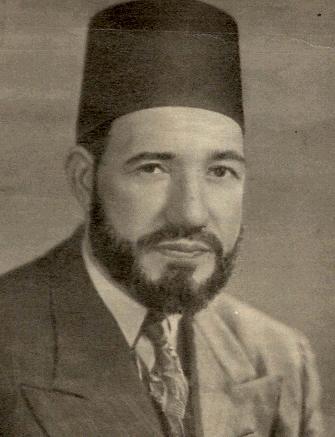
The story began much earlier. Nationalist sentiment against British rule in Egypt during the 1920s created conditions for the radicalization of parts of the population. One example of this radicalization emerged in 1928, when the Sunni Muslim schoolteacher Hassan al-Banna founded the Society of Muslim Brothers, better known as the Muslim Brotherhood.
In the decades that followed, the Brotherhood became one of the most influential secret organizations in modern history. Its primary objective was to fill the vacuum left by the collapse of the Ottoman Caliphate, which had been abolished in the Republic of Turkey by Mustafa Kemal Atatürk in 1924. The movement sought the eventual restoration of the caliphate. Al-Banna, the son of an imam, presented his movement as an alternative to the secular nationalist Egyptian Wafd Party. His organization advocated the implementation of Sharia law and the establishment of an Islamic theocracy not only in Egypt but throughout the Muslim world.
Anti-Jewish Campaign of the 1930s
At the beginning of the 1930s, the Muslim Brotherhood remained relatively small, with around 800 members in Egypt and only a limited presence in Palestine, Syria, and elsewhere. This changed dramatically in 1936 when the organization joined the jihadist campaign led by the Grand Mufti against Jews in Palestine. Within two years, membership reportedly rose to approximately 200,000.
The Brotherhood declared jihad against Jews in Palestine and against the British, whose Balfour Declaration and administration of the Palestine Mandate under the League of Nations encouraged Jewish immigration, particularly from Nazi Germany.
The Rise of Amin al-Husseini
Amid growing Arab protests in Palestine in April 1936, the Arab Higher Committee was established. Earlier, the British had appointed Mohammed “Haj” Amin al-Husseini as Grand Mufti of Jerusalem, the highest Islamic religious authority in Palestine. Although initially expected to help calm tensions, al-Husseini became a leading figure in Arab opposition to Jewish immigration.
He chaired the Arab Higher Committee, which demanded an end to Jewish immigration and called for protests and civil disobedience. Al-Husseini also served as imam of the Al-Aqsa Mosque in Jerusalem and president of the Supreme Muslim Council.
In 1935, Hassan al-Banna sent his brother to Jerusalem to meet al-Husseini and formalize a close partnership that would endure for nearly four decades. During the Arab Revolt of 1936–1939, the Muslim Brotherhood provided financial support for al-Husseini’s activities in Palestine. The Brotherhood distributed selected Quranic passages hostile to Jews alongside Nazi antisemitic propaganda. These efforts encouraged boycotts of Jewish and British businesses and fueled anti-Jewish demonstrations.
Al-Husseini was not merely a Palestinian nationalist. He was an ardent antisemite who had already been involved in inciting anti-Jewish violence and unrest in Hebron and throughout Mandatory Palestine since 1920.
The First Links Between Arab Radicals and the Third Reich
Shortly after Adolf Hitler came to power in Germany, al-Husseini reportedly sent a letter to the Führer in March 1933 expressing support for Nazi anti-Jewish policies. Thus began cooperation between Nazis and jihadists.
On March 31, 1933, the German Consul General in Jerusalem, Heinrich Wolff, met with the Grand Mufti. Wolff later reported to Berlin:
“The Mufti explained to me today in great detail that Muslims, both in Palestine and beyond, welcome the new government in Germany and hope for the spread of fascist, anti-democratic forms of government in other countries as well. The current Jewish economic and political influence is harmful everywhere and must be opposed.”
Convergence of Nazi and Jihadist Interests in Palestine
Initially, Nazi Germany supported Jewish emigration from Germany to Palestine. In August 1933, the Haavara Transfer Agreement allowed German Jews to transfer part of their assets to Palestine while simultaneously promoting German exports.
Over time, however, Nazi policy changed. By 1941, plans centered on emigration were abandoned as Germany recognized that no peace agreement with Britain was forthcoming and increasingly moved toward the implementation of the Final Solution. Al-Husseini lobbied against Jewish emigration to Palestine and encouraged a harsher anti-Jewish policy.
When the British Peel Commission recommended partitioning Palestine into separate Jewish and Arab states in 1937, ties between al-Husseini and the Muslim Brotherhood strengthened further. Nazi Germany opposed the creation of a Jewish state, viewing it as a source of increased Jewish influence, and increasingly saw Arab nationalists and Islamists as useful allies.
The Arab Revolt Strengthens the Alliance
During the Arab Revolt, the Muslim Brotherhood called for boycotts of Jewish products throughout Egypt. Rumors spread in mosques and factories alleging that Jews and the British were desecrating Islamic holy sites in Jerusalem. The Brotherhood circulated false reports and inflammatory propaganda to intensify anti-Jewish sentiment.
Financial support from Nazi Germany reportedly helped fund Brotherhood publications and propaganda campaigns. German officers also assisted in developing the movement’s paramilitary capabilities.
Meanwhile, Radio Zeesen near Berlin broadcast daily Arabic-language programs throughout the Middle East. These broadcasts mixed Quranic passages, Nazi antisemitic propaganda, and Arabic music. Al-Husseini became a central figure in these propaganda efforts.
Al-Husseini Arrives in Berlin
While Hassan al-Banna focused on expanding the Muslim Brotherhood in Egypt, Amin al-Husseini became deeply involved with Nazi Germany.
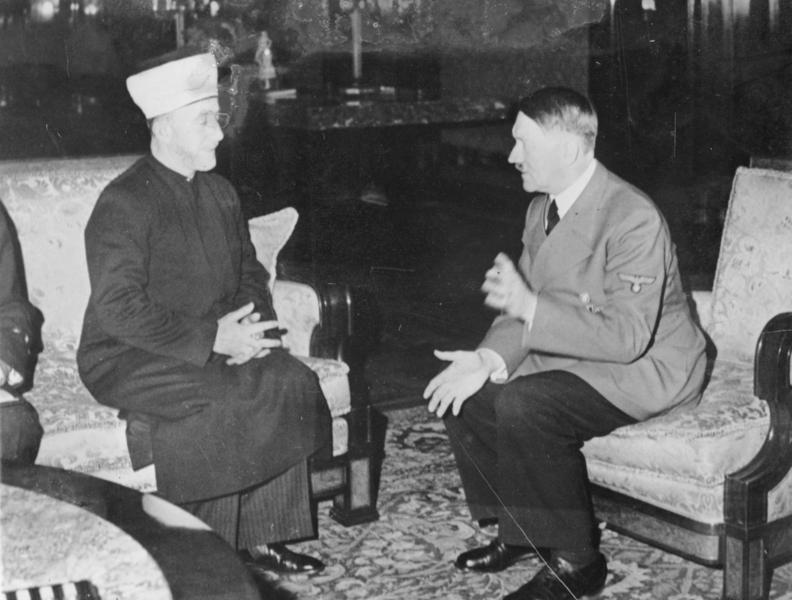
In 1941, he arrived in Berlin after traveling through Iraq, Lebanon, and Fascist Italy, where he had met Benito Mussolini. In Berlin, al-Husseini developed close relations with senior Nazi leaders, including SS chief Heinrich Himmler.
Following the war, al-Husseini described his cooperation with Germany in his memoirs, portraying the alliance as part of a common struggle against Jews.
The Grand Mufti and the Holocaust
At the Nuremberg Trials, Dieter Wisliceny, a deputy to Adolf Eichmann, testified that al-Husseini had supported anti-Jewish policies and maintained close contact with key figures involved in Nazi persecution programs.
When al-Husseini met Hitler in November 1941, the Nazi leader reportedly assured him that Germany intended to continue its struggle against Jewish influence in the Middle East after achieving military victories in the Soviet Union.
The Symbiosis of Nazi and Islamist Antisemitism
Between 1941 and 1945, al-Husseini played an important role in Nazi propaganda directed at Arabic-speaking audiences. German authorities treated him as a symbol of the German-Arab alliance against Jews.
As head of Arabic broadcasts from Radio Zeesen, he repeatedly called for jihad against Jews and Allied powers. Although Nazi propaganda amplified these messages, anti-Jewish hostility within al-Husseini’s movement predated its alliance with Germany.
In December 1942, al-Husseini became chairman of the newly established Islamic Central Institute in Berlin. During its opening ceremony, he delivered a speech condemning Jews and linking them to Britain, the United States, and communism.
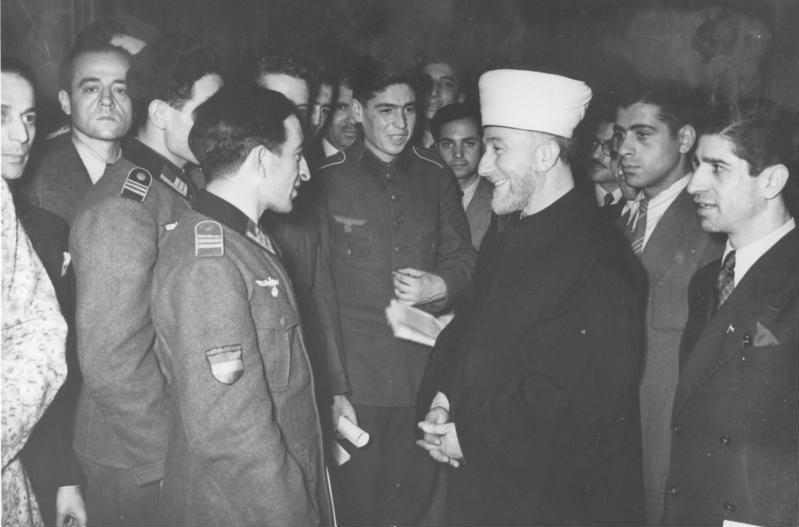
Al-Husseini’s Radicalism
The Mufti’s hostility toward Jews extended beyond wartime propaganda. In 1943, he reportedly protested efforts by the Bulgarian government to permit several thousand Jewish children and their families to leave Europe for Palestine rather than face deportation. Similar interventions were reportedly directed toward Hungarian officials.
Former German Foreign Ministry officials later described him as an uncompromising enemy of the Jewish people.
Recruiting Muslims for the Wehrmacht in the Caucasus
Al-Husseini also cooperated with Gerhard von Mende in the Reich Ministry for the Occupied Eastern Territories (Ostministerium), headed by Alfred Rosenberg.
Von Mende oversaw efforts to recruit Muslim volunteers from Soviet territories. These initiatives resulted in the enlistment of tens of thousands of Tatars and other Muslim recruits who opposed Soviet rule and viewed Nazi Germany as a potential liberator.
As German forces advanced into the Caucasus in 1942, recruitment expanded among Tatars, Azerbaijanis, Uzbeks, Turkmens, and Kyrgyz. Al-Husseini publicly endorsed these formations.
The Creation of the 13th Waffen SS Handschar Division
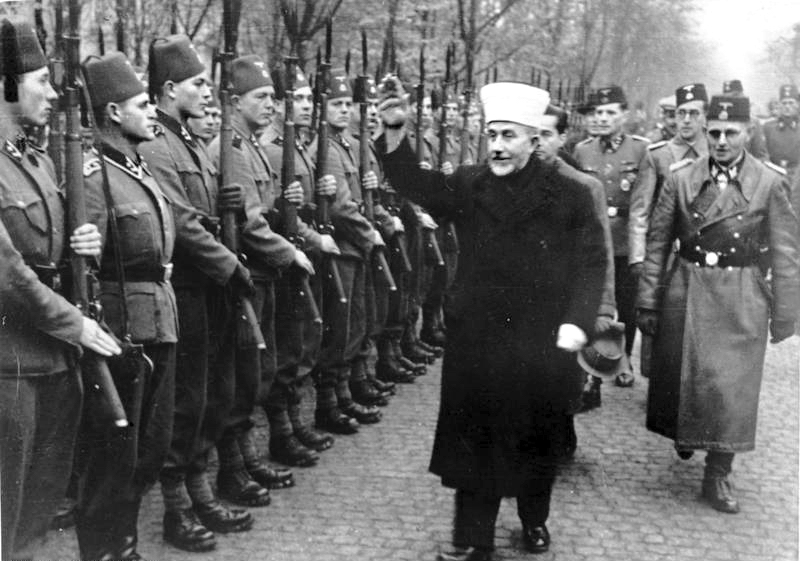
One of the most controversial aspects of al-Husseini’s wartime activities was his involvement in recruiting Bosnian Muslims for the 13th Waffen SS Handschar Division in 1943.
Himmler believed Bosnian Muslims could become highly motivated anti-partisan fighters. Al-Husseini visited Sarajevo and helped encourage recruitment efforts. The division consisted primarily of Bosnian Muslims, though it also included Croats, Volksdeutsche, and Albanian recruits.
The division participated in anti-partisan operations in Bosnia, Syrmia, the Zagreb region, and Baranja. It later became associated with numerous atrocities committed against civilians.
After the War: No Punishment for the Islamists
Following the end of the war, both al-Husseini and the Muslim Brotherhood faced accusations relating to wartime collaboration and anti-Jewish activities.
However, al-Husseini was never brought before an international tribunal. After escaping custody, he eventually settled in Egypt. As Cold War tensions intensified, Western intelligence agencies increasingly focused on countering Soviet influence rather than prosecuting all wartime collaborators.
According to various historical accounts, former networks of Arab nationalists, Islamists, and anti-communist activists were later viewed by some Western powers as potential assets in the broader geopolitical struggle against the Soviet Union. In the decades that followed, Islamist groups would play significant roles in several Cold War conflicts, particularly in regions where Western and Soviet interests clashed.