By Matija Šerić
International flows of liquid cargo are formed between exporting and importing countries, with oil taking the lead, followed by liquefied natural gas (LNG). Since maritime transport is the most widespread, dominant, and cost-efficient mode of transportation, the majority of liquid cargo is shipped by sea. Moreover, trade in liquid cargo typically occurs on an intercontinental scale between different parts of the world. Under such conditions, transporting liquid cargo is realistically feasible only via maritime routes.
The importance of maritime transport for energy flows
The distribution of oil and liquefied natural gas takes place through maritime transport within a well-established and integrated network connecting oil and gas fields with port terminals. Maritime transport accounts for the majority of liquid cargo movement (62%), while the remaining portion (38%) is transported over land. Maritime oil transport dates back to 1878 on the Caspian Sea and has since become ubiquitous. Today, around 3,500 tankers are used for oil transport. At the beginning of the 21st century, estimates suggested that approximately 3.6 billion tons of oil were transported annually by sea.
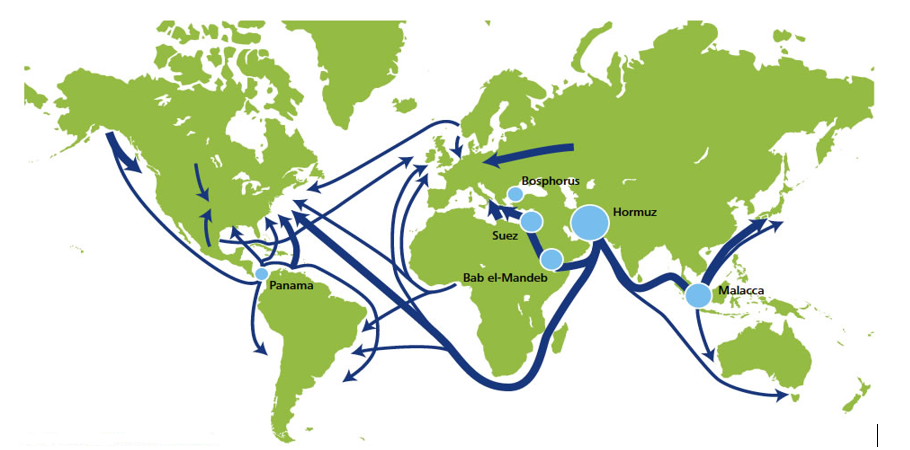
Most maritime flows of liquid cargo follow established shipping routes. More than 100 million tons of oil are transported daily by tankers, the majority of which are loaded in the Middle East and shipped to Japan, China, the European Union, and the United States. Tankers bound for Asian countries typically pass through the Strait of Malacca, while those heading to Europe and the United States pass through the Suez Canal or around the Cape of Good Hope, depending on tanker size and destination.
The role of transport costs
Transport costs play a significant role in determining market choices and maritime routes for liquid cargo. For example, three-quarters of U.S. oil imports come from the Atlantic basin (including West Africa), with transport times typically under 20 days. A vivid comparison illustrates time savings: tankers traveling from Venezuela to U.S. ports take about 8 days, while those from Saudi Arabia take around 6 weeks. Most Asian oil imports come from the Middle East, with journeys lasting approximately 3 weeks.
The most significant oil and gas exporters include Russia, Middle Eastern countries, Nigeria, Venezuela, and Mexico, while the largest importers are the United States, EU member states, China, and Japan. Although oil is transported over intercontinental distances by sea, transport costs make up only a small portion of the final fuel price at the pump—between 5% and 10%. With rapid motorization and economic growth in developing countries such as India, Pakistan, and China, future demand for oil and LNG is expected to rise further. This will require larger tankers and could increase pressure on maritime chokepoints.
The emergence of congestion in maritime transport
When analyzing maritime routes for liquid cargo, chokepoints must be considered. Maritime transport has inherent limitations, as international routes often pass through narrow straits, channels, capes, and bays that restrict navigation due to limited width and shallow waters. The greater the traffic intensity and the larger the vessels, the more problematic these chokepoints become—a trend that is increasingly evident.
There are approximately 200 maritime chokepoints worldwide, several of which hold global strategic importance. Many are located in politically unstable regions, increasing risks to navigation. Chokepoints may be partially or completely blocked due to maritime accidents, geopolitical conflicts, wars, piracy, or organized crime.
The most important global chokepoints
Maritime chokepoints represent the “Achilles’ heel” of the global economy. There are six key global chokepoints: the Strait of Hormuz, the Suez Canal, the Bab el-Mandeb Strait, the Turkish Straits (Bosporus and Dardanelles), the Strait of Malacca, and the Panama Canal. These routes are used not only for liquid cargo but also for containerized and bulk goods. Around 60% of global oil flows pass through the Strait of Hormuz and the Strait of Malacca.
Strait of Hormuz
Located between Oman and Iran, the Strait of Hormuz connects the Persian Gulf with the Gulf of Oman and the Arabian Sea. It is the most critical maritime chokepoint due to its direct access to Middle Eastern oil fields. Approximately 20 million barrels of oil pass through it daily—about 20–21% of global seaborne oil transport. Around 80% of this oil is destined for Asian markets. Despite being 48 to 80 km wide, navigation is restricted to a 3 km-wide channel, making transit complex. Security risks are heightened by geopolitical tensions, including ongoing conflicts involving Iran, Israel, and the United States.
In the event of a blockade, alternatives include pipelines controlled by Saudi Arabia and the UAE. Saudi Arabia’s East-West pipeline has a capacity of 4.8 million barrels per day, while the UAE’s Abu Dhabi pipeline can transport 1.5 million barrels daily.
Suez Canal
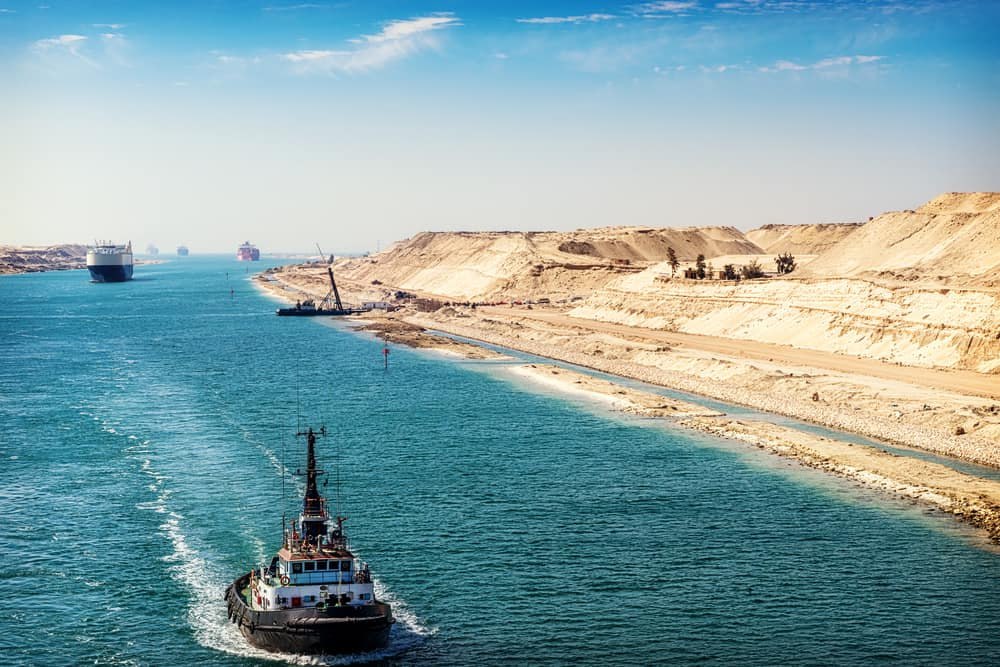
Located in Egypt, the Suez Canal connects the Red Sea and the Mediterranean Sea. It is one of the most important chokepoints in global maritime trade. Around 25,000 ships pass through it annually, accounting for roughly 10% of global oil transport. Daily flows reach about 7.5 million barrels of oil. Most northbound oil is destined for Europe (78%) and North America (14%), while southbound cargo heads toward Asian markets.
If the canal were closed, the SUMED pipeline would serve as an alternative. Otherwise, tankers would have to reroute around the Cape of Good Hope, significantly increasing travel time and costs.
Bab el-Mandeb Strait
This chokepoint connects the Indian Ocean with the Red Sea and controls access to the Suez Canal. Located between Yemen, Djibouti, and Eritrea, it is a strategic link between the Horn of Africa and the Middle East. Most oil shipments passing through the Suez Canal also pass through Bab el-Mandeb.
Turkish Straits (Bosporus and Dardanelles)
The Bosporus connects the Black Sea with the Sea of Marmara, while the Dardanelles link the Sea of Marmara with the Aegean Sea. Together, they form the only maritime route between the Black Sea and the Mediterranean. These straits are crucial for transporting oil and gas from Russia and the Caspian region to Europe. Around 2.5 million barrels of oil pass through daily, with oil accounting for about 80% of liquid cargo.
Heavy traffic creates congestion and risks of accidents. Due to safety concerns, large tankers are prohibited from passing at night to protect the densely populated city of Istanbul.
Strait of Malacca
The Strait of Malacca connects the Indian and Pacific Oceans and represents the shortest route between the Middle East and East Asia. Around 23 million barrels of oil pass through it daily (about 29% of global flows). It is also a major route for LNG shipments, especially from Qatar to East Asia.
At its narrowest point, the strait is only 2.7 km wide, increasing the risk of collisions. Piracy and organized crime are also significant threats. If blocked, vessels would need to reroute around the Indonesian archipelago, increasing costs and transit times.
Panama Canal and Trans-Panama Pipeline
The Panama Canal connects the Pacific Ocean with the Atlantic Ocean via the Caribbean Sea. Approximately 13,000 ships pass through it annually. Although important, it is not crucial for global oil supply, handling about 2.9% of liquid cargo flows. Around 2.3 million barrels of oil pass through it daily.
Alternatives include the Strait of Magellan, Cape Horn, and the Drake Passage, but these routes significantly increase travel distance and costs. A more practical alternative is the Trans-Panama pipeline, with a capacity of 860,000 barrels per day.
Conclusion
Maritime transport is essential for global energy supply, as the majority of liquid cargo is transported by sea. Given that exporting and importing countries are located on different continents, these flows would not be possible without maritime transport.
Chokepoints—straits, channels, and canals—play a crucial role in these flows due to their limited space and high traffic density. Ensuring their openness and security is vital. Any disruption or blockade could lead to severe consequences for the global economy, including inflation, stagflation, supply shortages, and job losses—effects that have already been witnessed in recent weeks.