By Matija Šerić
Few expressions have been as widely used in public discourse in the former Yugoslavia over the past few decades as the term “third entity.” It is used so often that one might think it actually exists. Although the expression itself could mean many things, in the context of Bosnia and Herzegovina it exclusively refers to the Croatian entity, i.e., a federal unit. Even though the term “third entity” is not 100 percent precise (for example, there could be three entities without any of them being Croatian), it clearly reflects the desire to finally resolve the political inequality of the Croatian people in BiH.
Historical Context
It should be emphasized that the Croatian entity is not a marginal, strange, or radical idea, but rather a very real solution arising from both history and the present. After all, certain forms of a Croatian entity were an integral part of many international peace plans proposed by the European Union and the United Nations during the Bosnian war in the 1990s. The most important of these were the Carrington–Cutileiro, Vance–Owen, and Owen–Stoltenberg plans. In fact, the Croatian entity already existed in the form of the Croatian Community/Republic of Herzeg-Bosna (1991–1996) and the Croatian Self-Government (2001). The first was entirely legitimate and in line with international peace plans (the Hague Tribunal did not characterize the idea of Herzeg-Bosna itself as a criminal act), while the second was an ill-considered reaction to unilateral moves by the international community that de-constitutionalized Croats.
By all accounts, a Croatian entity would exist today had the Americans not intervened in 1994 and imposed the concept of the Croat-Bosniak Federation, seeking to eliminate the threat of a Bosniak entity, which they viewed as a potential outpost of radical Islamism in the heart of Europe. However, both the Dayton Agreement and post-Dayton BiH have proven to be long-term failures, and a Croatian entity remains one of the possible alternatives for a more sustainable solution. This raises the question: what would a majority-Croatian entity actually look like?

The Idea
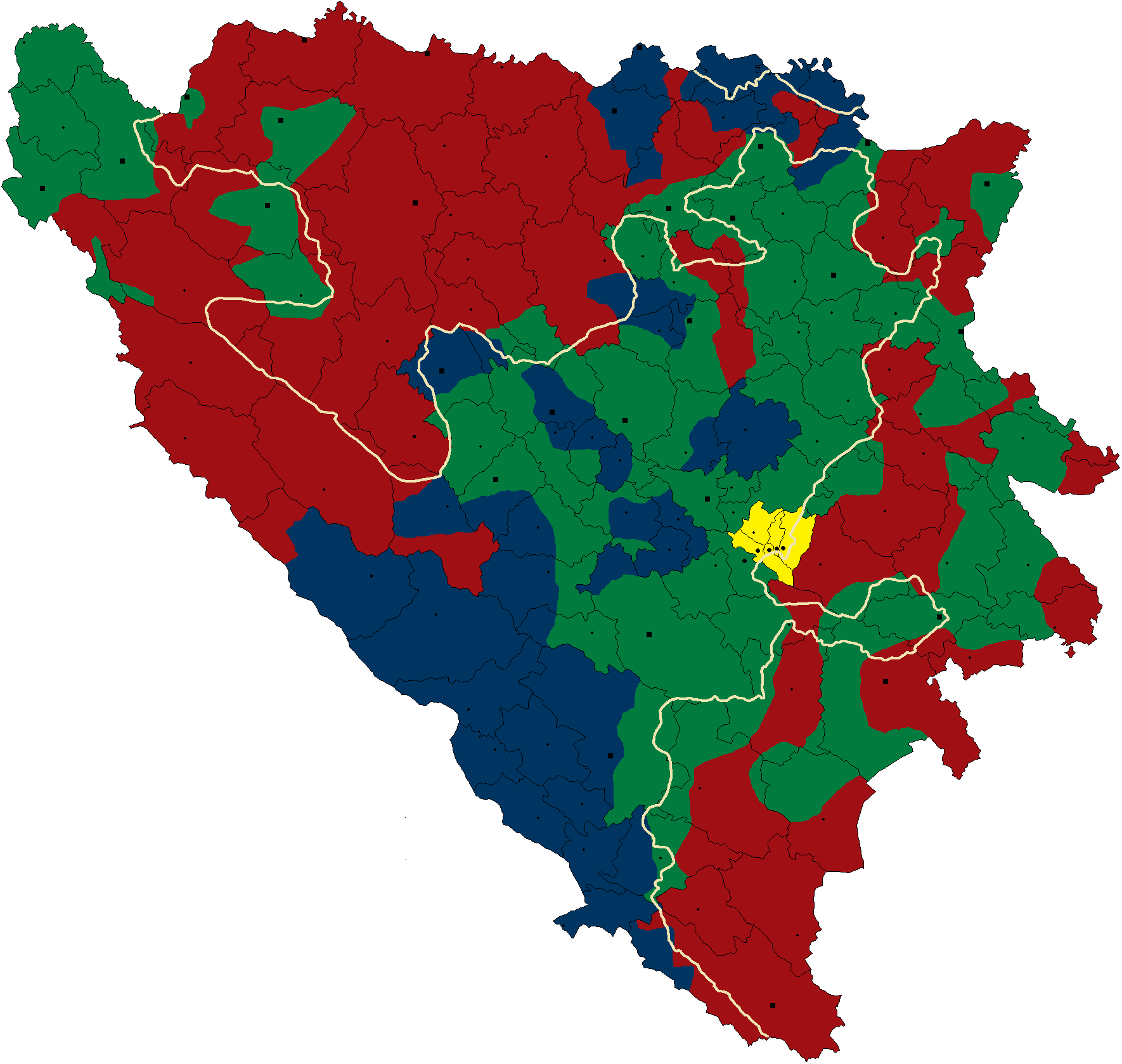
There are several options for how this new political unit might manifest itself. In most cases, advocates of the idea envision executive, judicial, and legislative powers within a Croatian territorial-political unit covering certain areas. This unit could be territorially discontinuous, encompassing regions where Croats form a majority or a significant percentage of the population. In practice, this would amount to about 15–20% of BiH’s territory. Essentially, the Croatian entity would mirror the existing entities – the Federation of BiH and Republika Srpska. A kind of “state within a state” with broad autonomy, empowered to make decisions on all major issues, while the state-level government of BiH would retain only a small number of competencies such as diplomacy, foreign trade, and interstate agreements.
Advocates argue that the Croatian entity would be more efficient and, ultimately, more successful than today’s majority-Serb and majority-Bosniak entities. But to assess this idea realistically, its advantages and disadvantages must be considered.
Main Advantage – Equality for the Croatian People
The advantages of the idea are undeniable. First and foremost: a Croatian entity would certainly improve the political status and position of Croats in BiH. Institutional marginalization, majorization, exploitation, and deceit might not be eliminated entirely, but they would be significantly reduced. In other words, institutional equality of Croats with Serbs and Bosniaks would largely be achieved. Political equality goes hand in hand with broader political autonomy, which should not be an end in itself.
Political Autonomy for a Better Life
Croatian political autonomy should result in greater self-governance in healthcare, education, the economy, finance, culture, sports, and all other areas. In fact, the Croatian entity should aim to provide its residents with a better life, which is precisely the ultimate goal of any political community – from a municipality to a state.
A better life for ordinary people was one of the main motives behind the creation of an independent Republic of Croatia, since within Yugoslavia Croatia and its citizens were disadvantaged compared to Serbia and other republics. When a community has political autonomy, it can shape daily life according to its own needs. Even though independent Croatia has not fully realized its potential, no politician or intellectual today (at least not publicly) advocates a return to Yugoslavia. Despite Croatia’s shortcomings, life would be worse under Yugoslavia. Similarly, one may assume that a Croatian entity in BiH would offer better development prospects and prevent Croatian regions from being exploited by Sarajevo and Banja Luka. More large-scale infrastructure projects such as schools, hospitals, kindergartens, or roads could be implemented. Successes or failures in the economy and other areas would then depend solely on the choices made by Croats themselves at the ballot box.

Political Pluralism
This leads to another advantage: the political pluralization of the Croatian electorate. Over the past 30 years, Croats have generally been forced to vote collectively for the strongest party and its representatives (HDZ BiH) in elections at the cantonal, entity, and state levels in order to remain politically relevant. A Croatian entity where 70–80 percent of the population would be Croat would eliminate such fears. Sooner or later, Croats would withdraw support from HDZ BiH, which has proven itself to be a typical corrupt and nepotistic party incapable of addressing major issues (no better than SDA, SNSD, or other Bosnian parties). It would be refreshing to see political leadership in Croat areas not dominated by HDZ.
Uniting the Croatian People
Croats in BiH could achieve political unification through a discontinuous entity linking Bosnian Posavina, Central Bosnia, and Herzegovina. Although not geographically consolidated, their daily needs could be met through entity institutions. This would also bring emotional satisfaction, as they would no longer be a minority within the state, but rather a majority in part of BiH’s territory.
Political Efficiency
Another significant advantage would be the elimination of political deadlock. Both BiH and the Federation of BiH are notorious for constant legislative blockades, resulting from competing parties representing different ethnic groups that fail to reach consensus on nearly every serious issue. By contrast, an entity government would propose laws that its entity parliament could easily pass, much like in most European states. There would be no endless wrangling in upper chambers. Similarly, Serb and Bosniak entities could also adopt laws more swiftly. As a result, BiH as a whole could become politically more efficient.
Protection of Culture and Identity
Another major advantage would be the protection of Croatian culture and identity through institutions such as ministries, government agencies, cultural centers, museums, theaters, and cinemas. The entity would undoubtedly emphasize Croatian cultural and historical heritage within BiH, ensuring its proper safeguarding – an important consideration in today’s complex world.

Stabilization or Destabilization?
Here the main advantages come to an end. The rest are either unclear or debatable. Proponents argue that the creation of a Croatian entity would resolve not only the national question of Croats, but of all three constituent peoples. Bosnia and Herzegovina would finally be politically stabilized and consolidated, three decades after the war. This interpretation, however, is highly questionable.
Yes, BiH would indeed be more logical and functional as a state of three entities and three constituent peoples than under the current arrangement. The strange asymmetry imposed by the Dayton Agreement (a Serb-dominated entity vs. a Croat-Bosniak one) would be replaced with symmetry – each people with its own entity.
However, such a tri-entity arrangement would not automatically guarantee peace, stability, or prosperity. National tensions would likely rise. Many would attempt to sabotage this arrangement – first and foremost Bosniak nationalists and Bosnian unitarians, who still support Slobodan Milošević’s concept of “one man, one vote.” Such a concept is unsustainable in a state defined as Bosniak-Serb-Croat. They could be joined by dissatisfied Serbs and Croats, either due to secessionist ambitions or discontent with entity borders.