By Lazar Baćović
When representatives of the Revolutionary Armed Forces of Colombia (FARC) signed a peace agreement with the Colombian government in 2016, it seemed that the longest-running conflict in the Western Hemisphere might finally come to an end. The peace deal granted former insurgents seats in Congress, amnesty, and a vaguely defined plan for agrarian reform in exchange for the demobilization of tens of thousands of fighters. Today, nearly a decade after the agreement was signed, the situation in Colombia is arguably even worse than before 2016.
Colombia is a country with one of the highest levels of inequality in the world. Although the vast majority of Colombians now live in cities, the country still has immense rural areas inhabited by around ten million campesinos (peasants). As a result of structural inequality and the extreme concentration of land ownership in the hands of a small elite, millions of Colombian peasants are unable to own land or sustain a decent livelihood. The situation is further aggravated by the neoliberal policies of the Colombian state, which favor the cultivation of a limited number of commercial crops—leaving smallholders unable to compete in the market.
In order to survive, peasants in many rural regions are forced to cultivate coca, the main ingredient used in the production of cocaine. For many, coca represents the only reliable source of income, as other crops are not economically viable under current market conditions. During its long struggle, FARC developed a symbiotic relationship with Colombian peasants. In areas under its control, FARC provided protection and security in exchange for a tax on raw coca sold by farmers to drug cartels. Throughout its existence, FARC consistently denied allegations of involvement in the production and distribution of cocaine.
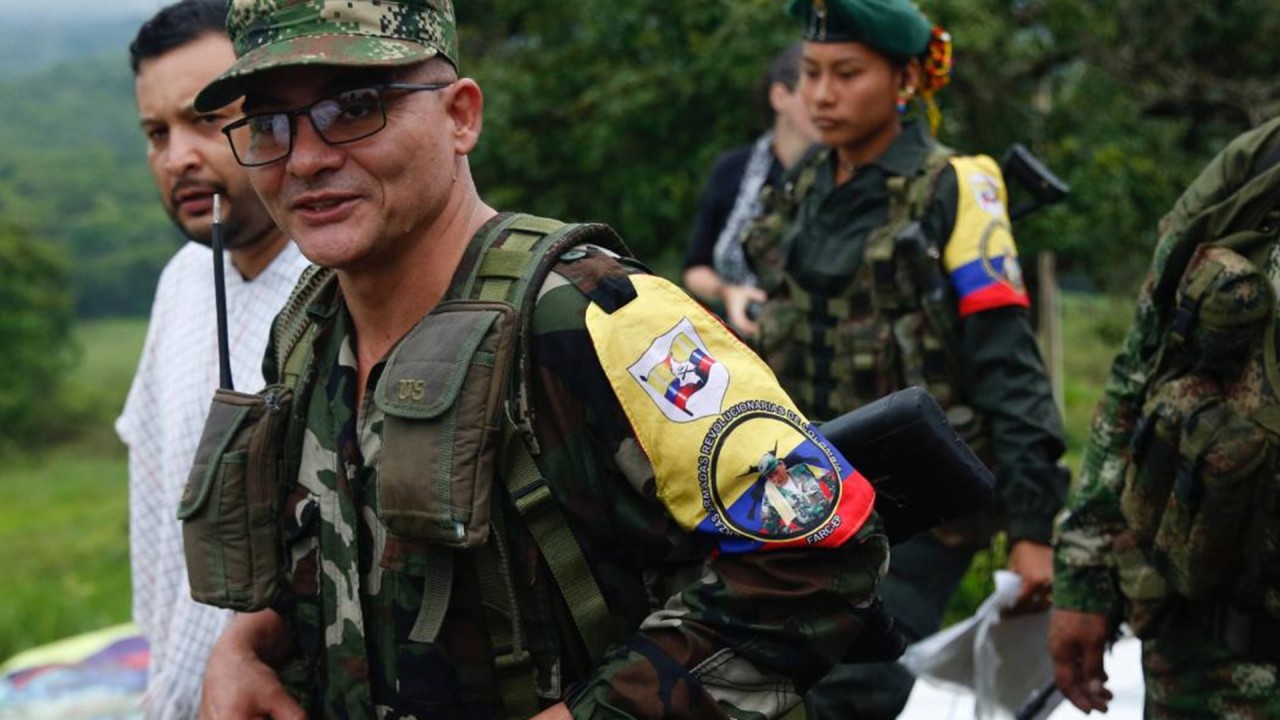
The demobilization of most FARC fighters was successful, but a smaller faction refused to lay down arms and continued the struggle. They justified their decision by pointing to the lack of meaningful structural reforms and the fear of retaliation by right-wing paramilitary groups. Initially numbering only a few thousand, these dissidents were eventually consolidated under the leadership of Néstor Gregorio Vera Fernández, better known as Iván Mordisco, by 2022. A former commander of a FARC front (a basic combat unit of 300–500 fighters), Mordisco gradually built strong authority among dissident groups and succeeded in re-establishing a nationwide network of military units across Colombia.
In Colombia, there is a widespread perception that FARC dissidents are less ideologically driven than their predecessors. Despite this, Mordisco has presented himself in public appearances as a political leader and a defender of the rights of Colombian peasants. While FARC advocates for a peaceful end to the conflict, it demands substantial agrarian reform, support for rural development, access to education and healthcare, and an end to political persecution and insecurity in the country.
FARC dissidents are one again important military force
Although Colombia has been led by leftist president Gustavo Petro since 2022, his tenure has not resulted in a de-escalation of the conflict. On the contrary, the country has witnessed a significant surge in violence in recent years. Mordisco’s FARC is not solely responsible for this deterioration, as several other major insurgent groups operate in Colombia (alongside numerous criminal gangs that lack any political ideology). FARC itself is fragmented, as in addition to Mordisco’s faction, at least two other dissident movements have emerged since the 2016 demobilization.
Since 2019, the group known as the Second Marquetalia has been active, led by Iván Márquez, the former chief negotiator of FARC and one of its most prominent leaders. Another faction is led by Calarcá Córdoba, once a close ally of Mordisco, with whom he is now in open conflict. In addition to FARC dissident groups, the National Liberation Army (ELN)—an organization inspired by liberation theology and Christian socialism—maintains a strong presence in Colombia. Alongside leftist groups, a number of right-wing paramilitary formations also operate in the country, historically maintaining close ties with government and military forces.
The main strongholds of insurgents under Mordisco’s leadership are isolated and neglected rural areas in eastern and southern Colombia. In departments such as Cauca, Nariño, Putumayo, Meta, and Caquetá, Mordisco and FARC effectively function as the real authority in rural communities, as the Colombian state is largely absent outside major cities. Colombia is administratively divided into around thirty thousand veredas (small rural municipalities), which are nearly impossible to control. As long as discontent persists among peasants, FARC can easily recruit new members and ensure its survival.
In recent years, the Colombian military has launched a series of operations aimed at eliminating Iván Mordisco. All of these attempts have failed, contributing to an aura of invincibility surrounding him. The government in Bogotá suffered its greatest embarrassment in 2022, when it triumphantly announced Mordisco’s death in an airstrike—only for him to reappear months later and publicly prove he was alive. The authorities, then led by right-wing president Iván Duque, were left humiliated in the eyes of the public.
Today, Colombia once again represents one of the main hotspots of conflict in Latin America. The country is torn by political, economic, and social tensions, and for many in rural areas, FARC remains the only means of expressing resistance against the system. Iván Mordisco, the leader of this insurgency, is now the most wanted man in Colombia—and perhaps in all of Latin America. The obsession with his figure has become so intense that ruling circles accuse each other of harboring Mordisco’s informants, allegedly warning him of planned military operations and enabling his survival. With an upcoming change of government this year and the possible election of a new president (potentially from the far right), Colombia once again faces a historic dilemma: how to deal with mass insurgency in its rural periphery.