By Matija Šerić
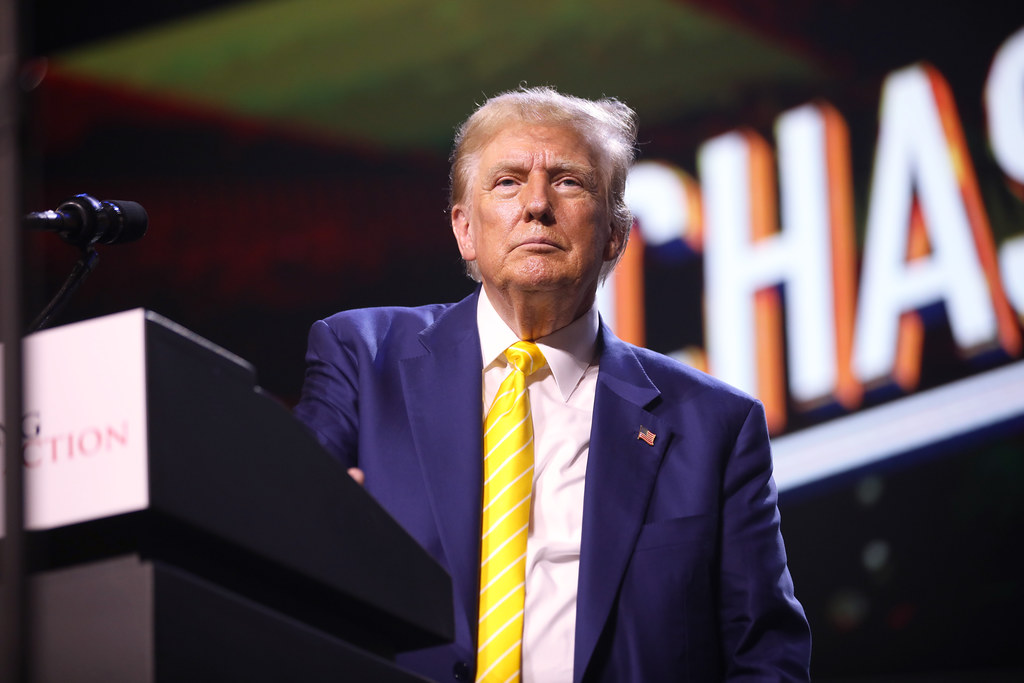
Donald Trump is known as an unconventional politician, not just in theory, but also in practice. His actions—high tariffs in global trade, rolling back transgender rights, not supporting green energy, bombing Iran, and more—often spark controversy. Some strongly support them, while others vehemently oppose them. One move that has divided the American public is the announcement made on Monday, September 29, when the president declared that he would impose a 100% tariff on all films produced outside the United States.
Sensational Announcements
This is a repeated threat. Trump had already made a similar warning in May about foreign cinema, although at that time he did not clarify whether he meant films from certain countries or all foreign productions. Back then, a coalition of American film unions sent a letter urging Trump to support tax incentives for domestic film production to bring more film and television projects back to the U.S. Now, in a post on his social media platform Truth Social, the president wrote a provocative statement: “Other countries have stolen our film industry from us, just like a child’s candy is stolen.”
It is unclear, however, how he intends to implement his idea—through legislation in Congress or via an executive presidential decree. Logically, it would have to go through Congress, since presidential decrees do not serve the purpose of imposing tariffs on films. Such a move falls under tax and trade policy, which is under Congress’s jurisdiction according to the U.S. Constitution.
A Move Not Supported by Experts
Although Trump designed the 100% tax on foreign films to protect Hollywood, many American filmmakers are troubled by such a sensational announcement. And that is not unusual. Film production is one of the most complex forms of production overall. Creating films entirely within the U.S. is almost impossible for most American studios. Script development, casting, rights and licensing, financing, production, post-production, and visual effects are all integral elements of the filmmaking process and are difficult to execute entirely within U.S. borders. Films are often produced in multiple countries, sometimes more than ten—examples include the Lord of the Rings trilogy, Avatar (2009), or Inception (2010).
US movie studios react to Trump’s decision
Boomerang Effect
Although the U.S. remains the world’s number one film power, its dominance is not absolute. Hollywood fears that other countries could retaliate by imposing high tariffs on American films and TV series. Such a move could significantly reduce the revenues of American studios and threaten Hollywood’s global dominance, as many countries might simply opt out of purchasing expensive American films, no matter how visually impressive or star-studded they are.
At the same time, this could unexpectedly encourage many smaller countries to invest in their own film industries to save money and attract a larger share of their domestic audiences. Trump’s decision on tariffs could thus create a boomerang effect of cultural self-sufficiency. This would not be bad for many film industries that were once hugely successful but have declined in recent decades—Germany, Italy, and France, for example.
However, such a scenario would be highly negative for American studios and filmmakers globally. U.S. producers warn that imposing a wide range of tariffs on films could harm Americans working abroad, from production crews to visual effects experts, as their work is naturally distributed across multiple countries.
Films—A Multinational Team Effort
Film producer Mark Wolradian pointed out that the film industry differs significantly from traditional production; production teams often choose foreign locations for filming because of the film’s subject matter. Some scenes cannot be adequately shot in the U.S.: specific historical locations, particular cities, or exotic climates and terrains. “A general obligation for domestic production is unrealistic, as cross-border filming is a key part of our creative process,” Wolradian said. Besides filming abroad, many films are not 100% American because U.S. studios collaborate with foreign production companies, mostly European and Asian. Europeans or Asians are often responsible for financing projects, accessing local markets, and distribution (through cinemas, TV channels, or streaming platforms).
Lack of Domestic Filming Capacity
Furthermore, Wolradian revealed something that many in the industry might not know: the U.S. does not have unlimited capacity for film production. American capacities are limited. One large city, Atlanta, can accommodate three film crews simultaneously, which translates to six films per year. Given the high demand for filming, the U.S. cannot accommodate all American studios domestically. Therefore, many American studios are forced to film abroad.
Additionally, filming in studios in major cities like Los Angeles or New York is very expensive, so many productions shoot in smaller cities like Albuquerque or Santa Fe, where costs are much lower. Or U.S. studios simply choose to film in foreign locations where it is more economical—countries such as Canada, Mexico, New Zealand, Australia, and the United Kingdom. In these countries, tax incentives have attracted filming of a wide range of projects, from blockbusters to small dramas and soap operas.
The Film Industry—One of the Few Profitable American Industries
According to the Motion Picture Association, the American film industry recorded a trade surplus of $15.3 billion in 2023, thanks to the export of films and TV content abroad worth $22.6 billion. These are excellent figures that few other American industries can boast. If tariffs on foreign films were actually introduced, these revenues would be at risk. As early as May, Benjamin Swinburne, head of U.S. media research at Morgan Stanley, warned that introducing 100% tariffs could reduce U.S. film industry revenues, decrease the number of domestic studios, and increase costs. This is an outcome that no American would want. Therefore, it would be advisable for Trump not to make a decision that could negatively affect the American film industry and the economy as a whole.
Trump’s Tariff Offensive Continues
It should be noted that tariffs on films are part of Trump’s broader tariff policy. The U.S. government has announced plans to soon impose 100% tariffs on branded pharmaceuticals, 50% tariffs on kitchen cabinets and sinks, 25% tariffs on heavy trucks, and 30% tariffs on upholstered furniture. Clearly, Trump’s tariff offensive shows no signs of slowing, despite opposition. Economic logic may be against it, but as a businessman, Trump might have a broader perspective that could yield long-term benefits. It is hard to believe that the president aims to push the U.S. into economic trouble, which is already slowly beginning.
References:
https://edition.cnn.com/2025/09/29/economy/trump-movie-tariff
https://www.cnbc.com/2025/09/29/trump-movie-tariffs-why-production-has-left-hollywood.html