By Matija Šerić
Although the Boston Celtics were one of the pleasant surprises of the current NBA season, considering the absence of Jayson Tatum and injuries to other players, they disappointed in the playoffs. And badly so. Even though they led 3–1 in the quarterfinal series against the unpredictable 76ers, they ultimately lost 4–3. They thus became only one of 15 teams in NBA playoff history to squander a 3–1 series lead, a rare occurrence. Now, seeing Philadelphia losing 3–0 in the semifinals against New York makes the defeat hurt even more. Many fans of the most successful NBA franchise are asking what happened and how the second seed in the East lost to the seventh seed. We will try to provide answers.
Without Tatum in Game 7
The decisive Game 7 was played at TD Garden. Despite expectations from Celtics fans that the team would respond and win even without the injured Tatum, the victory did not materialize. From the beginning, it was a game dominated by the visitors. It appears that Tatum’s absence affected both the coaching staff and the players.
Coach Joe Mazzulla stated that he found out the team’s first superstar would not play just 45 minutes before tip-off, even though in Game 6 Tatum had already spent some time off the court due to pain in his left calf. Mazzulla had to improvise. Alongside stars Jaylen Brown and Derrick White, he started young players Ron Harper Jr., Luka Garza, and Baylor Scheierman.
Clear Dominance of the 76ers
It immediately became clear on the court that this was not a good combination. The mentioned starting five played together for the first time all season and quickly fell behind by nine points (0–9). Boston did not score in its first six possessions.
Believe it or not, Harper, Garza, and Scheierman did not score a single point in the entire game!
The 76ers led throughout the match, except for 31 seconds. A five-point halftime lead was extended to +18 in the third quarter. At the start of the fourth, the gap dropped to 13, and Boston opened the quarter with a 16–4 run to close the score to 91–92.
Philadelphia led 98–101 when Tyrese Maxey freed himself and scored a layup with 1:15 remaining. Boston then missed its next four shots, and the 76ers extended the lead to 98–105 with two free throws from Maxey.
Joel Embiid, fully recovered, finished with 34 points, 12 rebounds, and six assists. Tyrese Maxey added 30 points, 11 rebounds, and seven assists. VJ Edgecombe scored 23 points, while Paul George contributed 13.
The Celtics Were Not at Their Level
The Celtics, usually excellent three-point shooters, were poor in this game as well as in the previous two. They shot 13 of 49 from beyond the arc (29%).
Overall field goal percentage also showed dominance from Philadelphia: 48% compared to Boston’s 40%.
Interestingly, both teams were tied in rebounds at 40–40, while turnovers favored Boston slightly (9–5).
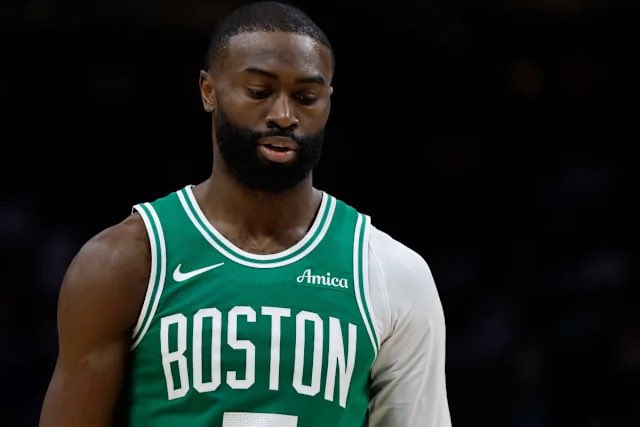
Although Jaylen Brown scored 33 points with nine rebounds, Derrick White added 26 points (including five threes), and Neemias Queta had 17 points and 12 rebounds, it was not enough. Payton Pritchard (13 points) and Sam Hauser (11 points) did not contribute sufficiently, even if that is not fully visible in the stats. The team lacked cohesion, courage, and inspired plays.
Embiid – the Key Factor in Boston’s Elimination
Embiid returned after missing the first three games of the series due to appendectomy surgery. The result was devastating for Boston. He became the deciding factor of the series.
He became the first player in NBA playoff history to score more than 100 points in a series after missing the first three games.
His dominant inside play destroyed the Celtics, which the team itself acknowledged. Fearing Embiid in the paint, Boston often resorted to contested three-point shots that did not fall.
Throughout the series, the Cameroonian-American star played at MVP level, averaging around 28 points, nine rebounds, and seven assists, consistently creating mismatches in the paint and taking over in crucial moments.
Without Embiid, Boston might have advanced. With him, there was no chance.
From Unexpected Season to Massive Disappointment
A strange season for the Celtics. Initially, expectations were low due to Tatum’s serious injury (ruptured Achilles tendon) in last year’s playoffs. However, the team showed it could play well without its superstar.
During the regular season, Boston was one of the best teams in both offense and defense – 4th in offense and 9th in defense, and 3rd in assist rate. They finished second in the Eastern Conference with a 56–26 record.
After Tatum’s return on March 6, expectations skyrocketed. A run to at least the Eastern Conference Finals seemed realistic. That seemed even more likely after they led Philadelphia 3–1 in the series.
However, in Game 5 they squandered a 13-point third-quarter lead and eventually lost the series, exiting in the quarterfinals.
This is their earliest playoff exit since 2020/21, when they lost in the first round to the Brooklyn Nets 4–1. Overall, the season is considered a failure for a franchise that always aims for the NBA title.
Reasons for the Loss
The main reason for the Celtics’ defeat was Embiid’s performance. However, the playoffs exposed all the weaknesses in their game.
During the regular season, Boston was the league’s best three-point shooting team. Only 41% of their shots came from the paint, but that dropped to a poor 36% in the playoffs.
Their three-point shooting collapsed in losses to Philadelphia: 27.4% (49–179).
They missed easy shots. Fear of attacking the paint against Embiid proved costly. Their “run and gun” style was not enough at this level.
Brown and White, as team leaders, failed to take control in the third and fourth quarters. They are excellent players but lack the leadership traits of players like Embiid or LeBron James.
Boston struggled with consistency in crucial moments, often forcing individual plays instead of structured offense. Defensively, they made mistakes in rotations and pick-and-roll situations.
Although Mazzulla praised his deep rotation during the season, bench players failed to deliver in the playoffs.
An Uncertain Future
The Celtics’ season is over. However, the future is full of uncertainty.
Roster changes are possible, including trades involving key players. Some analysts have even suggested Boston consider trading Jaylen Brown, Derrick White, or even Jayson Tatum for Milwaukee Bucks superstar Giannis Antetokounmpo.
Brown has stated he could stay in Boston for the next ten years, but reports suggest frustration with the organization. Tracy McGrady revealed that Brown feels underappreciated as a leader, especially during Tatum’s absence.
If true, a trade scenario is not impossible.
Although Tatum is the face of the franchise, some believe Boston might consider trading him, though this is currently unlikely. His absence clearly showed his importance.
The futures of Payton Pritchard and the younger players are also uncertain. It will be an interesting summer for Boston.