By Matija Šerić
“‘Four-four-two like lottery numbers, and Ćiro said: ‘son, trust Otto’’” is a line from the Croatian fan chant Ako zabijemo gol, performed by General Woo, Nered, Ćiro, and Željko Vela ahead of the 2004 European Championship in Portugal. The fact that the 4-4-2 formation made its way into a fan song highlights its immense popularity at the start of the 21st century. It is one of the most popular formations in modern football. Interestingly, it was the absolute number one for a while (late 20th and early 21st centuries), almost completely disappeared around 2010, only to make a strong comeback in recent years.
Formation Structure
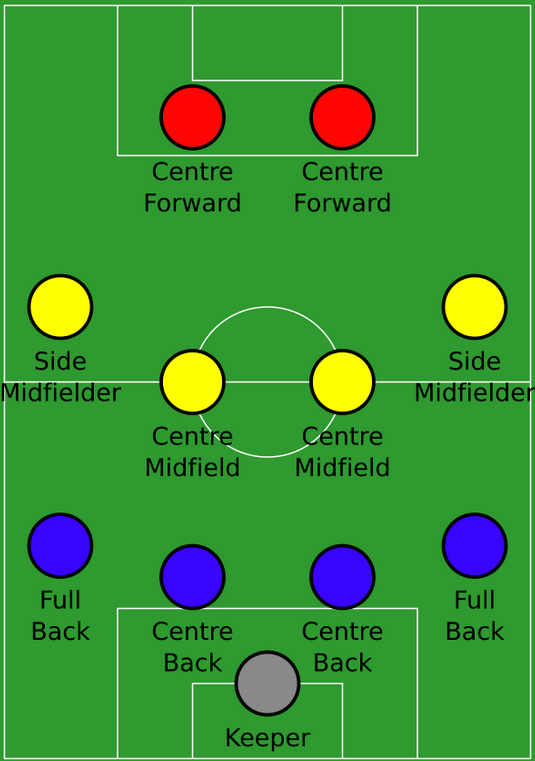
The formation is very simply structured, and its clarity is largely responsible for its success. It consists of four defenders (two center-backs and two full-backs), four midfielders (two central midfielders and two wingers), and two central forwards. In the original formation (which has been slightly modified today), the roles and positions of all players were unambiguously defined. The task of the two center-backs is to create a solid block in front of the goalkeeper and deliver precise long passes into the attacking part of the game. The two full-backs must cover their defensive areas along the left and right flanks and contribute to the attack as much as possible. In the original setup, full-backs rarely crossed the center line during offensive actions and did not serve as wing-backs like many modern full-backs do in almost all formations.
Of the two central midfielders, one is usually defensive, while the other is offensive. Essentially, one plays the classic holding midfielder role, while the other acts as a playmaker (a withdrawn number ten) who also carries a host of defensive responsibilities. The two wingers are responsible for distributing the ball, stretching the game across the flanks, and delivering precise crosses into the opponent’s penalty area. The two central forwards form the main attacking duo. One typically plays slightly withdrawn as a second striker (known as the “mantinela”), while the other is a traditional finisher, waiting for teammates to “feed” him the ball to take shots on goal.
Origin in England
The 4-4-2 formation is an English invention, imposed by English coaches from the 1960s to the 1980s. During the 1990s and 2000s, it became universally recognized as the most popular formation, indispensable to football. England won its only World Cup title in 1966 using a 4-4-2 under manager Alf Ramsey. Argentina and Brazil won the 1986 and 1994 World Cups, respectively, using the same formation, albeit with some modifications.
The formation’s popularity is evident from the fact that a prestigious English football magazine launched in 1994 was named FourFourTwo. The original success of the formation lay in English and British clubs’ preference for solid organization and fast counterattacks, i.e., “kick and rush” football, where defenders (like Harry Maguire today) would send long balls that attackers would chase. This bypassed the midfield, as England at the time lacked strong playmakers (number tens) like Jude Bellingham today.
Fergie Perfects the Formation
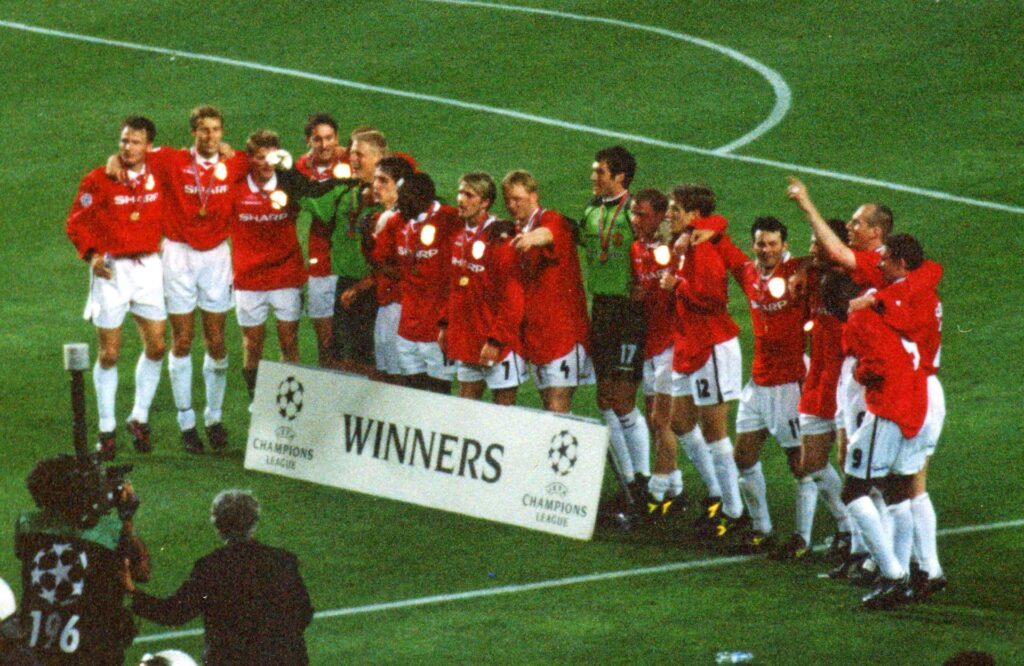
The formation was most popularized by Manchester United manager Sir Alex Ferguson, who dominated the Premier League in the 1990s and won the Champions League in 1999 with it. That legendary squad featured Peter Schmeichel in goal; the defense from left to right consisted of Denis Irwin, Jaap Stam, Ronny Johnsen, and Gary Neville. Paul Scholes and David Beckham were the central midfielders, while Jesper Blomqvist and Ryan Giggs played on the wings. The two forwards formed the greatest attacking duo of all time: Andy Cole and Dwight Yorke. The Cole-Yorke partnership entered history as an iconic duo. Even today, football fans refer to their partnership when emphasizing effective teamwork in attack.
The 4-4-2 became the golden standard in all elite leagues, except perhaps Italy. Even Brazil, under Luiz Felipe Scolari, played some matches in a 4-4-2 setup during the 2002 World Cup in Japan and South Korea while winning the title, though they mostly used 3-4-1-2.
Strengths Based on Simplicity
The greatest advantage of the formation is its simplicity. High tactical knowledge is not required for players to understand their roles on the field. The formation provides a good balance in both defense and attack. All positions are doubled, allowing the creation of compact defensive blocks. Full-backs and wingers form defensive blocks on the flanks, while the two center-backs and two central midfielders create blocks in the center. Similarly, attacking duos can be formed in the center and on the flanks. Moreover, the 4-4-2 is ideal for transitions, allowing fast counterattacks after the opponent loses the ball. The wingers stretch the game wide to the touchline, creating problems for opposing defenses.
Weaknesses Bring the Formation to the Brink
However, weaknesses exist. A major issue is the lack of an attacking midfielder (number ten) to create plays, leading to limited creativity in attack. Wingers play a huge role, and the ability to create chances heavily depends on them. If opposing full-backs “shut down” the wingers, scoring opportunities often vanish. The formation is fragile against teams using high pressing. Passing lanes are predictable, and opponents with the physical capability to sustain pressing can suffocate ball distribution.
The biggest weakness, which many teams cannot overcome, is the presence of only two central midfielders. Around 2010, many clubs began to emulate Barcelona under Pep Guardiola. Although the colorful Catalan did not invent it, he popularized the 4-3-3 formation (the famous tiki-taka). He positioned three midfielders in the center, dominating possession, which almost destroyed 4-4-2. Teams playing tiki-taka (whether classic 4-3-3 or 4-2-3-1 variants) effectively had an extra player in midfield. This revolutionary change, combined with high pressing, pushed the 4-4-2 to the brink of extinction.

Tough Times, but the Formation Survives
During the 2010s, very few clubs consistently played 4-4-2. Of course, we’re not talking about second halves when teams that are losing take off a defensive midfielder and bring in a second striker to score a goal. At that point, they actually transform a 4-3-3 into a hybrid 4-4-2, which is more like a 4-2-4 because the two wide midfielders push very high. But there were exceptions.
Atlético Madrid under Diego Simeone continued to play 4-4-2 with a solid midfield and quick counterattacks. This brought Atlético two Champions League finals in 2014 and 2016, as well as the La Liga title in 2014. Simeone modernized the system, making it more flexible and offensive, but retained the core philosophy of a compact block and efficient transitions. This system is still in use today. Some teams (Juventus, Napoli, Roma) revived 4-4-2 in a diamond shape, which Simeone also occasionally used.
A Fascinating Comeback
A major comeback of the formation happened in the 2015/16 season when the underdog Leicester City performed a miracle and won the Premier League title. Italian mastermind Claudio Ranieri revived a formation that many had long forgotten. He created a solid defensive block and used the work ethic of midfielder N’Golo Kanté to enable quick counterattacks, brilliantly executed by Riyad Mahrez and Jamie Vardy. The formation was further popularized by Spanish coach Unai Emery, who led Villarreal from 2020 to 2022 and Aston Villa from 2022 onward. It turned out that 4-4-2 could succeed in both Spain and England.
Emery achieved this by having his wide midfielders move into the center of the pitch (at Villarreal, Yeremy Pino and Giovani Lo Celso; at Aston Villa, Philippe Coutinho and Leon Bailey), covering the spaces between lines and effectively becoming inside forwards. In attacking situations, Emery’s teams then have six players in midfield battling five opponents (two center-backs and three midfielders). This is a revolutionary adjustment. Even Argentina, during their 2022 World Cup victory, occasionally played a flexible 4-4-2, with Di María and Messi drifting inside.
A Formation with a Future
4-4-2 has proven to be a sustainable formation that still captures the imagination of football experts and fans alike, as it’s easy to understand but very difficult to execute. If a team has the right roster, 4-4-2 can be an excellent choice. The key is for players to understand their roles and have chemistry on the field, because even a small lapse in coordination can completely disrupt the structure of the game.