By Matija Šerić
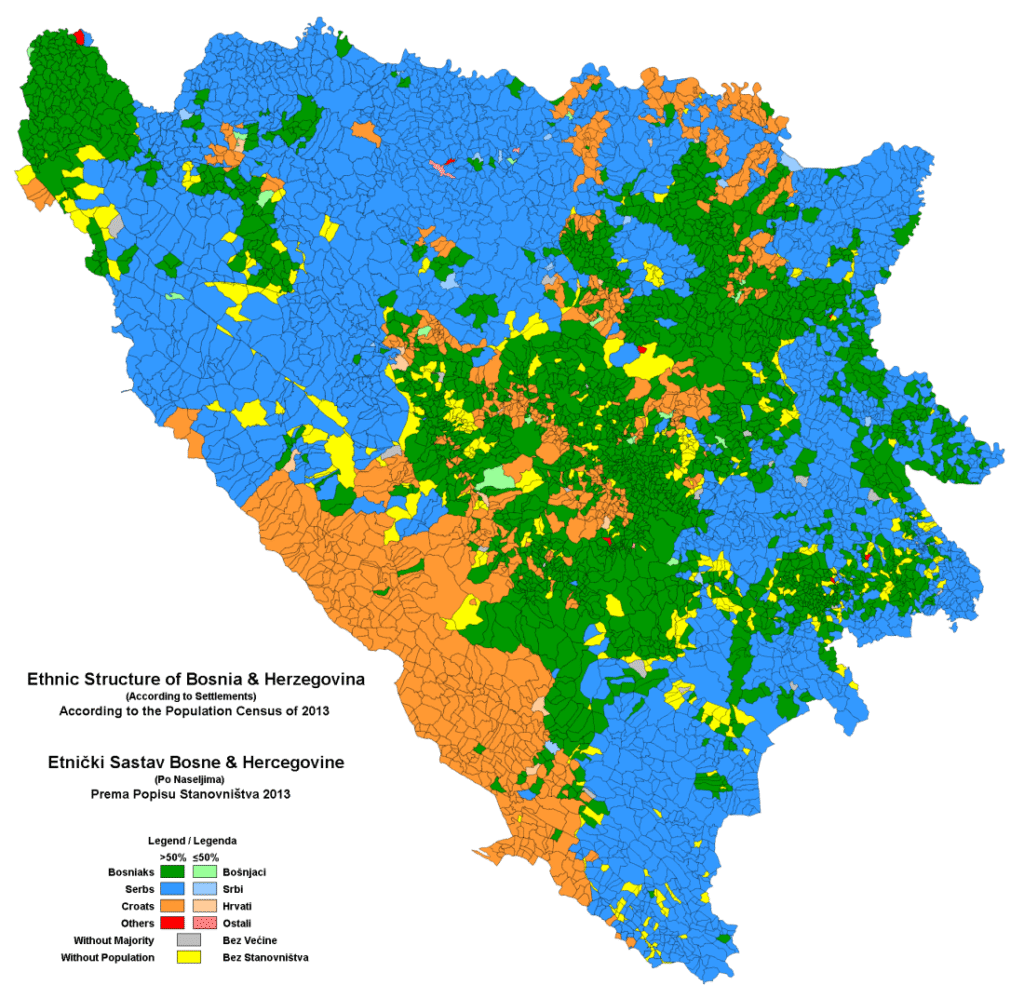
The greatest weakness of a Croatian entity lies in its borders. One might even say this is an insurmountable obstacle that is very difficult to overcome. While the concept of an entity itself is not a bad one, its weakest point is territorial delineation. The problem is the territorial dispersion of Croats, who do not live only in majority-Croat Herzegovina, but also across Bosnia. Proponents of the idea wish to include other areas of BiH as well, which is, unsurprisingly, opposed by Serb and Bosniak politicians – and their peoples.
Territorial Demarcation – The Biggest Weakness
There are indeed proposals on how borders could be drawn, with the 1991 census often cited as the fairest baseline. This would mean carving out parts of BiH as Croatian, and others as Bosniak. Unsurprisingly, Bosniak nationalists – who dominate Bosniak politics – reject this. Whatever the borders, some Croats (along with parts of their historical and cultural heritage) would inevitably remain outside the Croatian entity. That is a painful compromise many Croats are unwilling to accept, especially the Roman Catholic Church.
Expanding Bureaucracy
The establishment of a Croatian entity would undoubtedly bring about an expansion of the bureaucratic apparatus. A government, agencies, institutions, advisors, consultants, and other bodies would emerge. If the entity were further divided into additional levels of government such as districts or cantons, bureaucracy would grow even more. The question is whether BiH can sustain such a large number of publicly funded officials when the private sector – which should finance them – is weak. As things stand today, it clearly cannot.
Questionable Financial Sustainability
It is uncertain to what extent a new entity would be financially viable. It would likely encompass most of Herzegovina and some parts of Bosnia – areas that have unfortunately been economically devastated by 30 years of poor governance, caused both by the incompetence of HDZ and SDA and by neglect from federal and state institutions. While the siphoning of resources by Sarajevo might decrease, it is questionable whether an entity government in Mostar could raise enough revenue to efficiently provide services. One possible solution could be special relations with the Republic of Croatia, which might provide financial support. However, any substantial funding from Croatia is uncertain and would depend on which political party is in power in Zagreb.
Further Ethnic Divisions
Although the creation of an entity might at first bring relief to Croats, critics argue it would further deepen ethnic divisions. The three peoples would retreat into their respective enclosures, each potentially conspiring against the other in politics and beyond. Plans might then emerge to dismantle the system altogether, as BiH could shift from two entities to three – or to something entirely new, either unitary or fully dissolved. National identity would gain even greater importance in BiH, a state already strained by ethnic divisions. Personal-level conflicts, fights, and incidents between members of different communities could flare up more frequently.
Prelude to State Collapse?
Ethnic homogenization and inter-entity disagreements could hinder BiH’s development as a state. Passing laws at the national level would become even more difficult, let alone pursuing membership in international organizations or signing international treaties. Entity vetoes would become even more powerful than they are today, potentially paralyzing the state politically. Dysfunctional central institutions, coupled with interethnic conflicts, could spiral into violence with the potential for renewed war. Whether such a war would actually erupt remains uncertain – but the potential, sadly, exists.
From a Questionable to a Mainstream Idea
The Croatian entity in BiH has always been a sensitive topic in Croatian politics. More broadly, BiH itself provokes a remarkable diversity of views in Croatia. In the 1990s, the Croatian entity (then in the form of Herzeg-Bosna) did not enjoy broad political support. It was backed by HDZ, part of the right, and some others, but the entire opposition – including the main opposition party HSLS, as well as right-wing groups like HSP – opposed it. Centrists and leftists were against it because they saw it as a prelude to the division of BiH, while many right-wingers regarded Bosnian Muslims as part of the Croatian nation.
Over time, support for a Croatian entity has grown stronger in Croatia. In the 1990s, perhaps a slim majority supported it; today, by rough estimates, at least two-thirds do. This is a direct consequence of changes imposed by the High Representatives for BiH in the early 2000s, after which Croats began facing electoral and other forms of discrimination.
Advocates of the Idea
The strongest supporters of a Croatian entity are HDZ BiH (within the Croatian National Assembly – HNS), alongside other right-wing and centrist parties in both BiH and Croatia, as well as various associations and intellectuals. Even the Croatian Academy of Sciences and Arts (HAZU) endorsed the idea of a third entity in 2022. In recent years, opposing the entity has become politically toxic for right-wing politicians in Croatia. This was one reason why Milan Kujundžić fared poorly in the 2014 presidential elections.
Interestingly, some former opponents of the Croatian entity have since become its supporters. Notably, the late professor Zdravko Tomac, once a loud critic of Tuđman’s BiH policy in the 1990s, later embraced the idea in the 2000s. In his memoirs, Tomac confessed he felt guilty for opposing Tuđman, ultimately viewing the Washington and Dayton agreements as a deception against Croatia and BiH Croats – a view vindicated over time. Likewise, HOS general Ante Prkačin, who in the 1990s supported a de facto unitary BiH, has in recent years endorsed a three-entity arrangement. Former U.S. ambassador to Croatia (1998–2000) William Montgomery, who later moved to Konavle, also supported the Croatian entity. In a 2009 interview, he said:
“Let’s be honest. The American project of the Federation of BiH never succeeded. A tri-entity BiH, had it been created from the beginning, would have been a much more stable and cheaper solution for all citizens of BiH.”
Potential International Supporters
No country officially promotes the Croatian entity, but certain states – besides Croatia – might consider it. Under Donald Trump, the U.S. would likely have favored a tri-entity BiH as the most logical and business-friendly solution. Russia might also support it, as it already strongly backs Republika Srpska. Hungary under Viktor Orbán and other Visegrad countries could follow. If a Bosniak entity emerged that Iran could influence, Tehran might in turn back a Croatian entity. After all, some Iranians believe Croats originated from Iran, a narrative that has never been politically exploited. Turkey, too, as a historic friend of Croatia, could lend support. If so, it would be interesting to see how Israel – which in recent years has shown sympathy for Croat rights – would react.
Opponents of the Idea
Opposition to the Croatian entity has always been plentiful. Unsurprisingly, the loudest opponents are Bosniak unitarians and, to some extent, Serb secessionists (depending on the fate of Bosnian Posavina). In Croatia, opponents include parts of the pro-Yugoslav left, who view BiH as a chance to revive some form of Yugoslavia. Other political groups oppose the idea because they see alternative federalist models as the better solution for BiH.
The most vocal pro-Croat institution opposing the Croatian entity is the Roman Catholic Church. The Vatican, as well as the Church in Croatia and BiH, has consistently supported the preservation of a unified BiH and rejected ethnic partition. The Church’s stance cannot be dismissed as anti-Croat: it has condemned both fascism and communism, while supporting Croatian statehood. Yet it never endorsed the Croatian entity. On the contrary, two major conflicts between the Church and HDZ centered on this very issue: in 1993, when the Church refused to support the Herzeg-Bosna platform, and in 2018, over the Istanbul Convention. Despite three decades of opportunities, the Church has never shifted its position – primarily because many Croats and much Church property would remain outside the entity. Whether this stance will change as the number of Catholics outside majority-Croat areas declines remains to be seen.
Is the Croatian Entity the Solution?
Taking all facts into account, the Croatian entity in BiH can be seen as a legitimate and potentially positive platform for restructuring BiH – but it is fraught with risks and contradictions that could prove disastrous. A key issue is the scope of entity powers: without sufficient powers, the entity would be meaningless. The principles behind the idea are consistent with a federalist framework. However, BiH could also be federally organized not only through three national entities but through a mix of several or a dozen larger regions, “mega-cantons,” or districts – some national, some mixed.
The principles of the Croatian entity could be incorporated into such consociational models, which would feature parity and veto powers in governments, parliaments, and institutions. A good alternative to a classical entity might be a Croatian parliament in BiH with the authority to pass laws and/or exercise veto powers across parts or all of BiH. In any case, the current situation is unsustainable. The only way forward for BiH is federalization and respect for the equality of all constituent peoples and citizens. Secessionism and unitarism, on the other hand, lead only to ruin.