By Ivo Kokić
The myth of Isis and Osiris is one of the most important myths of ancient Egypt, and its cult “survived” even into antiquity. Its significance is best illustrated by the fact that we do not find it fully recorded in any single Egyptian source. Fragments of it appear in pharaohs’ tombs, coffin inscriptions, the Book of the Dead, and texts such as the Hymn to Osiris and the Lament of Isis and Nephthys, among others.
However, the complete story can only be partially reconstructed from Egyptian sources alone. This may seem counterintuitive, but there are two well-argued theories that use this very fact to demonstrate the myth’s importance—assuming it was truly unwritten in Egypt and not simply undiscovered. The first theory claims that the story was so widely known that everyone knew it by heart, making written records unnecessary. The second goes further, suggesting that the myth was considered a sacred mystery, and writing it down would have profaned it. Thus, the first full account comes only from the ancient Greek writer Plutarch in his work De Iside et Osiride (On Isis and Osiris).
Isis and Osiris
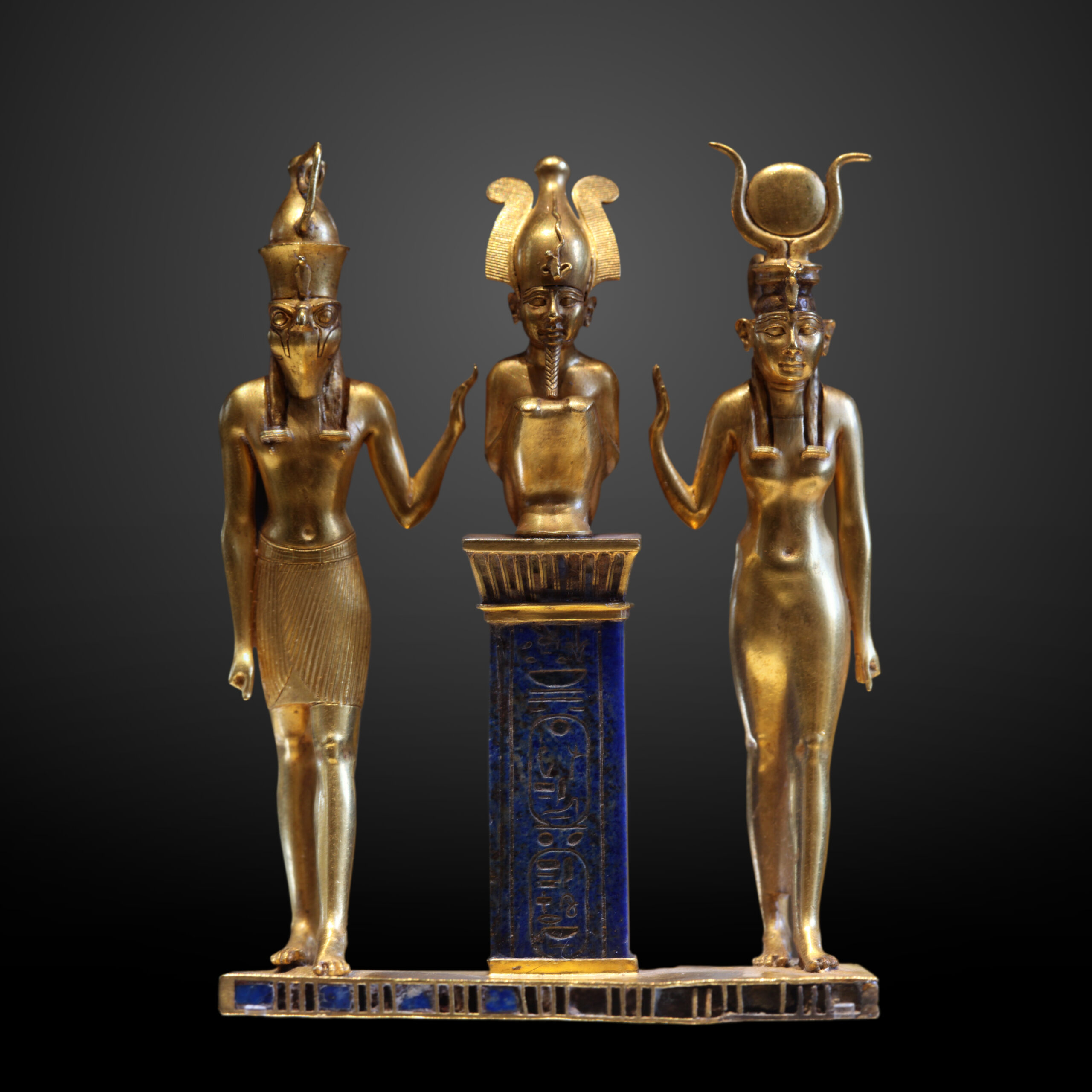
Osiris was one of the principal and most revered Egyptian gods. He was a god of fertility and played a crucial role in the transition of the soul to the afterlife. His importance is reflected in artistic depictions, where he appears as a mummy holding a scepter and flail—symbols of pharaonic authority. The green color of his body symbolizes evergreen vegetation, emphasizing his immortality.
His sister and wife Isis did not enjoy the same level of popularity until the Hellenistic period, but she was far from unimportant. She was the goddess of motherhood, magic, and healing. She is depicted with a solar disk and cow horns, and her symbols include the cobra and falcon wings. The cow horns were also associated with the complex goddess Hathor, who was the most important Egyptian goddess until the New Kingdom and likely the original protector of fertility. Hathor was connected to the solar cult and often depicted as a celestial cow. The symbolism of falcon wings becomes clearer later in the myth, referring to Isis’s search for Osiris’s dismembered body—similar to how a falcon searches for carrion. Despite these animal elements, Isis and Osiris were depicted in human form, which was rare in Egyptian religion, where gods typically had animal heads. This anthropomorphism made the myth more appealing to Greeks and Romans, whose gods were human in appearance.
Other key figures are the spouses Set and Nephthys, who were also siblings of Isis and Osiris. All four were children of the sky goddess Nut and the earth god Geb—an unusual reversal of the common ancient pattern where the sky is male and the earth female. It is also uncommon for a male deity like Osiris to be associated with fertility.
The Content of the Myth
Since no complete Egyptian version survives, we rely on Plutarch’s interpretation. He uses the name “Typhon” for Set, equating him with the Greek monster Typhon to emphasize his role as a force of evil.
According to Plutarch, Osiris was a just king of Egypt who worked to eliminate poverty and immoral behavior. He guided people toward proper worship, lawfulness, and agriculture. He was beloved and ruled without force, sometimes using music and song—hence the Greek comparison to Dionysus. Isis helped maintain order, while Set did not openly oppose the system.
One day, while Osiris was away, Set conspired with the Ethiopian queen Aso and 72 accomplices. He secretly measured Osiris and crafted a beautiful chest to fit him exactly. At a banquet, Set offered the chest to whoever could fit inside it. When Osiris lay in it, the conspirators quickly sealed it with molten lead and threw it into a branch of the Nile, later called “cursed.”
Isis learned of the event, cut off her hair, and donned mourning clothes. She set out on a long journey, asking everyone about the chest. Children guided her to the river branch, leading Egyptians to believe children had prophetic abilities. During her search, she also discovered Osiris had fathered a son, Anubis, with Nephthys. After Nephthys abandoned the child out of fear of Set, Isis found and raised him.
Eventually, Isis learned the chest had washed ashore in Byblos, where it became encased in a tamarisk tree used as a palace pillar. Disguised, Isis befriended the queen and became nurse to her child. She attempted to grant the child immortality but was discovered. Revealing her divine form, she retrieved the chest and returned to Egypt.
Later, Set found the body, cut it into pieces, and scattered them across Egypt. Isis traveled in a papyrus boat, collecting the parts and building tombs where she found them. After reassembling Osiris and briefly reviving him, he fathered Horus. Osiris then became ruler of the underworld, while Horus prepared to avenge him.
Horus eventually defeated Set in battle. Isis spared Set’s life at one point, but he later challenged Horus’s legitimacy. The gods confirmed Horus as rightful heir, and Set was ultimately defeated.
The Cult of Isis and Osiris
In Egyptian belief, Horus represented the living pharaoh, while the deceased pharaoh became Osiris. The central theme of the myth—death followed by rebirth—was essential to Osiris’s worship. His main cult center was Abydos.
Isis’s cult grew significantly later, especially during the 30th Dynasty and into the Hellenistic and Roman periods. Greeks adopted and transformed her image, while Romans introduced Serapis to replace Osiris in the divine triad. Emperors like Augustus and Hadrian supported her cult, and temples dedicated to her appeared throughout the Roman world, including Pompeii.
Conclusion
The myth of Isis and Osiris had an immeasurable impact on Egyptian society. Its focus on fertility and the promise of life after death made it deeply meaningful. The association of the pharaoh with both Horus (in life) and Osiris (after death) highlights its importance.
Thanks to its human-like divine figures, the myth also appealed to Greek writers like Plutarch, whose account preserved the full story. While Osiris’s unusual appearance may have seemed strange to Romans, leading to the creation of Serapis, the cult of Isis continued to flourish and remained highly influential throughout antiquity.