By Ivo Kokić
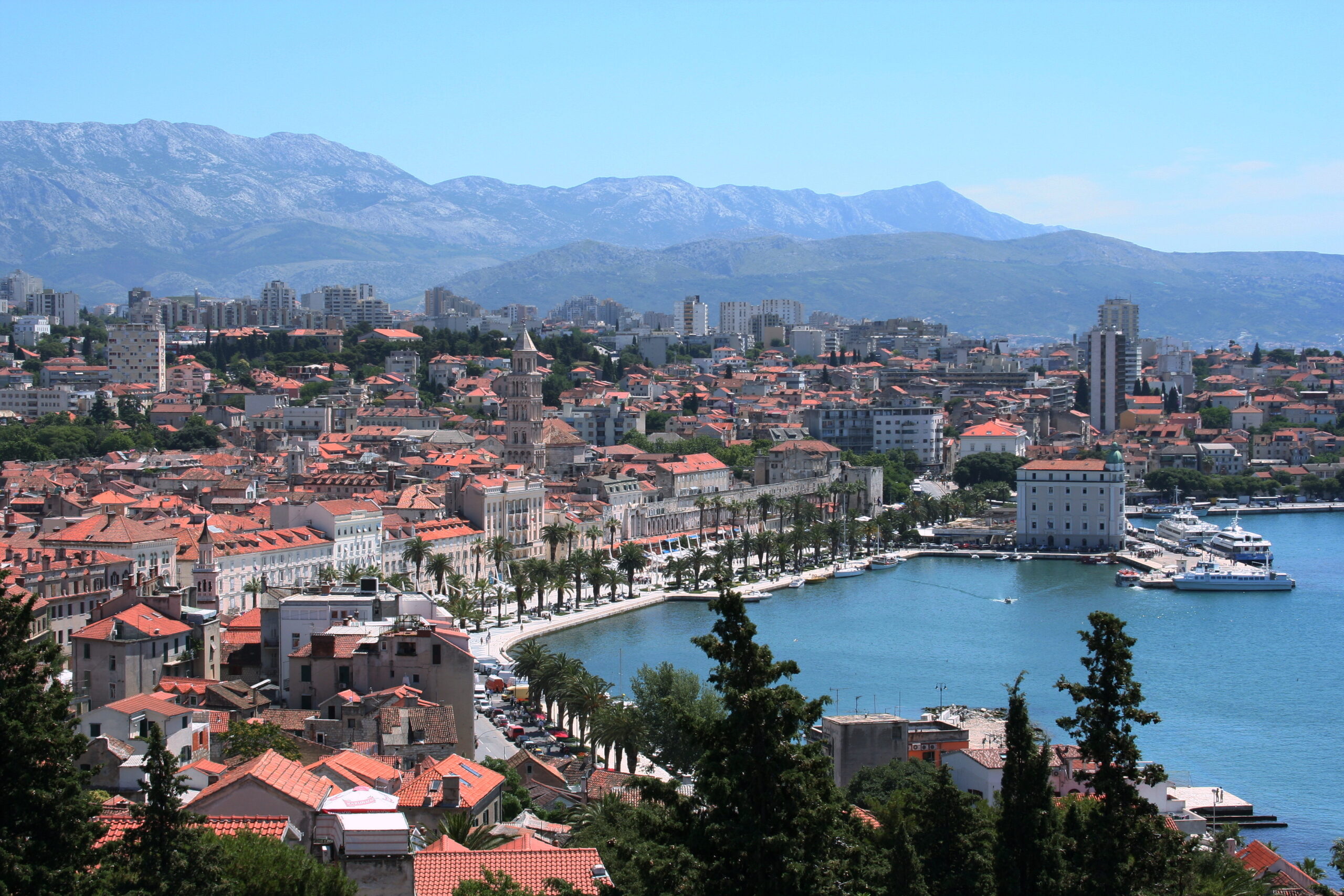
Every government considers the naming of public spaces and buildings important in order to ensure that certain names circulate as widely as possible among the population. It is also important which monuments are visible while walking through a city, as this demonstrates to whom or to what importance is being given. Therefore, this topic is highly relevant from a scholarly perspective, especially considering that it concerns Split, the second-largest Croatian city. This article analyzes the condition of cultural landmarks in Split from the end of the Second World War to the present day.
Architexture can be described as the totality of urban architecture and text. The term derives from the Anglophone expression “city-text.” It forms collective identity in the same way as coats of arms, flags, books, and similar symbols do. Moreover, architexture is harder to “avoid,” because one may ignore the promotion of a book, but must mention a particular person if arranging to meet at a square named in that person’s honor.
This issue remains highly relevant today. On September 19, 2019, the European Parliament adopted the Resolution on the Importance of European Remembrance for the Future of Europe (2019/2819(RSP)). The resolution is based on condemning totalitarian systems and holds that remembering their victims and raising awareness about the legacy of those crimes is essential for the unity of Europe. It recalls that Nazi, communist, and other totalitarian regimes committed genocide, deportations, human rights violations, and other crimes against humanity on an unprecedented scale. All EU member states were called upon to clearly investigate crimes committed by totalitarian regimes. Concern was also expressed regarding the use of their symbols in public spaces and for commercial purposes. Particularly important for this article is the note that some European countries still have monuments in public spaces that glorify such regimes.
The Architexture of Split
After the end of the Second World War, Split’s Riva waterfront was renamed the Promenade of Marshal Tito. This was intended to demonstrate his importance, since the city’s most significant promenade bore his name. Following the breakup of Yugoslavia, the Riva was renamed the Croatian National Revival Waterfront. This further illustrates the importance attached to naming major public spaces.
Not every attempt to reshape the city’s architexture was realized in practice. In May 1980, immediately after Tito’s death, the leadership of NK Hajduk proposed to the Republican Conference of the Socialist Alliance of Working People of Croatia (SSRNH) that the Poljud stadium be renamed Stadium Tito. However, this idea was never implemented.
Although such naming practices are not insignificant, this article primarily focuses on visually noticeable elements of architexture. These shape collective memory, that is, the recollections of a given community. Therefore, their construction (or destruction) represents the creation of collective memory, or directed work upon memory itself. This is important so that a community may renew its perception of the past within its collective consciousness and preserve certain historical contents.
At the end of the 19th century, the Monumental Fountain, nearly ten meters high, was built in Split. It was richly decorated with various ornaments and contained twenty-one sculptures arranged across six levels. Near the top of the fountain stood the fasces, the lictorial symbol carried by attendants of senior Roman magistrates and priests as a symbol of the power of ancient Rome. Naturally, this was almost half a century before the rise of Fascism in Italy. Furthermore, Fascism took its name from this symbol, not the other way around. The fasces, a bundle of rods with an axe dating back to ancient Rome, symbolized the strength of unity, and in the 19th century it was intended to symbolize the unity of Split’s citizens. Particularly interesting is the fact that the current emblem of the French Republic still contains the fasces, demonstrating that it can continue to carry a broad range of meanings. However, during the Second World War, the symbol came to represent Fascist occupation to the people of Split. In March 1944, before Split was finally liberated, someone smashed the fasces on the fountain. Thus, Split entered liberation and the establishment of the Federal People’s Republic of Yugoslavia without the controversial symbol remaining on the fountain. Nevertheless, on May 30, 1947, the fountain was completely demolished because it reminded authorities of the pro-Italian mayor Antonio Bajamonti, during whose administration it had been built. To this day, the Monumental Fountain has never been restored in its original form, and a simple fountain without sculptural content now occupies its former location.
The next structure targeted was the Split Lazaretto, whose construction took place during the 16th and 17th centuries. This lazaretto represented one of the most organized and beautiful buildings of its kind. Many were as impressed by it as by Diocletian’s Palace itself. During the 19th century, and even more so during the Kingdom of Yugoslavia, its importance steadily declined, while Allied bombing of Split in 1943 caused additional damage. Nevertheless, the decisive moment came with the 1945 decision to demolish it. Even after this decision, it was not too late to restore the destroyed sections, and some structures still remained intact at the time. One part of the former lazaretto was removed in 1968 to make way for the Palace of Tourism. During the construction of this building, the foundations of the lazaretto’s central section were discovered. However, the new building was not designed in accordance with those foundations in a way that might at least have evoked the lazaretto’s original floor plan. Not only were its final remains destroyed, but research into the site was not even conducted scientifically.
Following the decline of the Benedictine Monastery of Saint Stephen beneath the Pines, built during the Middle Ages, an extra-urban cemetery was established at Sustipan in 1825. The cemetery contained around 400 masonry tombs and approximately 4,000 earth graves, while the total number of burials reached around 42,000. Split’s new cemetery, Lovrinac (originally called Tršćenica), opened in 1928. Nevertheless, some burials at Sustipan continued until 1943 despite official prohibition. During the Kingdom of Yugoslavia, there were proposals either to preserve or remove the cemetery. Over time, the cemetery became increasingly neglected. Finally, in 1959, a decision was made to remove Sustipan Cemetery entirely. The idea of preserving at least its central monumental section was rejected, and a park with only a small number of gravestones and archaeological artifacts was arranged on the site instead. Cultural landmarks and monuments were senselessly destroyed throughout 1959 and 1960. Clearly, there was insufficient awareness of the value represented by monuments created by Meštrović, Rendić, and others. Several monuments were saved only through personal interventions and transferred to the Museum of the City of Split and the Museum of Croatian Archaeological Monuments, from where they were later moved to the Archaeological Museum.
These three examples represent not only culturicide, as a crime against culture, but also memoricide, meaning the destruction of memory about the past through the annihilation of monuments that testify to the culture of a region in a particular era. However, in 2019 a commendable example of remembrance culture took place. On the entrance wall of the Sustipan Memorial Park, the words “you shine – you illuminate – you universe me” by poet Tonči Petrasov Marović were inscribed in golden letters. Marović had once been among the few who protested against the devastation of the cemetery. At the unveiling ceremony in July 2019, many citizens laid flowers in tribute not only to the poet but also to the cultural values that had been destroyed.
Not all changes to Split’s architexture were aimed at cultural devastation. In the iconic year 1968, the first artistic intervention in public space took place. Eight young Split artists painted the surface of the Peristyle within Diocletian’s Palace red. The performance shocked citizens and represented a true “1968-style” expression of rebellion. It remained remembered as the Red Peristyle.
Conclusion
It can be concluded that architexture played a significant role in shaping postwar Split. The naming and renaming of public spaces were certainly important to the city authorities. Likewise, independent artists found ways to make their voices heard and raise public awareness of their dissatisfaction.
Most importantly, it is necessary to emphasize the massive and unjustified devastation of cultural landmarks. Their destruction represents a tragedy and an immeasurable loss. Therefore, efforts must be made to preserve the culture of remembrance surrounding them. A commendable example is the memorial erected at Sustipan. Although the destroyed statues cannot be restored, history can at least be rescued from oblivion through artistic intervention. Furthermore, the Split Lazaretto deserves greater attention not only in historiography but also in broader public awareness.
Finally, the destruction of the Monumental Fountain represents a rare example of devastation that is still not too late to correct. Therefore, it should be restored and rebuilt in its original form.