By Matija Šerić
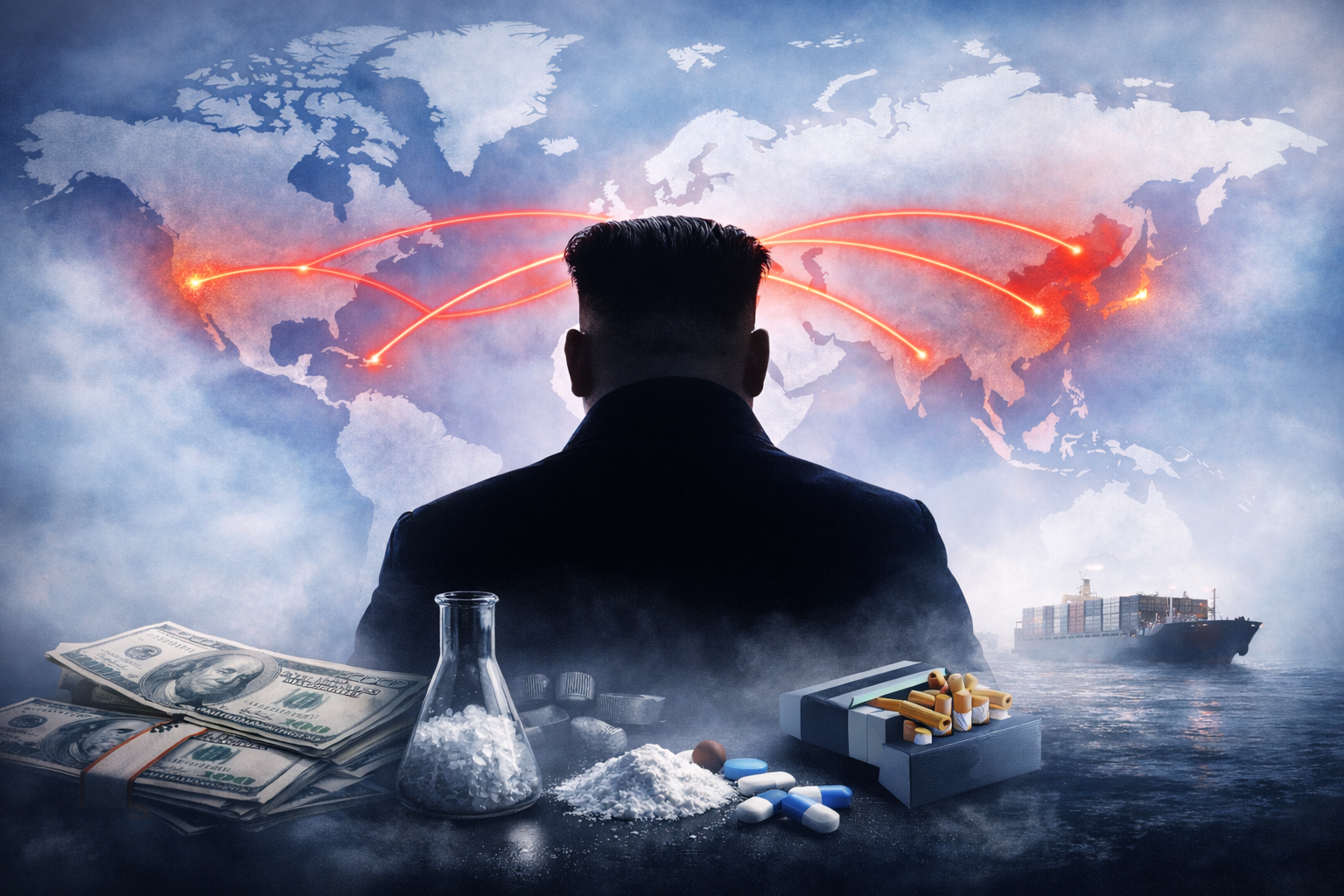
In North Korea’s illegal activities, drugs play a central role. In the “Hermit Kingdom,” absolutely all processes take place: cultivation, harvesting, production, processing, storage, sale, and transport of drugs. A 2008 U.S. Congress report found that “since 1976, North Korea has been involved in more than 50 confirmed incidents, including drug seizures in over 20 countries, including Bulgaria, Ethiopia, Germany, Singapore, Turkey, Venezuela, and Zambia, among others.”
While North Korea produced and trafficked various drugs, including cocaine, hashish, and hallucinogenic pills, historically it focused most on the production and distribution of opium and opium derivatives, such as heroin, and methamphetamines, better known as crystal meth.
Drugs – the center of illegal activity
Although in the early 1970s North Korea only distributed foreign drugs, it soon began cultivating its own, and North Korean heroin spread worldwide. All collective farms were required to reserve 25 hectares for poppy fields and opium cultivation. The socialist regime continued to invest in narcotics activities to offset losses from declining weapons sales revenue after the Iran-Iraq War ended in 1988.
The narcotics industry accelerated sharply during the mid-1990s famine, when heavy rains and prolonged droughts prompted the regime to focus on methamphetamine production, which does not depend on weather conditions. The enormous growth in drug demand in China, Japan, Russia, and Southeast Asia further encouraged North Korean authorities to take this step.
Millions in methamphetamine and opium revenue
In recent years, estimates suggest that the DPRK has the capacity to produce 50 tons of opium and 15 tons of methamphetamine annually. Although estimates vary, North Korea earns between $150 and $220 million annually from drug sales. Defectors often describe their homeland as a “narcostate in which all aspects of narcotics operations – from children working in opium fields to government methamphetamine factories and state-owned ships – are controlled by the Kim dynasty.”
Counterfeit banknotes
Two North Korean trade company directors were arrested in Macau in 1994 while attempting to deposit $250,000 (in counterfeit $100 bills) into a local bank. In 1996, a North Korean trade representative was expelled from Romania for exchanging $50,000 in fake dollars. That same year, another DPRK official was arrested in Ulaanbaatar for trying to deposit $100,000 on the black market. Two years later, a party official was arrested for attempting to exchange $30,000 for rubles.
Kattalio floods the world
These were the first public appearances of counterfeit U.S. dollars illegally printed in North Korea. Since the mid-1990s, fake U.S. dollars produced in North Korea appeared worldwide in cities such as Las Vegas, San Francisco, Manila, and Belgrade. These counterfeit dollars, known as “kattalio,” reportedly generate North Korea between $15 and over $100 million annually.
The infamous Factory 62
The fake North Korean dollars are of excellent quality and very difficult to detect. Their source is “Factory No. 62” in Pyongyang. They are printed on the same type of press used by the U.S. government. The machine was purchased from Japan, the paper comes from Hong Kong, and the ink from France. In August 2005, the FBI conducted secret operations codenamed “Royal Charm” and “Smoking Dragoon” targeting Chinese Triads. Many arrests occurred across the U.S., in Los Angeles, Chicago, Las Vegas, Philadelphia, and elsewhere. In addition to drugs, counterfeit medicines, and cigarettes, $4.5 million in high-quality North Korean counterfeit U.S. dollars were seized.
High-quality fake dollars
In October of the same year, under U.S. orders, prominent former Irish leftist leader Sean Garland was arrested in Belfast for distributing fake U.S. dollars produced in the DPRK across Europe. Estimates suggest that around $45 million in North Korean counterfeit U.S. dollars are in circulation. Numerous incidents of currency counterfeiting linked to the DPRK have occurred, with indications that even in the 1950s the Kim regime counterfeited South Korean currency.
Documentary about illicit activities of the Kim regime
Cigarettes and medicines
In the past decade, the DPRK has become known for high-quality counterfeit cigarettes and medicines it sells on the market. North Korean counterfeit cigarettes of global brands are noted for both quality and packaging. Several factories in North Korea produce counterfeit American and Japanese cigarettes.
Estimates suggest that the Kim regime earns between $80 and $160 million annually from counterfeit cigarettes, whose street market value can reach $720 million. Satellite images and footage from the Japanese Coast Guard show North Korean ships regularly transporting cigarettes in containers and handing them over to vessels under Thai, Cambodian, and Mongolian flags.
From Marlboro to Viagra
North Korean counterfeit cigarettes have appeared in thousands of locations worldwide, including remote areas such as Greece, Colombia, Belize, and the U.S. According to U.S. Justice Department information from 2006, a 40-foot container carrying $70,000 worth of counterfeit cigarettes, which were sold on the street market for $3–4 million, entered the U.S. every month.
In addition to fake Marlboro, North Koreans have specialized in counterfeit medicines, most notably tadalafil and sildenafil, better known as Viagra and Cialis, intended to treat erectile dysfunction in men. Like cigarettes, these counterfeit products are known for excellent packaging and very high chemical purity.
The state – patron of organized crime
North Korean counterfeit banknotes are known for top quality, and drugs like methamphetamine for their purity. Such high-quality production is possible only with state support, which provides security, working conditions, and resources available only from the government. Counterfeit banknotes, counterfeit pharmaceutical products, and cigarettes are produced in state-owned factories; drugs are grown on state farms and processed in state chemical laboratories. The Juche regime uses state-owned ships, embassies, and companies to facilitate criminal activities. The regime also employs intermediaries, uses front companies, and foreign entities to conceal its own involvement.