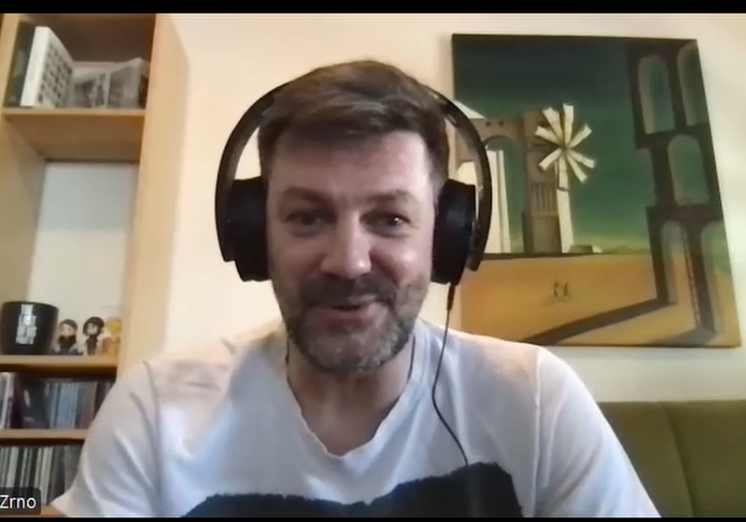
The time we live in is a time of brutal wars. From the Middle East and Africa, through Ukraine to Myanmar, war atrocities are unfolding that claim lives daily, destroy infrastructure, and cause unspeakable suffering. The only fortunate circumstance from a Croatian perspective is that the war for Croatian independence, the Homeland War, ended in 1995 and today we have the opportunity to live in peace. Peace, although not sufficient in itself for stability and prosperity, is a key prerequisite for both national and personal progress. In order to appreciate peace, we must look at our recent history. On the importance of the Homeland War in Croatia and Bosnia and Herzegovina, we conducted an interview with Croatian historian and journalist specializing in the Homeland War, Borna Marinić.
In your opinion, what was the key battlefield of the Homeland War in 1991? Different authors interpret this differently. Most mention the eastern Slavonian battlefield with emphasis on Vukovar (the strongest JNA forces), while some point to the Karlovac battlefield due to the possibility of cutting Croatia in two. There is also the northern Dalmatian front where Croatia was cut off by land after the Maslenica Bridge was destroyed in November 1991, although not all strategic objectives of the JNA were achieved.
I have never looked at any battlefield as more important than the others. Since I am from Zagreb, it was natural for me to devote more attention to the battlefields closer to me—Western Slavonia and Banovina—which I would also highlight alongside those you mentioned. In Western Slavonia, some Serbian forces held positions near the Podravska highway, which became a vital communication line after the highway toward Lipovac and eastern Croatia was closed. Had that route been cut, or had Serbian forces reached the border with Hungary, the situation for eastern Croatia would have become extremely complex, while it would have been extremely favorable for strategists who envisioned their eastern border along the line from Virovitica southwards.
As for Banovina, Serbian forces there were closest to Zagreb, and if they had broken through the Kupa River line and linked up with numerous JNA forces in the wider area of the Croatian capital, it would have been checkmate and the sacrifice on other battlefields would have lost its significance. I hope this answer shows that the battlefields were highly dependent on one another and that none of them—not even the eastern Slavonian front—can be singled out as the decisive one.
What was the real number of members of the Croatian National Guard (ZNG), the future Croatian Army, during 1991 before Croatia received international recognition on January 15, 1992? How well equipped and trained were these units in reality?
It is impossible to determine the exact number of ZNG members with certainty. I am always surprised when I hear that someone who was part of the Croatian National Guard or the Croatian Army does not have the Homeland War Memorial Medal nor official veteran status. A few months ago, I recorded a podcast with Sofia Fruk, who arrived in Croatia from Australia in the autumn of 1991 where she had been born. An 18-year-old girl left security and comfort behind and replaced them with the hell of the front line as a member of the 1st A Brigade of the Croatian National Guard. She is one of those who are not even officially registered today as having served in the ZNG. What more can be said after such knowledge?
The development of Croatia’s armed forces must be viewed in three phases. The first phase was before, and the second phase after, the Battle of the Barracks, which proved to be one of the most important events of the Homeland War. Through it, Croatian forces finally managed to obtain significant weaponry while their opponent simultaneously lost access to it. Until then, Croatian forces relied on what the police had—since the police were the only force that could legally acquire weapons—and on what could be smuggled into the country illegally. That was enough only for basic defense.
The third phase began after Croatia’s international recognition when there was progress not only in logistics and equipment but also in training. From 1992 onward there was commando training in Žutica led by the Frankopans, as well as training in Radmanove Mlinice conducted by instructors known as “Argentinac Rodolfo” and “Nijemac Kurt.” In 1994 a non-commissioned officer training center was established in Šepurine. That cadre would prove crucial for achieving the goals realized during the final operations Bljesak and Oluja.
Can the war in Croatia and the war in Bosnia and Herzegovina be viewed as one single war that took place across two states? These wars were also in the service of creating Greater Serbia.
It is impossible to observe those two wars separately. Already in 1991, aggression against the Republic of Croatia was carried out from the territory of Bosnia and Herzegovina, and this continued throughout 1992 when Bosnia and Herzegovina was already an internationally recognized state. That fact alone leads to the conclusion that these two wars must be viewed as one large war for “Greater Serbia,” which ultimately suffered its final defeat in 1995 precisely in Bosnia and Herzegovina.
The end of the war in Bosnia and Herzegovina came with the Dayton Agreement, which effectively also determined the end of the war in Croatia and enabled the peaceful reintegration of the Croatian Danube region. On a micro level, this thesis can be further elaborated through battles for cities such as Livno, Mostar, and many other parts of Bosnia and Herzegovina. One can learn the most about this through the monograph Death of the Armored Brigade by Davor Marijan.
Was the defeat of Croatian forces in Bosanska Posavina at the end of 1992 the result of the military inferiority of the HVO and smaller Croatian Army units compared to Serbian forces that sought to establish the so-called Serbian corridor at any cost, or was something else at play (a political agreement)?
The fact that the defensive line in Bosanska Posavina suddenly collapsed in chaos and disarray under circumstances unlike those on any other battlefield raises questions that still have no clear answers. The historian who most seriously dealt with this difficult topic is Davor Marijan, and as a historian I can only stand behind his theses: Serbian forces were better armed, better organized, and six times more numerous; Bosanska Posavina was of key strategic importance to them (connecting the Federal Republic of Yugoslavia with Republika Srpska and the Republic of Serbian Krajina); HVO formations would often disintegrate once they lost control of their home municipalities; and the government of Bosnia and Herzegovina in Sarajevo largely ignored that front.
Was the Croatian Army capable of liberating large parts of Croatia already in 1992 if the international community had given the green light? At that time UNPROFOR was present in the territory of the so-called Krajina, and if Croatia had launched larger military operations it might have been accused of escalating the war and possibly faced UN sanctions. Did the Croatian Army already have enough experience and resources for such operations, or would that have been premature and too risky?
Already in 1991 Croatia liberated large parts of its territory and demonstrated that it was capable not only of defending itself but also of launching counteroffensives. Military operations in Western Slavonia, had they continued two to three weeks longer after January 3, 1992—when the peace plan began to be implemented—would almost certainly have resulted in the liberation of all occupied territory in that area.
In that case, the operation Bljesak would not have been necessary. However, the fact that Croatia liberated that territory in just two to three days during Bljesak instead of two to three weeks clearly shows how much progress the Croatian Army had made, while on the other side the JNA had collapsed and the forces of the Army of the Republic of Serbian Krajina that replaced it could not keep up with that development.
Are young people today sufficiently familiar with the topic of the Homeland War? We know that young people are often more interested in TikTok and trivial content. In your opinion, what should be done to present the Homeland War better to younger generations?
I believe young people are very interested in the Homeland War and that this interest is actually growing. More and more of them contact me through social media, where I try to satisfy their curiosity. Their questions are constructive and their way of thinking about recent Croatian history is far more mature than many people assume.
Of course, I may be subjective and do not know how large that sample is compared to the entire young population in Croatia. Everything I do is primarily for those generations who did not experience the war and do not know how valuable peace is. Today we take it for granted, and young people sometimes behave as if Croatia had been obtained “at the negotiating table.”
My goal through content on YouTube—such as the podcast Gdje si bio ’91?, the television program Veterani mira on HRT, the radio show Domoljubne minute on Hrvatski katolički radio, and through social media—is to make them aware that great sacrifices were made for this peace and for this state. Not to burden them with it, but so that examples from that period of history may serve as inspiration and encouragement for them to build society in peace, remembering the circumstances in which its foundations were laid.
Interview conducted by Matija Šerić.