By Ivan Toth
The first Allied action on D-Day itself was Operation Deadstick, which involved a glider assault at around 00:16 on Pegasus Bridge over the Caen Canal and another bridge over the River Orne, about 800 meters to the east. Both bridges were quickly secured with minimal casualties by members of the 5th Parachute Brigade and the 7th Parachute Battalion. Five bridges over the River Dives were destroyed with little effort by the 3rd Parachute Brigade.
At the same time, troops assigned to deploy radar beacons and lights for incoming paratroopers (scheduled for 00:50 to secure the landing zone north of Ranville) were blown off course by strong winds and set up navigation aids further east than planned. Many paratroopers were also scattered by the wind, landing far from their designated drop zones, with some spending hours or even days searching for their units.
Battle of Merville
British Major General Richard Gale arrived in the third wave of gliders around 3:30, bringing anti-tank guns, jeeps, and additional troops to help secure the area against German counterattacks, initially carried out only by nearby units.
Around 2:00, the commander of the German 716th Infantry Division ordered Feuchtinger to launch a counterattack with the 21st Panzer Division. However, as it was part of the armored reserve, Feuchtinger needed approval from the OKW before proceeding. This order did not arrive until shortly before 9:00. In the meantime, he formed a battle group on his own initiative, including tanks, to engage British forces east of the Orne.
Only 160 of the 600 men from the 8th Battalion assigned to neutralize the artillery at Merville reached the assembly point. Lieutenant Colonel Terence Otway decided to proceed regardless, as the guns had to be disabled by 6:00 to prevent bombardment of the invasion fleet and Sword Beach.
At Merville, Allied forces disabled the German guns using plastic explosives, suffering 75 casualties. Instead of 150 mm guns, they found 75 mm artillery pieces. Otway’s remaining forces withdrew with assistance from the 1st Canadian Parachute Battalion. This action completed the final objective of the British 6th Airborne Division. Reinforcements arrived around 12:00 from commandos of the 1st Special Service Brigade who had landed on Sword Beach, and later at 21:00 via gliders in Operation Mallard.
Utah Beach
Utah Beach was defended by two battalions of the German 919th Regiment. The 8th Infantry Regiment of the 4th Infantry Division was scheduled to land at 6:30. Strong currents pushed their landing craft about 1.8 km east of the intended location.
This turned out to be advantageous, as there was only one defensive strongpoint instead of two, and Allied bombers had struck German positions more accurately than planned. The currents also cleared many underwater obstacles. Brigadier General Theodore Roosevelt Jr., the highest-ranking officer on the beach, ordered all subsequent landings redirected to this location.
The initial infantry assault was followed by 28 DD tanks and several waves of engineers clearing obstacles and mines. Breaches were made in barriers to allow faster movement inland. Combat units began advancing around 9:00, moving through flooded fields and canals while engaging German defenders equipped with anti-tank weapons and rifles.
By noon, the main strongpoint and surrounding area had been secured. Although not all objectives were achieved due to the shifted landing, about 21,000 troops landed with only 197 casualties.
Pointe du Hoc
This area between Utah and Omaha was assigned to the 2nd Ranger Battalion, about 200 men under Lieutenant Colonel James Rudder. Their mission was to scale 30-meter cliffs and destroy artillery on top.
The cliffs were defended by the German 352nd Infantry Division and French collaborators. Supported by naval gunfire from destroyers Satterlee and Talybont, the Rangers climbed the cliffs, only to find the guns had been relocated.
Surrounded by enemy forces, they faced counterattacks from the German 914th Regiment. Many were captured, and by the end of the day, only 90 men remained combat-ready. Reinforcements did not arrive until the next day.
With ammunition depleted, Rangers used captured German weapons, leading to confusion and friendly fire incidents. By the end of the battle, they suffered 135 casualties; German losses were 50 killed and 40 captured.
Omaha Beach
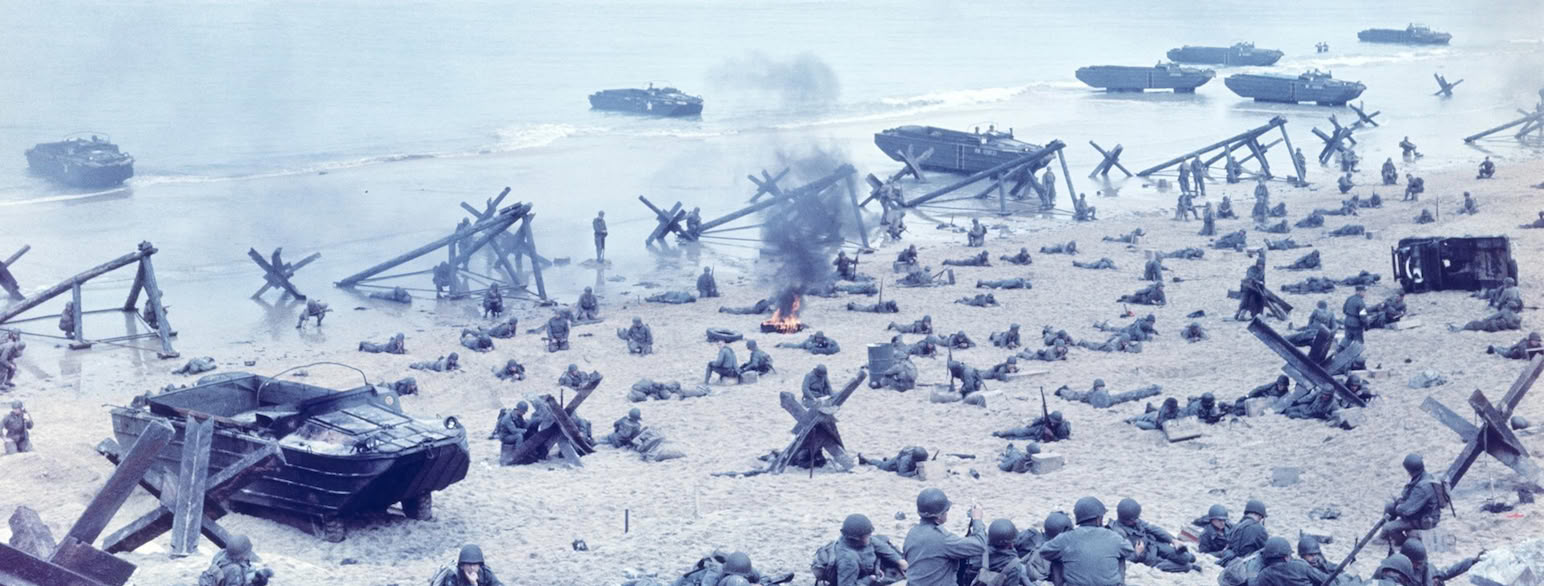
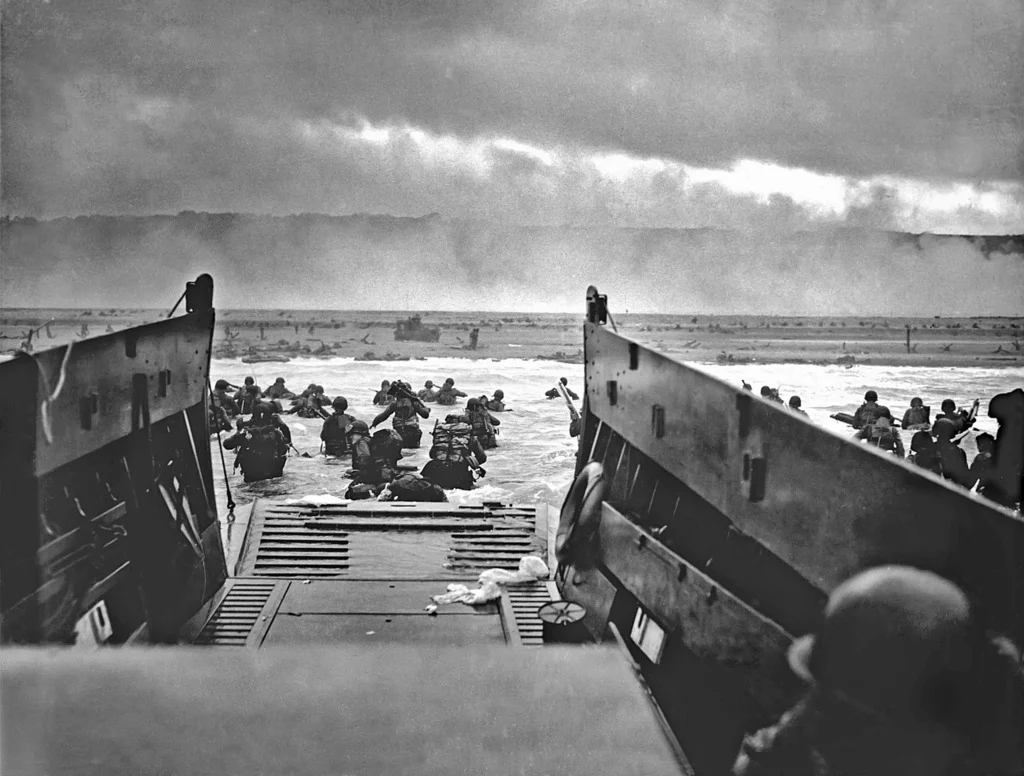
Omaha was the most heavily fortified beach. The U.S. 1st and 29th Infantry Divisions faced the German 352nd Infantry Division. Strong currents disrupted landings, and bombing delays left many defenses intact.
Troops had to wade 50–100 meters under heavy fire. Of the DD tanks launched offshore, 27 sank and 33 crew members died. Some disabled tanks provided temporary cover before being swept away by the tide.
Approximately 2,000 American soldiers were killed. Progress inland was slow, limited to narrow, heavily defended exits. By late morning, only about 600 troops had reached higher ground.
Naval destroyers moved closer at 8:30 to provide direct fire support, enabling continued landings. By noon, artillery fire weakened German defenses, allowing Americans to clear sections of the beach. Objectives at Omaha were fully secured only after three days. The unexpectedly strong resistance of the experienced German 352nd Division was the main cause of heavy casualties.
Gold Beach
Landings at Gold began at 7:25 due to tidal differences. Strong winds complicated the approach, and DD tanks were deployed closer to shore.
Three of four guns at Longues-sur-Mer were disabled by naval fire around 6:20. The fourth continued firing until the garrison surrendered on June 7. Air strikes failed to neutralize defenses at Le Hamel, where guns continued firing until 16:00, when a specialized armored vehicle destroyed them.
Another strongpoint at La Rivière was neutralized by 7:30. Infantry cleared fortified coastal houses and advanced inland. Commandos captured Port-en-Bessin the next day, while Arromanches was taken and contact established with Canadian forces at Juno.
Bayeux was not captured on the first day due to strong German resistance. Allied casualties at Gold are estimated at around 1,000.
Juno Beach
Landings at Juno were delayed by rough seas. Many soldiers advancing ahead of armored vehicles were killed or crushed during the landing. Bombardment largely missed German defenses.
Fighting in towns like Courseulles-sur-Mer, Saint-Aubin-sur-Mer, and Bernières-sur-Mer was intense, with house-to-house combat. Units advancing inland encountered fortified roadblocks and had to flank them.
Elements of the 9th Canadian Infantry Brigade reached the Carpiquet airfield but had to dig in due to lack of ammunition. The airfield was captured only after a month of heavy fighting.
By nightfall, Juno and Gold beaches formed a continuous front about 19 km wide and 7 km deep. Allied casualties at Juno were approximately 961.
Sword Beach
At Sword, 21 of 25 DD tanks successfully landed in the first wave, supporting infantry landings at 7:30. The beach was heavily mined and obstructed, and rising sea levels caused congestion.
Commandos advanced through Ouistreham to attack German positions from the rear. Strongpoints such as Riva Bella and Hillman were heavily defended, with Hillman captured only around 20:15.
French forces under Philippe Kieffer played a key role in clearing fortified positions.
The 2nd Battalion, King’s Shropshire Light Infantry advanced toward Caen but had to withdraw due to lack of armored support.
At 16:00, the 21st Panzer Division launched a counterattack between Sword and Juno, nearly reaching the coast before being repelled by the British 3rd Division.
Allied casualties at Sword are estimated at around 1,000.