By Ivan Toth
Forces of the Wehrmacht and the Allies
The Allies had over 180,000 troops, along with numerous armored vehicles, aircraft, and naval forces at their disposal. The invasion of Normandy involved the U.S. First and Third Armies, seven armored divisions, two airborne divisions, and 14 infantry divisions. Air support included the U.S. Ninth Tactical Air Force, the U.S. Eighth Air Force, and the RAF’s Second Tactical Air Force. The British 21st Army Group consisted of the British Second Army, which had four armored divisions, the 6th Airborne Division, and eight infantry divisions. The British formation also included two Canadian infantry divisions, one Canadian armored division, and one Polish armored division.
Nazi Germany had five divisions stationed in France and nearby countries, with another 18 divisions in Denmark and Norway. Fifteen divisions were still being formed in Germany. Heavy losses during the war, especially on the Eastern Front, meant Germany no longer had a sufficient pool of young and capable recruits. Many Wehrmacht soldiers stationed in Normandy were Ostlegionen (Eastern Legions) – conscripts or volunteers from Russia, Mongolia, and other regions. They were mostly equipped with captured and outdated gear and lacked motorized transport.
Rommel’s Reliance on Coastal Defense
Rommel believed that the best chance to stop an invasion was directly on the coast. He did not trust static defense alone. He knew the Allies could only be repelled by attacking them head-on and destroying them. He advocated deploying as many divisions as possible—especially armored units—close to the shoreline, so they could quickly counterattack and push the invaders back into the sea. He argued that any delay would allow the Allies to build up overwhelming strength and exploit their numerical and air superiority. “The war will be won or lost on the beaches,” he said, adding, “the first 24 hours after the invasion will be decisive.”
Gerd von Rundstedt and other commanders opposed this view, believing the invasion could not be stopped at the coast.
Other German Generals Favored Conventional Doctrine
Gerd von Rundstedt, commander of all forces in the West, along with Panzer leaders such as Hausser, Dietrich, and von Schweppenburg, supported a conventional doctrine: keeping Panzer formations centrally located around Paris and Rouen, to be deployed only after the main Allied landing had been confirmed. Heinz Guderian, Inspector General of Armored Troops and a key architect of German armored warfare doctrine, strongly disagreed with Rommel. Rommel’s coastal deployment contradicted Guderian’s core principle—concentration of armored forces into a unified striking force. Rundstedt also noted that, as seen in the Italian campaign, tanks positioned near the coast could easily be destroyed by naval artillery.
Rommel, however, argued that Allied air superiority would make any large-scale tank movement impossible once the invasion began.
Hitler’s Compromise Decision
Hitler ultimately chose a compromise: three Panzer divisions remained under Rundstedt’s command, while Rommel was given operational control over three reserve divisions. Hitler personally retained control over four divisions as strategic reserves, which could not be deployed without his direct order. This proved to be a critical mistake, as it prevented a rapid counterattack.
German commanders agreed on one thing: they expected the invasion at Pas-de-Calais, between the Somme and Dunkirk—the shortest route to the Ruhr industrial region. Consequently, of the 58 divisions in France, Belgium, and the Netherlands, 25 were positioned north of the Seine, and only 17 between the Seine and the Loire.
The Atlantic Wall
Following raids on Saint-Nazaire and Dieppe in 1942, Hitler ordered the construction of the Atlantic Wall—from Spain to Norway—to defend against an Allied invasion. Over six months, half a million workers from Organization Todt built bunkers, fortifications, and artillery positions. Millions of mines and anti-tank obstacles were laid along the coast. The plan called for 15,000 defensive positions manned by 300,000 troops, but shortages of materials and manpower meant many were never completed.
Pas-de-Calais was the most heavily fortified area. In Normandy, the strongest defenses were around ports like Cherbourg and Saint-Malo.
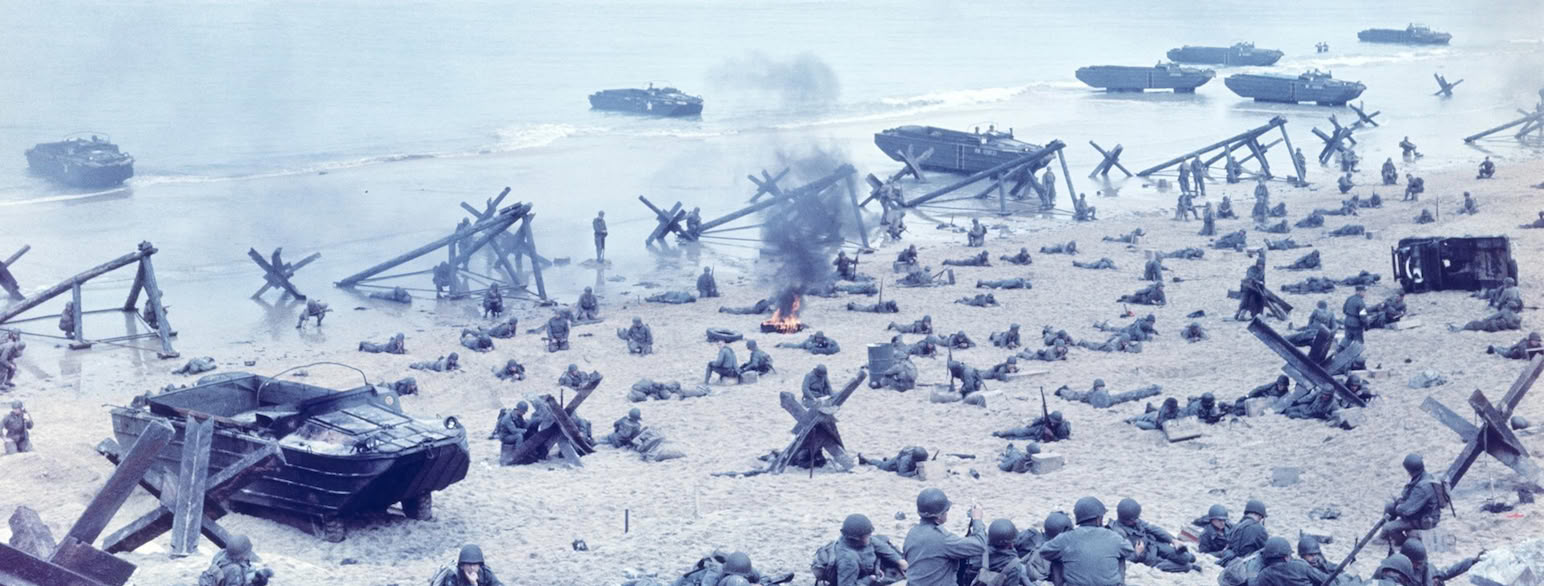
Rommel oversaw further construction along the expected invasion front and commanded Army Group B, which included the 7th and 15th Armies. He ordered extensive coastal defenses: wooden stakes, metal obstacles, mines, and anti-tank barriers, many placed at tidal lines to hinder landings. Mines were often linked to increase their effectiveness. Allied air superiority severely weakened the Luftwaffe—Germany had only 815 aircraft over Normandy compared to the Allies’ 9,453—leaving Rommel without effective air support.
Coordination with the French Resistance
Through the Free French forces in London and the British Special Operations Executive, the Allies coordinated sabotage operations with the French Resistance. Four major plans were executed:
- Plan Vert: sabotage of railways
- Plan Bleu: destruction of power facilities
- Plan Tortue: delaying German reinforcements
- Plan Violet: cutting communication lines
Resistance fighters received coded messages via literary quotes and disguised phrases. German intelligence detected increased radio activity on June 5 but largely ignored warnings. A 1965 report noted that sabotage destroyed 52 locomotives and disrupted rail lines in over 500 locations, isolating Normandy from the rest of France by June 7.
Allied Naval Operations
Naval operations were described by historian Correlli Barnett as a “masterpiece of planning never to be repeated.” Commanded by Admiral Sir Bertram Ramsay, the invasion fleet included 6,939 vessels from eight navies. These included 1,213 warships, 4,126 landing craft, and nearly 200,000 naval personnel.
The fleet was divided into western (supporting U.S. forces) and eastern (supporting British and Canadian forces) task forces. German naval opposition was limited but managed to sink the Norwegian destroyer HNoMS Svenner.
Bombardment of the Coast
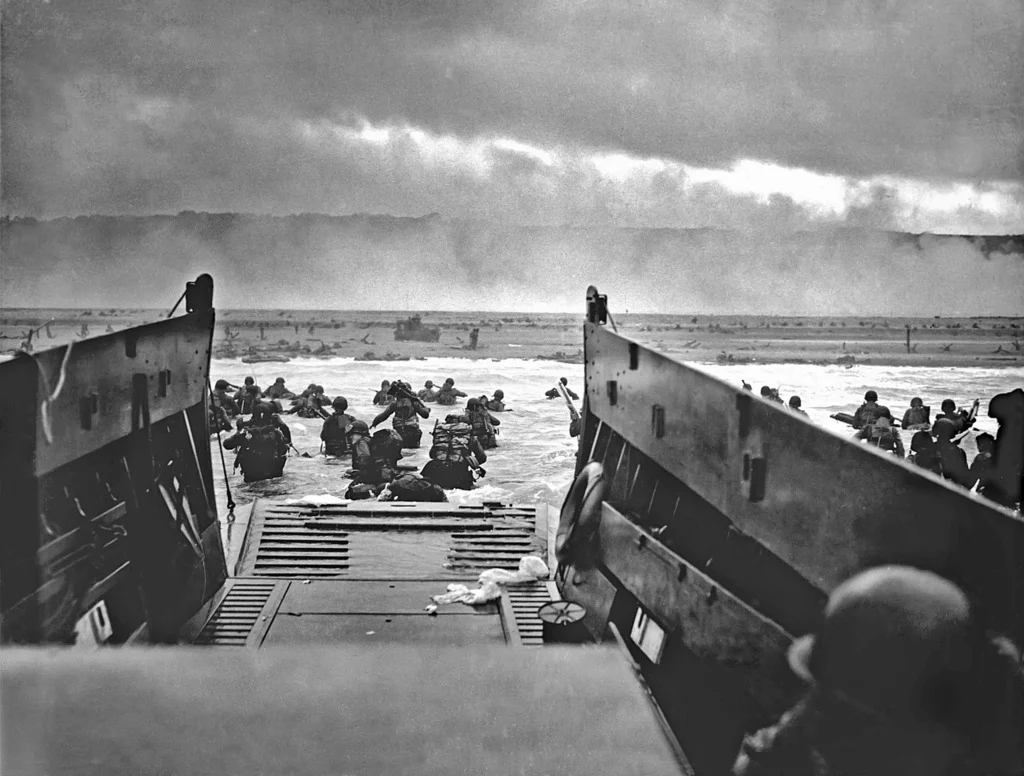
Bombing began around midnight with over 2,200 Allied aircraft. However, cloud cover reduced effectiveness, especially at Omaha Beach. Naval bombardment began before dawn, targeting coastal defenses. Amphibious Duplex Drive (DD) tanks were intended to support infantry but many sank, particularly at Omaha.
Planning of Airborne Operations
Airborne troops were tasked with securing key positions inland—bridges, roads, and flanks—to protect the beach landings and disrupt German counterattacks.
American Airborne Landings
The U.S. 82nd and 101st Airborne Divisions began landing shortly after midnight. Poor weather and navigation errors scattered many paratroopers. Despite heavy losses and disorganization, they secured key objectives such as Saint-Mère-Église, one of the first towns liberated.
Reinforcements arrived by gliders, though many landed off target. After 24 hours, only about one-third of airborne troops were under organized command. Despite the chaos, their wide dispersal confused German forces and reduced their response effectiveness.
German forces received reports of airborne landings around 1:20 a.m., but initial disbelief and destroyed radar installations delayed their reaction. The invasion fleet was only spotted around 2:00 a.m., far too late to mount an effective defense.