By Ivan Toth
The landing in Normandy, codenamed Operation Neptune, was an amphibious assault operation that began on Tuesday, June 6, 1944 (also known as D-Day). It was part of the broader Allied invasion plan within Operation Overlord, which aimed to liberate Western Europe from Nazi Germany during World War II. As the largest seaborne amphibious invasion in history, the operation sought to free northwestern Europe from Nazi control and significantly contributed to the Allied victory on the Western Front.
Introduction
Planning for the operation began as early as 1943. In the months leading up to the invasion, the Allies carried out extensive deception operations under the codename Operation Bodyguard, aimed at misleading the Germans about the actual date and location of the landing. Weather conditions on the day of the invasion were far from ideal, but there was no alternative, as postponement would have meant a delay of two weeks due to the need to align lunar phases, tides, and other environmental factors—leaving only a few suitable days each month for such a large-scale operation.
Adolf Hitler appointed Field Marshal Erwin Rommel to command German forces and oversee the fortification of the Atlantic Wall in anticipation of an Allied invasion.
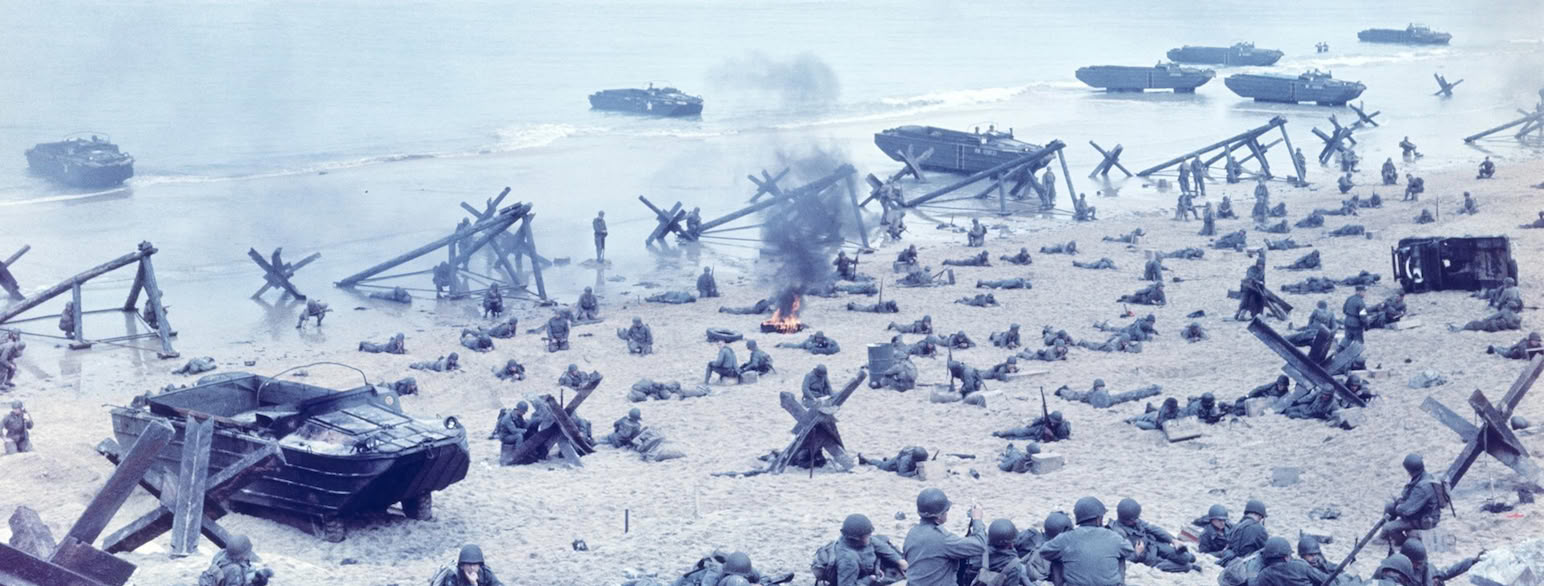
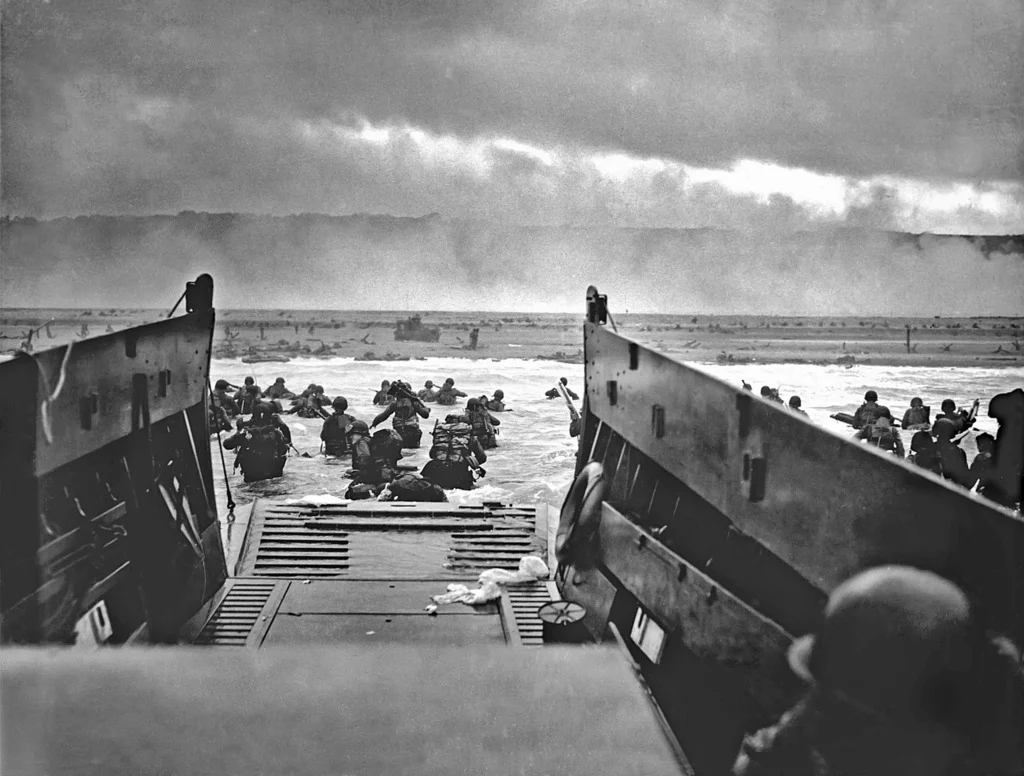
The amphibious assault was preceded by intense bombardment from Allied air forces and naval units, as well as an airborne assault involving 24,000 American, British, and Canadian troops who landed behind enemy lines shortly after midnight. Allied troops and armored vehicles began landing on the French coast around 6:30 a.m. The Allies divided the Normandy coastline—stretching roughly 80 kilometers—into five sectors: Utah, Omaha, Gold, Juno, and Sword beaches.
Strong winds caused landing forces to drift eastward from their intended targets, particularly at Utah and Omaha. Soldiers landed under heavy machine-gun fire from fortified positions above the beaches, while the shores themselves were mined and covered with obstacles such as wooden stakes, metal barriers, and barbed wire, making it extremely difficult for the initial assault teams tasked with clearing the way.
The highest casualties occurred at Omaha Beach, which featured steep cliffs and elevated defensive positions. In contrast, at Juno, Gold, and Sword beaches, several fortified towns were cleared through house-to-house fighting, and two large German guns at Gold Beach were neutralized.
The Allies failed to achieve most of their Day One objectives—towns such as Carentan, St. Lô, and Bayeux remained under German control, while Caen, a primary objective, was not captured until July 21. Only Juno and Gold beaches were linked on the first day, and all five were connected by June 12. Nevertheless, the operation gained momentum as Allied forces advanced in the following months. German casualties on D-Day are estimated between 4,000 and 9,000 soldiers, while the Allies suffered at least 10,000 casualties, including 4,414 confirmed dead.

Background of the Battle
Between May 27 and June 4, 1940, over 338,000 soldiers of the British Expeditionary Force and the French army were trapped along the northern coast of France and were rescued during the evacuation from Dunkirk.
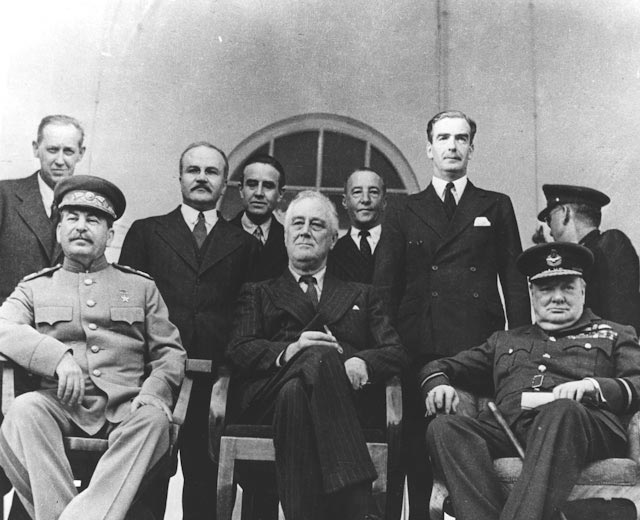
After Germany invaded the Soviet Union in June 1941, Soviet leader Joseph Stalin began pressuring the Allies to open a Western Front to relieve the Red Army. In May 1942, the Soviet Union and the United States issued a joint statement expressing full agreement on opening a second front in Europe. However, British Prime Minister Winston Churchill convinced U.S. President Franklin D. Roosevelt to delay the invasion, arguing that the Allies lacked sufficient military strength at the time.
Instead of returning immediately to France, the Allies launched campaigns in the Mediterranean, where British forces were already present. By mid-1943, the North African campaign had ended in Allied victory, followed by the invasion of Sicily in July 1943 and the broader Italian campaign by September. Meanwhile, the Soviets were on the offensive after their major victory at Stalingrad.
The decision to launch an invasion across the English Channel within the next year was made at the Trident Conference in Washington in May 1943. Planning was initially constrained by the availability of amphibious landing craft, many of which were deployed in the Mediterranean and Pacific.
At the Tehran Conference in November 1943, Churchill and Roosevelt promised Stalin that the long-awaited second front would open in May 1944. Four potential landing sites were considered: Brittany, the Cotentin Peninsula, Normandy, and Pas-de-Calais. Brittany and Cotentin were rejected due to the risk of German containment, while Pas-de-Calais—being the closest point to Britain—was expected to be heavily defended. Normandy, despite having fewer ports, offered better opportunities for expansion inland and eventual advances toward Paris and Germany.
To overcome the lack of ports, the Allies planned to construct artificial Mulberry harbors. Specialized tanks known as Hobart’s Funnies were also developed to deal with the unique challenges of the Normandy beaches.
The initial invasion date was set for May 1, 1944, with the plan approved at the Quebec Conference in August 1943. General Dwight D. Eisenhower was appointed Supreme Allied Commander, while General Bernard Montgomery commanded the 21st Army Group. They later expanded the plan to include five assault divisions and three airborne divisions to cover a wider area and accelerate the capture of Cherbourg.
Ultimately, 39 divisions took part in the Battle of Normandy: 22 American, 12 British, 3 Canadian, 1 Polish, and 1 French—totaling over one million troops under British command.
Deception Operations
Operation Overlord was the overall plan for the invasion of continental Europe, while Operation Neptune referred specifically to the amphibious assault phase.
To gain air superiority, the Allies launched Operation Pointblank, targeting German aircraft production, fuel supplies, and airfields. The broader deception strategy, Operation Bodyguard, aimed to mislead the Germans about the timing and location of the invasion.
A key component was Operation Fortitude, which included:
- Fortitude North – a fake campaign suggesting an invasion of Norway
- Fortitude South – the creation of a fictitious First U.S. Army Group under General George S. Patton, positioned in southeast England to simulate an attack on Pas-de-Calais
Fake radio traffic, dummy equipment, and misleading signals convinced the Germans that the main invasion would occur elsewhere. Even on the eve of the invasion, decoys such as dummy paratroopers and radar-deceiving tactics (Operations Taxable and Glimmer) reinforced the illusion of alternative landing sites.

Weather Conditions Before the Invasion
The invasion required precise environmental conditions, including specific lunar phases, tides, and daylight timing—limiting viable dates to only a few each month. A full moon was desirable to aid pilots, while the timing of tides was crucial for visibility of beach obstacles.
Originally scheduled for June 5, the invasion was postponed due to poor weather conditions, including strong winds and low cloud cover. RAF Group Captain James Stagg advised Eisenhower that conditions would improve on June 6.
After consulting with his commanders, Eisenhower made the critical decision to proceed on June 6. Had the invasion been delayed, a severe storm from June 19 to 22 would have made landings impossible.
Allied control of the Atlantic gave them superior weather intelligence compared to the Germans. As a result, many German commanders were away from their posts, and troops were less prepared. Rommel himself had returned to Germany for his wife’s birthday and to meet with Hitler, leaving German defenses less coordinated at the crucial moment.