By Matija Šerić
The comedy genre in film has produced countless beloved franchises over the past few decades, such as Home Alone, Police Academy, Ghostbusters, or American Pie. Each of these series has its unique appeal that captured the hearts of audiences worldwide. However, one comedic franchise that stands out in many ways is The Hangover. This trilogy has become a timeless classic that will never die, even though the first film hit theaters back in 2009. Seventeen years have passed since the first installment, and thirteen since the last, giving us plenty of time to revisit and analyze the reasons behind the success of this unmatched hit.
A True Story as Inspiration
American screenwriters and directors Scott Moore and Jon Lucas created a film that would make them famous. The duo based the story on a true story—not one they personally experienced, but one lived by producer Tripp Vinson. Vinson shared his story with Moore and Lucas through his fellow producer Chris Bender. Truth be told, the real events differ significantly from what unfolds on the screen.
One Night in Vegas, 2002: A Cinematic Gift
In 2002, Vinson was engaged to Adriana Alberghetti, a talent agent at Endeavor. Months before the wedding (not on the same weekend as in the movie), he and his friends decided to throw a bachelor party in Las Vegas. Thirty friends booked accommodations at the Hard Rock Hotel for a wild night of partying, including visits to restaurants, nightclubs, and strip clubs in the so-called “City of Sin.” During the evening, Vinson drank so much that he lost track of where he was, even losing track of his own party, and eventually passed out.
He woke up knowing nothing, in a strip club with an enormous bill he had to pay. While this was certainly a rough experience—and without the tiger, baby in a stroller, Mike Tyson, international criminals, police cars, or a lost tooth—it eventually became excellent inspiration for the film. It’s worth noting that Vinson was not involved in the production of the movie.
A Bachelor Party of Four Best Friends
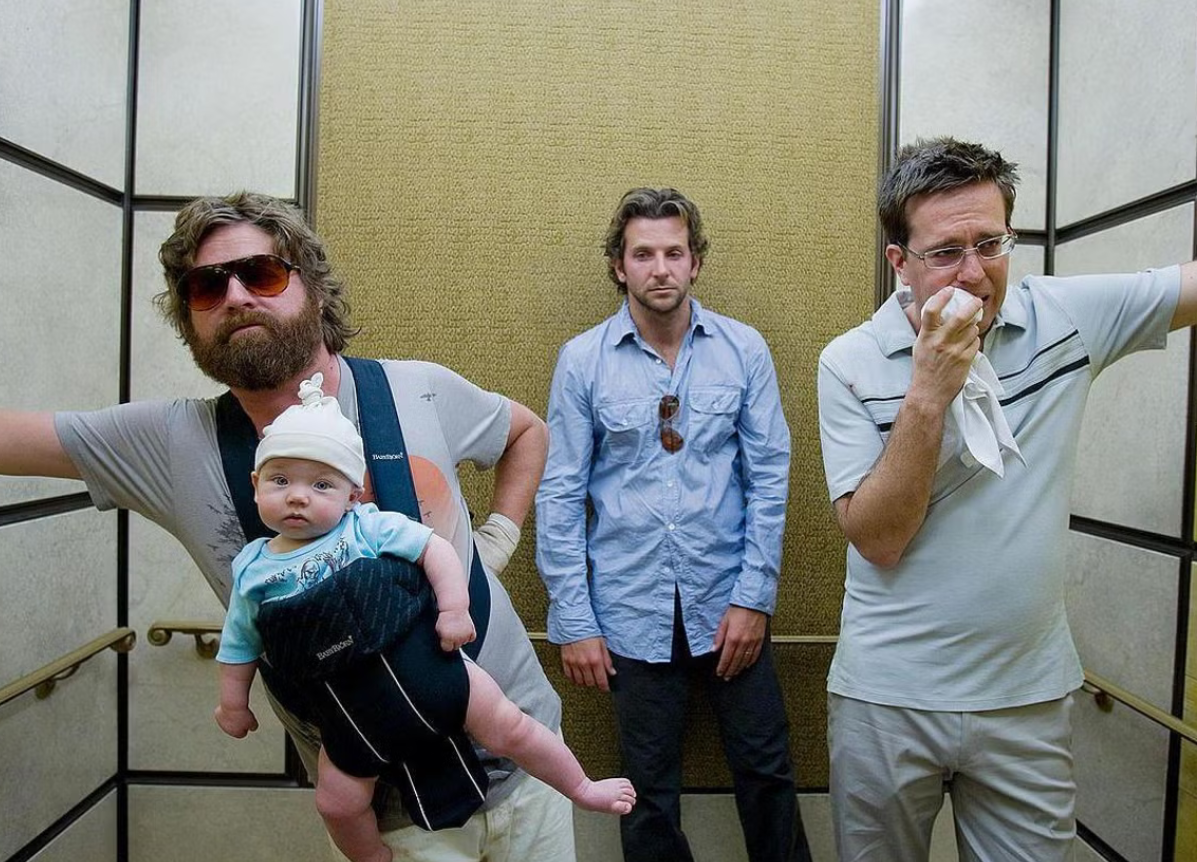
The plot of the first film—and the subsequent sequels—centers on the adventures of four friends: Phil (Bradley Cooper), Stu (Ed Helms), Alan (Zach Galifianakis), and Doug (Justin Bartha). Together, they form what’s called “The Wolfpack”—essentially a brotherhood of friends dedicated to partying. The main focus is the aforementioned bachelor party in Las Vegas, taking place two days before Doug’s wedding. While everything initially goes according to plan and the group is excited to enjoy Caesars Palace and other hotspots, the next morning no one remembers what happened. Doug is missing, and strange events unfold all around them. On top of that, they must rush to the wedding without the groom.
The Quartet in Wonderland
The film could almost have been called Quartet in Wonderland, as the friends’ bewilderment at the strange world around them during their hangover resembles Alice in Wonderland. Originally, the film was supposed to be titled What Happens in Vegas—a phrase repeated throughout the movie with the addition “stays in Vegas”—but this title was already used for another 2008 comedy. Throughout the film, we watch the three friends’ frantic attempts to piece together what happened the previous night, find their missing friend, and make it to the wedding.
One of the Best Films of the Year
The Hangover premiered in the spring of 2009 and achieved enormous commercial success that few could have predicted. With a budget of $35 million, it grossed nearly $470 million—making it the 10th highest-grossing film of the year, competing alongside Avatar, Harry Potter, and 2012. Beyond box office success, the film received critical acclaim and delighted audiences both in the U.S. and internationally. It became one of the most popular films of the year, winning the Golden Globe for Best Motion Picture – Musical or Comedy, among numerous other accolades. It also became the most successful R-rated comedy in the history of American cinemas.
A Captivating Story
There are several objective reasons for the film’s immense success. First is the story. The theme of a bachelor party in Las Vegas is so inherently appealing to audiences that even an average movie could have performed well. Stories about bachelor parties have always attracted viewers, and Las Vegas, as America’s entertainment capital, ignites the imagination of any audience.
However, this bachelor party subverts stereotypes by focusing not on the party itself, but on what happens the next day. We dive into a sea of emotions experienced by the characters, including the life crises of people in their thirties, when self-reflection and existential questions are common. Nevada’s cityscape provides the perfect backdrop for unchecked partying and chaos—a place where visitors go to escape everyday worries. Vegas + bachelor party = a winning combination.
Fantastic Cast Chemistry
The second reason for the film’s success is its outstanding cast. Cooper, Helms, and Galifianakis proved to be an incredibly compatible trio around whom everything else is built. The three actors developed a real friendship during filming, showcasing the quality of their on-screen chemistry. Each character embodies aspects of modern masculinity: determination and indecision, hidden anxiety, the pressure of expectations, and laid-back coolness. Supporting actors such as Mike Tyson and Ken Jeong (as gangster Leslie Chow), along with Jade—the soft-hearted stripper and single mother played by Heather Graham—add additional layers of intrigue.
Bradley Cooper: A Star is Born
The third reason for success is the unforgettable lead, Phil Wenneck, portrayed by Bradley Cooper. Cooper’s performance was flawless, earning him worldwide fame and serving as a springboard for his impressive Hollywood career. In the years following the first film, he starred in major hits like Limitless and American Sniper.
The question remains whether the franchise would have been as successful if someone else played Phil. While impossible to say definitively, Cooper’s charisma, verbal and nonverbal skills, confident presence, and ability to lead undoubtedly contributed the most to the trilogy’s triumph.
Unpredictable Twists
Most comedies—even great ones—suffer from predictability; audiences often know the ending will be happy. However, in The Hangover, the outcome is never clear. Unpredictable twists and sudden developments keep viewers glued to the screen. Every deviation from the main storyline has a purpose, and small details—like costumes—create a cohesive and well-structured narrative. This unpredictability is the fourth reason for the film’s success.
The Less Successful Sequel Duo
Fortunately for fans, The Hangover did not end with the first film. The Hangover Part II (2011) and Part III (2013) followed. The second installment is essentially a remake of the first, set in Bangkok, while the third focuses on Alan’s mental struggles, reintroduces familiar storylines, and brings unknown adversaries back into Las Vegas. Although both sequels were commercially successful (grossing $586 million and $362 million, respectively), audience opinions were divided. The second film was largely derivative, whereas the third offered more creative storytelling. While all three films are entertaining, the second could have been far more original.
Subgenre of Bachelor/Bridal Comedies
Whether a fourth film will ever be made remains uncertain. Rumors have come and gone. Director Todd Phillips has dismissed the idea, while Cooper and other actors have expressed interest in returning. Currently, no concrete plans exist, but never say never.
The Hangover influenced similar films such as Bridesmaids (2011) and Bachelorette (2012), though these films never achieved the same level of fame. It became impossible to surpass, establishing a subgenre of comedies revolving around bachelor and bachelorette parties, also inspiring movies like 21 & Over (2013) and The Internship (2010).
The Irreplaceable Hangover
The uniqueness of The Hangover proves it belongs in a class of its own. Even if another high-quality film were made, it would not diminish the achievements of the 2009 release. The trilogy is worth revisiting, as it lifts the mood and reminds viewers of the limitless possibilities life can offer.