By Matija Šerić
After several months of tension between the U.S. and Venezuela, the conflict reached its climax in the early morning of January 3. American troops, under the orders of Donald Trump, launched “Operation Absolute Resolve” – bombing northern Venezuela, especially Caracas, while Delta Force special operations forces kidnapped President Nicolás Maduro and his wife Cilia Flores. The president and first lady were taken aboard the U.S. warship USS Iwo Jima and transported to the United States. The master of political survival, Maduro, finally fell after surviving attacks for 13 years. With this dangerous move, Trump once again crossed the Rubicon (he first did so by bombing Iranian nuclear facilities in June), and the consequences could be far-reaching.
First and foremost, by carrying out armed attacks on the Bolivarian Republic of Venezuela and kidnapping its president, Trump mocked international law in the crudest way, as well as U.S. domestic law. Bombing a sovereign and independent state and abducting its president are illegal under the United Nations Charter. According to the U.S. Constitution, the president can order short-term military strikes or interventions only if U.S. national security is at stake. For everything else, Congressional approval is required. Trump obtained neither approval from the U.N. Security Council nor from the U.S. Congress for his actions. This should alarm not only the citizens of the U.S. and Venezuela but all of humanity. The commander-in-chief of the world’s foremost power is acting recklessly, like a teenager playing a video game.
The same applies to the U.S. Navy’s so-called “anti-terrorist” operations in the Atlantic and Pacific, which for weeks have been attacking ships from Venezuela and other nearby countries under the pretext that they are transporting drugs to the U.S. Even if that were true, such operations can only be authorized by the U.N., since they are conducted in international waters. While Maduro is illegally in power due to falsifying the 2024 elections and his regime is partially involved in drug trafficking and responsible for brutal repression of the opposition, this cannot justify Trump’s actions. This is classic armed aggression and interference in the internal affairs of an independent state. Anyone with even a basic understanding of geopolitics and international law can see that. Yes, Maduro should have been removed because he is an ineffective leader and lacks popular support, but through legitimate elections under international supervision—not by being dragged out of his country by American special forces. In this way, Maduro will enter the legends of resistance to American imperialism and be turned into a myth. It is also questionable how much influence Maduro had over operations of the Venezuelan gang Tren de Aragua (some regime structures collaborated), while the drug cartel Cartel de los Soles essentially does not exist operationally.
Second, it is now clear that the Trump administration has returned to implementing the 19th-century Monroe Doctrine, as evident in the new U.S. National Security Strategy (NSS) released on December 4. According to the Monroe Doctrine and Trump’s so-called “Trump Corollary,” only one power—the U.S.—can dominate North and South America. Trump views all countries in the Americas as his backyard and cannot allow regimes openly hostile to the U.S. to remain in power.
Let us recall that the Monroe Doctrine sowed chaos and disorder across both Americas. Various dictatorial and pro-fascist regimes came to power, destroying countries such as Argentina, Brazil, Chile, Uruguay, Panama, Nicaragua, Honduras, Guatemala, the Dominican Republic, and El Salvador. Although these regimes caused tens and hundreds of thousands of deaths and displaced persons, American policymakers were unconcerned as long as the regimes were pro-American and business-oriented. The Monroe Doctrine is pure imperialism, and Trump is a modern imperialist. All those who believed in the positive aspects of “America First” policy now realize that it is a policy of disguised imperialism, not one that allows every nation to freely choose its development path. All illusions have been burned. Trump is the new George W. Bush. Bush attacked Iraq and Afghanistan to change regimes; Trump attacked Venezuela.
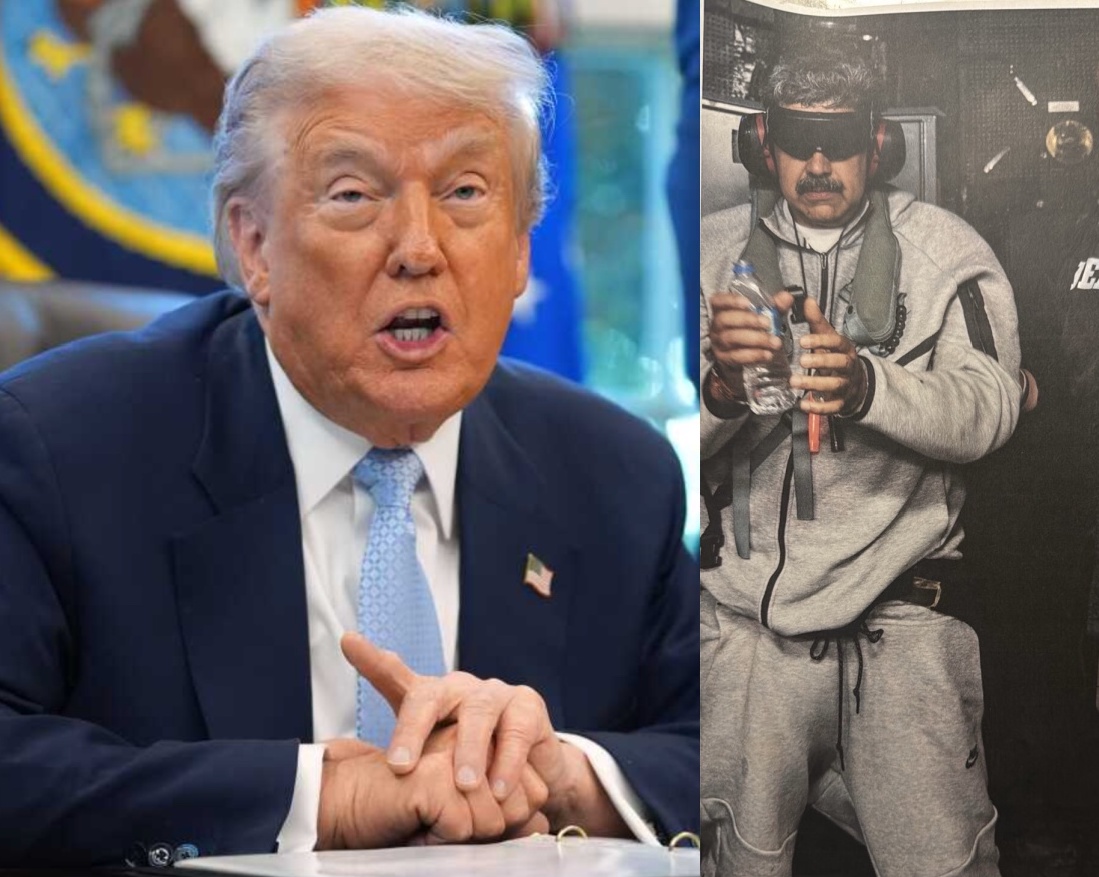
US forces captured Maduro
Third, although a U.S. strike on Venezuela was expected, Maduro’s fall was surprisingly smooth. Evidently, the Americans had some support from certain structures within the socialist regime, which sabotaged the protection of the president. It is clear that Maduro lost the support of the security, intelligence, and military apparatus that had kept him firmly in power for all these years. Maduro has evidently become a burden to the Chavista regime (or at least to some influential part of it), as Trump offered $50 million for his capture and declared him a narcoterrorist.
Fourth, although Trump announced at a press conference that the U.S. would temporarily manage Venezuela during a transitional period until democratic elections are held, it must not be forgotten that the socialist regime remains in power. Although Maduro has been removed from the country, his associates within the United Socialist Party of Venezuela (PSUV) still control all state powers. Trump claimed that Maduro’s vice president Delcy Rodríguez had taken the oath of office and was cooperating with the U.S. Rodríguez also gave a speech calling for Maduro’s release, calling him the true leader and legitimate president, but she has not assumed the presidency. One thing is certain: the Chavistas are still in power. Besides Rodríguez, the most powerful figures are Interior Minister Diosdado Cabello and Defense Minister Vladimir Padrino López. The socialist government in Venezuela has not been overthrown, no matter how spectacular the arrest of its leader.
Fifth, Venezuela’s future is highly uncertain. The main question is whether the new leadership will fully cooperate with the U.S., which would likely lead to the dismantling of the state, or whether it will resist. All high-ranking officials are implicated in years of repression against anti-government protests and dissidents, a repression that has lasted more than ten years. If the opposition comes to power, many current officials will face trial, imprisonment, or public retribution. Trump can offer political and military leaders exile in the U.S. and amnesty to win them over, but it is uncertain who will be protected. If a large number of officials are granted protection, the regime may be more likely to self-dismantle. But not everyone will be granted amnesty, especially mid- and lower-level party and state officials. These structures will resist regime change or emigrate, knowing they face harsh consequences once democratic structures take over—however democratic those may be.
Trump’s press conference about Maduro capturing
Sixth, it is highly likely that Venezuela will fall into a new period of chaos. If the ruling leftists do not relinquish power, violent right-wing protests and further bloodshed are a real possibility. While Trump has announced another wave of attacks if Maduro’s successors do not comply, U.S. airstrikes with missiles and drones may harm the regime but will not topple it. Overthrowing the regime would require American boots on the ground, a very difficult task for the U.S. Considering the country has about 30 million people, hundreds of thousands of soldiers would be needed for an occupation. Currently, U.S. forces in the Caribbean number only around 15,000. More than ever, a civil war in Venezuela is a real prospect.
Seventh, Trump’s aggression against Venezuela has sparked a wave of anti-American sentiment across Latin America. Colombian President Gustavo Petro, Brazilian President Luiz Inácio Lula da Silva, Cuban President Miguel Díaz-Canel, and Mexican President Claudia Sheinbaum have all condemned the U.S. intervention. Outgoing Chilean President Gabriel Boric and other regional leaders have joined in the denunciations. There is no doubt that even many in the region who were not sympathetic to the Chavistas now view the U.S. and its foreign policy negatively. Latin Americans simply do not like Uncle Sam interfering in their internal affairs, as it rarely ends well and often leads to large-scale disorder.
Eighth, Trump’s strike on Venezuela could disrupt oil markets and cause global oil prices to surge. Although Venezuelan oil production is not as significant as it once was (around one million barrels per day, about 0.8% of global production), traders are likely to exploit the chaos to drive prices up. Trump’s motivation for the attack is clearly tied to Venezuela’s oil reserves, estimated at around 303 billion barrels—one-fifth of global reserves and the largest in the world. He plans to bring back American oil companies to restore Venezuelan infrastructure and reap substantial profits. Oil prices will rise, and whether Trump secures Venezuelan oil remains to be seen. If a civil war occurs, production would likely collapse.
We will continue to monitor the situation in Venezuela, but the decade-long crisis is far from over. We have entered a new chapter of a thriller full of twists and dynamic developments.