By Matija Šerić
When Zlatko Dalić was unexpectedly appointed as head coach of the Croatian national football team on October 7, 2017, few expected that the former Hajduk and Varteks player would leave any kind of serious mark. Today, nearly eight years later, with two FIFA World Cup medals and a UEFA Nations League silver to his name, Dalić has become a national hero and the face of a football-loving country.
While Dalić is, in terms of results, the most successful Croatian manager of all time (and it’s unlikely anyone will surpass him soon), the painful truth is evident to both football experts and casual fans — though few are willing to say it out loud: over the past seven years, the national team has failed to develop strategically. In fact, the style of football Croatia plays is outdated, slow, uncreative, and uninspiring. As the man ultimately responsible, Dalić should step down.
His patriotism, religious devotion, and Herzegovinian background may make him unpopular with some — and that’s their problem — but the footballing reasons for his departure are more than enough.
The Circumstances Before Dalić’s Appointment
Dalić’s managerial journey began in unexpected fashion. The trigger for his arrival was Croatia’s 1-1 draw with Finland in World Cup qualifiers. On October 6, 2017, a disjointed Croatian side conceded a goal in the 90th minute at Rujevica Stadium, sealing the fate of then-coach Ante Čačić. Croatia had been playing poorly throughout the qualifying campaign, as well as during Čačić’s entire tenure, surviving primarily due to individual player brilliance.
Čačić, a solid domestic league coach, was clearly out of his depth managing a top-15 national team. It’s widely assumed that players may have deliberately underperformed in order to force a coaching change in their favor. If that’s true, their plan worked. Dalić is arguably the coach most responsive to player input in the history of Croatia’s national team.
The Accidental Coach
Just a day after the Finland game, Čačić was sacked, and a relatively unknown coach from Livno, Bosnia and Herzegovina, took over. The appointment was meant as a “shock therapy” ahead of a decisive match in Kyiv against Ukraine, just two days later. And the shock worked.
Overnight, Dalić “revived” the squad. Of course, he didn’t have time to implement tactical changes. What he did bring was a positive atmosphere, allowing players — especially captain Luka Modrić — to take charge on the pitch and arrange the game plan themselves. It’s likely that the team devised a plan between Čačić’s dismissal and Dalić’s arrival, with Dalić merely signing off on it.
Had Dalić tried to make sweeping tactical changes, Croatia would likely have lost to Ukraine and missed the World Cup. That would have opened the door for more “sabotage” or simply a stronger Ukrainian side. Instead, Croatia won 2-0 and kept their qualification hopes alive.
Croatia defeated Ukraine and qualified for the FIFA World Cup 2018
Mamić’s Puppet
It’s worth noting that, along with Čačić, Dalić had the weakest coaching résumé of any Croatian national team manager. But unlike players — who are expected to feature in Europe’s top clubs — the same standards were rarely applied to national team coaches.
People often forget that at the start of Dalić’s tenure, Davor Šuker was president of the Croatian Football Federation (HNS), while the real power resided with the infamous Zdravko Mamić, the de facto ruler of Croatian football, Dinamo Zagreb, and the national team. Dalić was brought in to serve as another Mamić puppet — not to dictate tactics, but likely to assemble the squad in a way that benefited Mamić’s business interests by increasing the value of Dinamo’s current and former players. This had been the case with previous managers, and Dalić followed suit at first, at least until Mamić’s influence started to decline.
A Stopgap Appointment
Dalić’s greatest “qualification” for the job wasn’t his coaching success, but his loyalty to the federation and, by extension, to Mamić. Even so, HNS didn’t offer him a full contract right away. They didn’t believe in his abilities and gave him a deal only until the end of the 2018 World Cup. He was essentially a temporary solution while the federation searched for a more qualified expert.
At that point, Dalić’s only notable achievements had come with Middle Eastern clubs Al Faisaly and Al Hilal in Saudi Arabia, and Al Ain in the UAE. While these were legitimate successes, they were not seen as equivalent to coaching in Europe’s top five leagues. In reality, he was a coach of average HNL (Croatian First League) pedigree. But although he was brought in as a stopgap, Dalić demonstrated football knowledge and leadership skills that delivered instant results.
One Late-Night Call Changed Everything
In November 2017, Croatia faced Greece in the World Cup qualification playoffs. This time, Dalić had some time to prepare a plan. To do so, he turned to a friend — Belgian national team coach Roberto Martínez. The now-famous phone call took place around 2 or 3 in the morning.
According to official reports, Martínez advised Dalić on how to tactically outplay Greece (a team Belgium had faced in their own qualifying campaign), though it’s possible he shared more than intended. Driven by a desire to help and the kind of inspiration that often strikes during late-night hours (as anyone who’s been to concerts or nightclubs will understand), the Spanish tactician provided his Croatian colleague with a detailed tactical blueprint.
In the months and years that followed, Dalić largely stuck to Martínez’s 4-3-3 formation and footballing philosophy. Results followed quickly: Croatia beat Greece 4-1 at Maksimir and held them to a goalless draw in Athens, thus securing a place at the 2018 World Cup. Dalić was rewarded with his first proper contract — a deal running until summer 2020, worth €500,000 annually.
A Fortunate Chain of Events Turns Dalić into a Star
All of Dalić’s success with the national team can be attributed to three key factors: player quality, managerial passivity, and football luck. Before the 2018 World Cup in Russia, few believed Croatia could achieve anything significant — not even a quarterfinal. The expectations had been high for the 2014 World Cup in Brazil and Euro 2016, but both tournaments ended in disappointment. The nation had lost faith in glory.
Objectively speaking, Croatia’s squads in 2014 and 2016 were stronger than in 2018. Top players like Ivan Rakitić, Luka Modrić, Dejan Lovren and others were younger then, and the team also had legendary captain Darijo Srna, who gave everything on the pitch. The real issue had been poor coaching. Niko Kovač and Ante Čačić lacked tactical insight and the ability to manage players effectively.
By 2018, Croatia’s key players were aging but at their absolute peak — and aware it might be their last chance to win something in the checkered jersey. Modrić, Rakitić, Perišić, Mandžukić, Lovren, and Vrsaljko were all starters at elite clubs like Real Madrid, Barcelona, Inter, Juventus, Liverpool, and Atlético Madrid.
They had class. All Dalić had to do was organize them decently and let them play — which he did, likely following Martínez’s guidelines. The Croatian national team was like a Formula 1 Ferrari: anyone behind the wheel had a chance to win. On top of elite talent and a “hands-off” manager (which was ideal in that moment), came the third ingredient — luck.
Croatian path to silver medal
The Unexpected Russian Saga
Croatia opened the tournament with a lackluster 2-0 win over Nigeria (own goal and a penalty). At that point, a breakthrough seemed unlikely. Then came an unexpected morale boost — forward Nikola Kalinić refused to come off the bench and was sent home by Dalić. The squad responded positively, and the change in energy was evident. In the next match, Croatia dismantled a disoriented Argentina (with a disastrous defense and goalkeeper) 3-0, sparking belief across the nation. The final group game against Iceland (a 2-1 win) was largely ceremonial. But luck would soon begin to favor Croatia heavily.
The knockout stage draw opened up beautifully. In the Round of 16, Croatia faced Denmark (a marginally weaker side), and in the quarterfinals, hosts Russia (clearly inferior). Croatia’s luck lay in the fact that Russia eliminated Spain on penalties, despite Spain dominating with over 80% possession for 120 minutes. Even so, Croatia needed penalties to get past both Denmark and Russia — despite having a stronger squad.
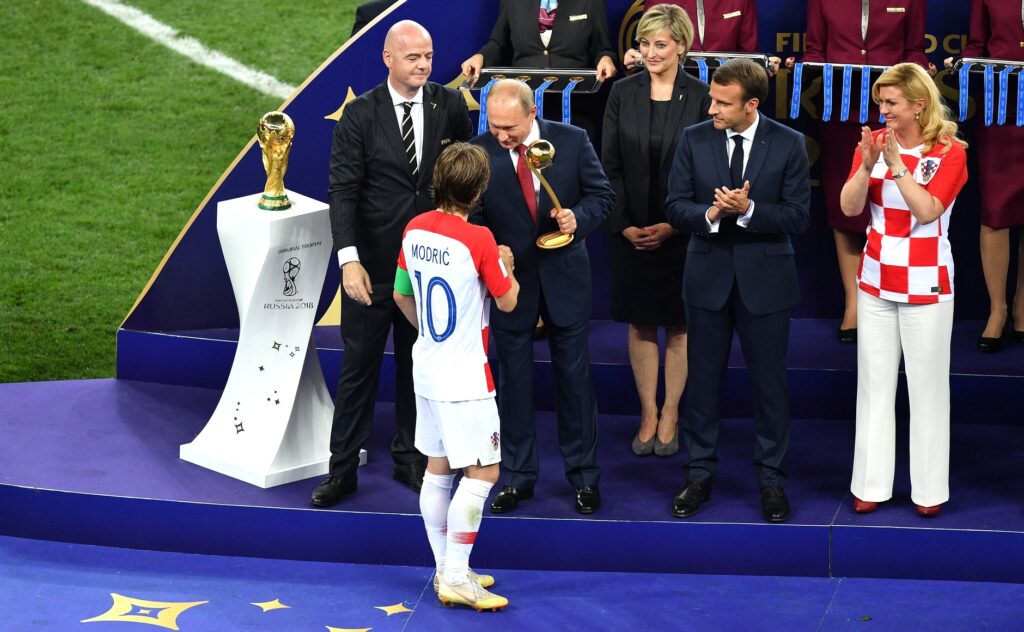
In the semifinal against England, Croatia played a poor first half and trailed 1-0, and could easily have conceded more. But luck smiled again — and Croatia turned the match around in extra time to win 2-1. By the final, the team was exhausted and no longer able to compete with a fresh and powerful French side, losing 4-2.
Squandered Gold
Although Dalić deserves credit for Croatia’s silver medal — thanks to his passive approach (giving players freedom) and overall positive energy — under the given circumstances, most managers would likely have achieved similar results. However, with a more tactically astute coach, Croatia might have won gold.
Elite managers like Carlo Ancelotti, Vicente del Bosque, or Marcelo Bielsa would probably have beaten Denmark and Russia within 90 minutes, allowing the players to be fresher for the final. Tactical experts would have prepared a specific strategy for France, while Dalić stubbornly stuck with the familiar formula.
Instead of the standard 4-3-3, Croatia should have reinforced the midfield with a 4-4-1-1 or 4-2-3-1 formation — placing Brozović and Modrić deeper in central midfield, with Kramarić (or Pjaca) behind Mandžukić. This setup would have better neutralized France’s deadly counterattacks, especially those involving Mbappé.
Beating France would have still been difficult, but with a tactical adjustment, Croatia would have had a real shot. One of Dalić’s most costly mistakes was allowing Subašić to play the final injured, with an unresolved hamstring issue — an error that directly contributed to two of France’s goals (scored by Pogba and Mbappé).
Interestingly, Hajduk Split never congratulated the national team for the silver medal — a move interpreted by many as a reaction to Zdravko Mamić’s continued shadow influence. Among some fans, the bitter phrase “May you lose everything” (“Sve izgubili dabogda”) continued to circulate.
The Beginning of the Decline
Following the silver in Russia, Croatia entered a three-year slump — something winger Ante Rebić publicly pointed out during Euro 2021, which got him exiled from the squad. Croatia suffered a 6-0 humiliation against Spain in Elche in the newly established UEFA Nations League, and the team underperformed throughout both the 2018/19 and 2020/21 editions.
It was a transitional period after the retirement of Mandžukić, Subašić, Ćorluka, and Rakitić. Yet Dalić failed to establish a new tactical identity despite gradually introducing players like Bruno Petković, Nikola Vlašić, Josip Brekalo, Joško Gvardiol, Luka Ivanušec, Lovro Majer, Mislav Oršić, and others.
Even then, Dalić only gave these players opportunities under media pressure. Croatia managed to qualify for Euro 2021, and in the summer of 2020, Dalić signed a new contract worth €1.5 million per year. However, his decisions and results failed to justify the investment.