By Matija Šerić
After the collapse of the Soviet Union and the Eastern Bloc in 1991, North Korea’s economic situation rapidly deteriorated, as its main patron and financier ceased to exist, along with the large socialist East European market with which it had conducted trade. In the early 1990s, foreign aid accounted for one third of North Korea’s economic income, another third came from trade (weapons, metals, minerals, agricultural products, fish), while the final third consisted of illegal trade.
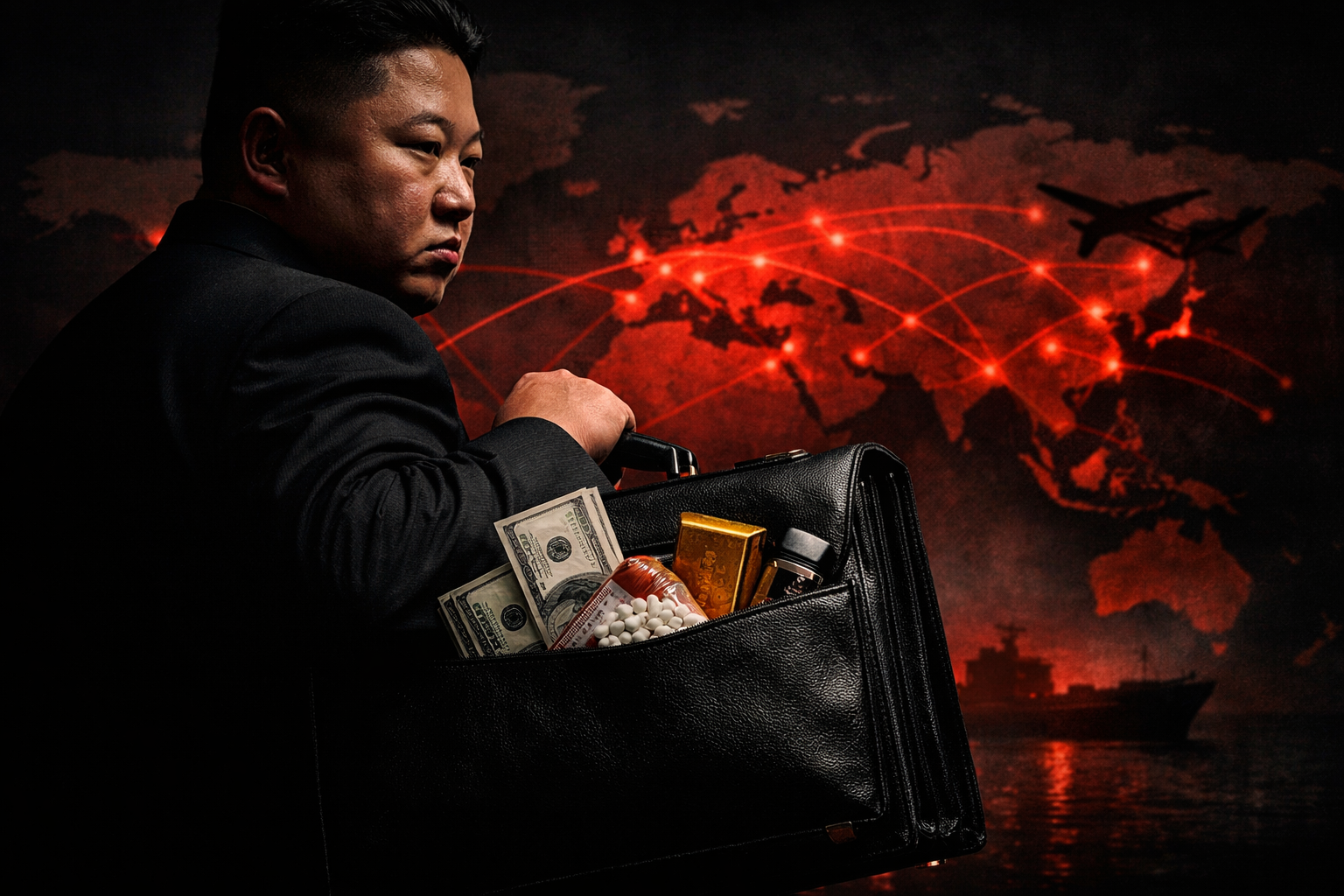
Due to its involvement in illegal trade channels, North Korea acquired derogatory labels in global media such as “Narco Korea” or a “Gangster Regime.” Even the North Korean supreme leader, Kim Jong-il, was branded the “Tony Soprano of North Korea,” a label that would be a trivial absurdity were it not for the fact that Kim did indeed share certain similarities with the iconic character from the cult mafia TV series The Sopranos.
The Beginnings Date Back to the 1960s
Since the late 1960s, the North Korean state has been involved in various forms of production and distribution of narcotics, cigarettes, counterfeit banknotes, and other goods, as well as money laundering, insurance fraud, smuggling of precious stones, rare minerals, endangered plant and animal species, and even human trafficking. These criminal activities financed the repayment of massive government debts, sustained an enormous conventional army, supported the development of nuclear and ballistic missile programs, and enabled the political elite to enjoy a luxurious and carefree lifestyle. Involvement in illegal activities has continued in some form to this day.
Examples from Other States
Crime exists in every country in the world, unfortunately even where it would least be expected, such as the Vatican. In some places it is more pronounced, in others less so. In countries such as Bulgaria, Romania, and many Latin American states, authorities often turn a blind eye to crime because they themselves benefit from it. Some states, like Mexico, are simply too weak to curb powerful drug cartels such as Sinaloa. Unlike such countries, where crime is led by private mafia organizations, the authorities of the DPRK use crime as a means of profit. Moreover, the state plays the central role in the entire process.
Some analysts have gone so far as to claim that the Democratic People’s Republic of Korea practices a special form of “criminal sovereignty,” given that the state protects individuals and organizations involved in criminal activity. Without state protection, they would face prosecution. The DPRK uses its institutions and territory to encourage or tolerate illegal activities and profit from them.
Motive – Survival of the Political System
For approximately half a century, the North Korean leadership has been involved in illegal activities across all continents. Since the mid-1970s, when the state could no longer service its foreign debt, the regime turned to illicit activities in order to preserve itself. As the government was unable to finance numerous diplomatic and consular missions abroad, it launched a policy of “self-financing” embassies and consulates. This policy enabled diplomats to fund their missions and personally enrich themselves by smuggling highly profitable goods such as drugs and precious stones, while their diplomatic immunity shielded them from prosecution.
Over time, criminal activities spread throughout state structures, involving military personnel and intelligence services in cooperation with foreign criminal groups. Illegal activities gradually expanded, reaching a dramatic peak in the 1990s. Between 1994 and 1998, North Korea was struck by a major famine, and its economy effectively collapsed, opening the door wide to criminality. Although estimates vary, the annual value of North Korea’s criminal activities is estimated at between $500 million and $1 billion.
The State as the Fundamental Creator of Criminality
The key question is whether the state knowingly tolerates crime by “turning a blind eye,” or whether it actively orders it. The latter is unequivocally correct, and there is abundant evidence to support this. The DPRK may be more deeply involved in international crime than any other nation-state. According to respected experts such as Paul Rexton Kan, Bruce E. Bechtol Jr., and Robert M. Collins (2010), North Korea represents a unique case of a state that uses international crime as an instrument of geopolitical advantage.
The state largely directs illegal activities, as demonstrated by the existence of facilities for drug production and counterfeit currency printing, which are often transported abroad by North Korean diplomats.
Documentary about illegal trade of DPRK
The Indispensable Bureau 39
Criminal activities are managed by Bureau (or Room) 39 – a secret department of the Workers’ Party of Korea specializing in counterfeiting $100 banknotes, narcotics production (including methamphetamine synthesis and the conversion of opium into stronger opiates such as heroin), and international insurance fraud. Bureau 39 is the largest of the three so-called “third-floor offices,” alongside Office 35, responsible for intelligence activities, and Office 38, which handles legal financial operations.
Bureau 39 is believed to be located within the headquarters of the ruling Workers’ Party in Pyongyang, near one of the residences of North Korean leader Kim Jong-un. All three offices were originally housed on the third floor of a building that once contained Kim Jong-il’s office, hence the nickname “the Third Floor.”
Bureau 39 is estimated to hold around $5 billion in offshore bank accounts ranging from Macau to Switzerland. The funds are used to finance the nuclear program and support the lavish lifestyle of the party elite. The bureau maintains offices in all major ports and railway hubs, with officials in every city and province of the DPRK, ensuring operations proceed according to plan. In August 2014, Yun Tae-hyong, a senior official of Korea Daesong Bank (suspected of being controlled by Bureau 39), allegedly defected to Russia carrying $5 million in cash.
Cooperation with Foreign Non-State Actors
Although the North Korean state directs international criminal activity, it is by no means the sole participant. Foreign criminal and even terrorist organizations act as partners. Such cooperation is not new. In the past, the DPRK collaborated with non-state actors such as the Japanese Red Army, a socialist terrorist organization that sought to overthrow the Japanese government and monarchy and promote a global communist revolution.
Over time, ideology played an increasingly smaller role in North Korea’s cooperation with foreign terrorist organizations, with profit becoming the primary motivation. This led to collaboration with Japan’s Yakuza, Chinese Triads, South Korean and Russian mafia groups, and various terrorist organizations in Southeast Asia.
DPRK institutions use these criminal groups to purchase, sell, and distribute drugs, counterfeit currency, and precious stones on the international black market. There are even reports that the North Korean government provided sanctuary to foreign criminal organizations on its territory, integrating them into operations at drug production facilities and counterfeit currency printing plants.
Cooperation with Thai, Myanmar, and Chinese Criminals
A defector from the national security service claimed that during the 1990s, opium grown on state farms was “processed and converted into heroin under the supervision of several drug experts brought from Thailand to assist the North Korean government in its drug production program.” There are reports suggesting that members of Myanmar’s criminal underworld also helped North Korea establish narcotics laboratories. Taiwanese criminals were officially hosted by DPRK officials, while Chinese nationals from both mainland China and Taiwan managed drug factories on North Korean territory.
A Win-Win Arrangement
Both sides recognized that cooperation brought mutual benefits. North Korea supplied criminal organizations with high-quality drugs, counterfeit pharmaceuticals and currency, safe movement within its territory—including territorial waters—and logistical support. In return, criminal groups significantly reduced the risk of North Korea’s exposure and enabled a nationally and internationally recognized state to remain outside violent conflicts on illegal markets.
Nevertheless, North Korea’s involvement could not always be concealed. In April 2003, the Pong-su incident occurred, when a North Korean crew aboard the state-owned vessel Pong-su was caught attempting to smuggle 125 kilograms of Myanmar heroin into Australia. Despite occasional failed operations, cooperation with foreign criminal organizations remains highly profitable for North Korea.