By Matija Šerić
Although the Christmas season usually brings at least a temporary easing of geopolitical tensions and hope for the resolution of global crisis hotspots, this is not the case this year. Alongside the ever-pressing issue of Ukraine, other crises are emerging. The latest case is Donald Trump’s renewed effort to annex Greenland. On December 22, Trump appointed Republican Governor of Louisiana, Jeffrey Landry, as the U.S. special envoy for Greenland. In his statement, the President emphasized that Landry’s mission is far from ordinary: his task is the American annexation of the Arctic island, which belongs to Denmark.
National Security – Trump’s Imperative
Trump justified the move by claiming that the United States needs the territory for national security, given that Russian and Chinese ships and submarines pass near the world’s largest island. “Jeff understands how important Greenland is for our national security and will strongly promote the interests of our country for the safety, protection, and survival of our allies, and indeed the entire world… We need Greenland for national security, not for minerals. We have so many mineral and oil deposits and everything else,” Trump wrote on the social media platform Truth Social. He added that Denmark has invested nothing in its overseas territory and that the world’s largest island has no military protection. Landry thanked Trump for the appointment and said it was “an honor to serve in this voluntary position to make Greenland part of the U.S.” He also stated that this appointment “does not in any way affect” his role as Governor of Louisiana.
The President revealed that the governor himself first contacted him and proposed himself for the new position, praising Landry’s proactive approach. It should be noted that the position of special envoy for Greenland has not been formally established, but it exists—and that is the key point.
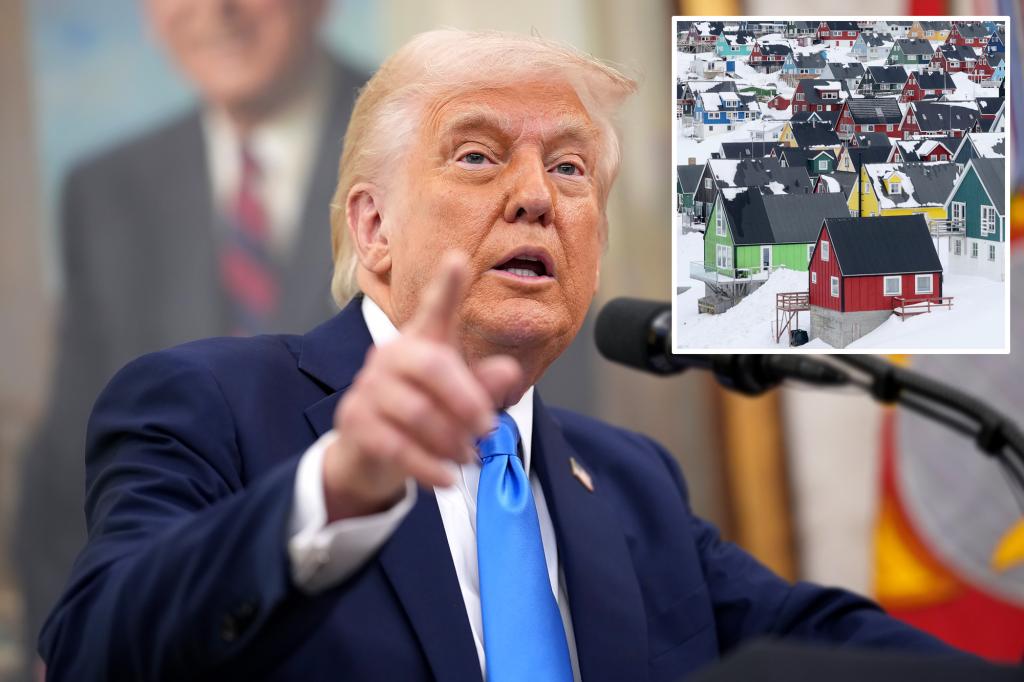
Trump wants to annex Greenland
Danes Outraged, but Only Verbally
Predictably, Denmark reacted strongly. Danish Foreign Minister Lars Løkke Rasmussen stated, “I am deeply disturbed by the appointment of a special envoy. I am particularly disturbed by his statements, which we consider completely unacceptable.” Rasmussen added, “We insist that everyone—including the U.S.—must show respect for the territorial integrity of the Kingdom of Denmark.” He also announced that he would hold consultations with the U.S. ambassador to Denmark, Ken Howery.
Danish Prime Minister Mette Frederiksen and Greenlandic Prime Minister Jens-Frederik Nielsen also expressed their opposition to the American plans to take over Greenland, stating that “you cannot annex another country, even under the argument of international security.” European Union spokesperson Anouar El Anouni said that “preserving the territorial integrity of the Kingdom of Denmark, its sovereignty, and the inviolability of its borders is crucial for the European Union.”
Basic Geographical Facts
Before examining Trump’s intentions to annex Greenland, it is worth outlining some basic facts about the territory, which can without exaggeration be called a land of eternal snow and ice. As mentioned, it is the world’s largest non-continental island, geographically part of North America (2.1 million square kilometers). Greenland is the largest area in North America after the U.S. and Canada. It is bordered by the Arctic Ocean to the north, the Greenland Sea to the east, the North Atlantic Ocean to the southeast, the Davis Strait to the southwest, Baffin Bay to the west, and the Nares Strait and Lincoln Sea to the northwest. Greenland shares a maritime border with Canada and a very small land border of 1.2 km on Hans Island. It is home to the world’s largest national park, with populations of musk oxen, polar bears, and walruses. Geologically, it belongs to the Canadian Shield. Around 80% of the territory is covered by ice. The climate is Arctic, with summer temperatures ranging from 10 to 15°C and winter temperatures from -10 to -25°C, dropping as low as -60°C in some areas.
Historical Path
Although part of North America, Greenland’s history is closely linked to Europe. Arctic peoples have lived in the region for about 4,500 years, with the Inuit arriving in the 13th century. From the 10th century, Vikings, mainly from Norway, settled the island until the 15th century. In the 15th and 16th centuries, Portuguese explorers passed along Greenland’s coasts but did not establish settlements. From the 17th century, Danish-Norwegian explorers re-established permanent settlements. After the dissolution of the Norway-Denmark union in 1814, Denmark took over Greenland, which was a Danish colony. During World War II, the U.S. assumed de facto control of the island after entering the war in 1941, but this was only temporary for wartime purposes.
In 1953, Greenland was formally granted equal status with Denmark and the Faroe Islands within the Kingdom of Denmark. In 1979, it gained self-government, with additional powers granted in 2008, both through referendums. Although Greenlanders hold many powers, monetary policy, security, foreign affairs, and citizenship remain under Copenhagen’s control. Many of Greenland’s roughly 56,000 residents are dissatisfied and desire full independence. The capital of Greenland is Nuuk. As a Danish possession, Greenland is part of the EU, NATO, and a member of the Council of Europe.
Greenland’s history
Strategic Importance of Greenland Increasing
Although many might initially dismiss Greenland as insignificant due to its harsh climate, its importance is growing. First, climate change is melting ice, making more of the territory habitable and suitable for economic activity. Second, the Arctic island occupies a strategically crucial location between North America and Europe; whoever controls Greenland and surrounding sea routes gains a launchpad for influence on both continents.
Third, Greenland is rich in mineral resources, including rare earth elements, zinc, lead, uranium, iron, gold, and diamonds. Rare metals such as neodymium and dysprosium, essential for modern technology and energy transition, are particularly important. Greenland and surrounding seas also have significant potential oil and gas deposits, mainly offshore. Exploitation is currently limited due to harsh conditions and high costs, but this could change.
Greenland in the U.S. Crosshairs
It should be noted that Donald Trump is not the first high-ranking U.S. official to advocate for Greenland’s annexation. During the 19th and 20th centuries, the U.S. government repeatedly tried to buy the territory from Denmark, without success, although Denmark agreed to sell the Danish West Indies in 1917, now known as the U.S. Virgin Islands. Publicly, annexation was supported by Secretaries of State William H. Seward (under Lincoln and Johnson) and James F. Byrnes (under Truman), and privately by Vice President Nelson Rockefeller (under Gerald Ford). Trump advocated annexation during his first term in 2019 (including purchase) and after his reelection in November 2024.
Recent U.S. Efforts
Shortly after his reelection, Republican Congressman Mike Collins shared an illustration of Greenland included in an electoral map as a Republican stronghold under the “Project 2029,” signaling that Trump could revive the idea of buying the Arctic island in a second term. In December last year, Trump clearly expressed his intention to purchase Greenland, and his son Eric Trump posted on X placing Greenland, Canada, and the Panama Canal in a “shopping cart.” In January, Donald Trump Jr. visited the island.
Vice President JD Vance visited in March, repeatedly claiming it was vulnerable and that the U.S. “had no choice” but to increase its presence. In August, the Danish Foreign Ministry summoned the U.S. envoy after public television reported Americans had attempted “influence operations” in Greenland. Earlier this month, Danish military intelligence FE classified the U.S. as a potential threat to Denmark’s and Europe’s national security, citing tariffs as an economic weapon aimed at annexing Greenland and not ruling out the possible use of military force. According to surveys, 85% of Greenlanders oppose joining the U.S., while about 40% of Americans support the idea.
U.S. National Security Strategy and Greenland
Trump wants Greenland for multiple reasons, but the fundamental explanation lies in the U.S. National Security Strategy (NSS) published by his administration on December 4. The strategy outlines “a plan to ensure that America remains the greatest and most successful nation in human history and the home of freedom on Earth.” Although based on Trump’s “America First” policy, which avoids interference in other countries unless U.S. interests are involved, the strategy explicitly calls for redirecting U.S. military efforts to the Western Hemisphere, where the U.S. must be the leading power to “control migration, stop drug flows, and strengthen stability and security on land and sea.” The NSS also outlines the “Trump Corollary,” additions to the Monroe Doctrine, stating that the U.S. must dominate politically, militarily, and economically in the Western Hemisphere. The document calls for strengthening the Coast Guard and Navy to “prevent illegal and unwanted migration, reduce human and drug trafficking, and control key transit routes in crisis situations.”
Greenland is empty, but that could change
Trump Doctrine = Continuation of the Monroe Doctrine
Since Greenland is part of the Western Hemisphere and the U.S.’ backyard, everything becomes clear. In the Americas, there can be only one master: Washington. With this in mind, Trump’s policy toward Panama, Canada, Mexico, Venezuela, and other regional states becomes easier to understand. Although Greenland is a NATO member, this is not sufficient for Trump to guarantee U.S. interests. NATO could dissolve at some point, but if Greenland becomes part of the U.S., it ensures American interests are protected. Of course, national security matters, but so do oil, gas, and numerous minerals. Natural resources are always beneficial to the U.S., even if Americans do not need them themselves—their possession is valuable for trade.
Both Denmark and the U.S. as Colonial Powers in Greenland
Both Denmark and the U.S. want Greenland. However, the island’s future should be decided by its residents. In terms of control, both Denmark and the U.S. are objectively colonial powers. This is an absolute fact, no matter how harsh it sounds. The territory cannot naturally belong to either country. Denmark once imposed its power, and now the U.S. government is attempting something similar.
“Rattling Weapons to Gain More”
So far, the Trump administration is attempting a peaceful takeover, but the use of military force cannot be ruled out. Trump is an unconventional politician willing to achieve objectives through threats, as seen in North Korea, Iran, Panama, and Ukraine. He often partially wins over smaller nations, which eventually give in to Uncle Sam’s pressure. If military confrontation occurs, U.S. forces could relatively easily defeat Denmark and take control of Greenland. Whether Trump will do this remains highly uncertain. Most likely, he will extract maximum concessions from Denmark and effectively take control of key economic resources on the island—but with a showman in the Oval Office, anything is possible.