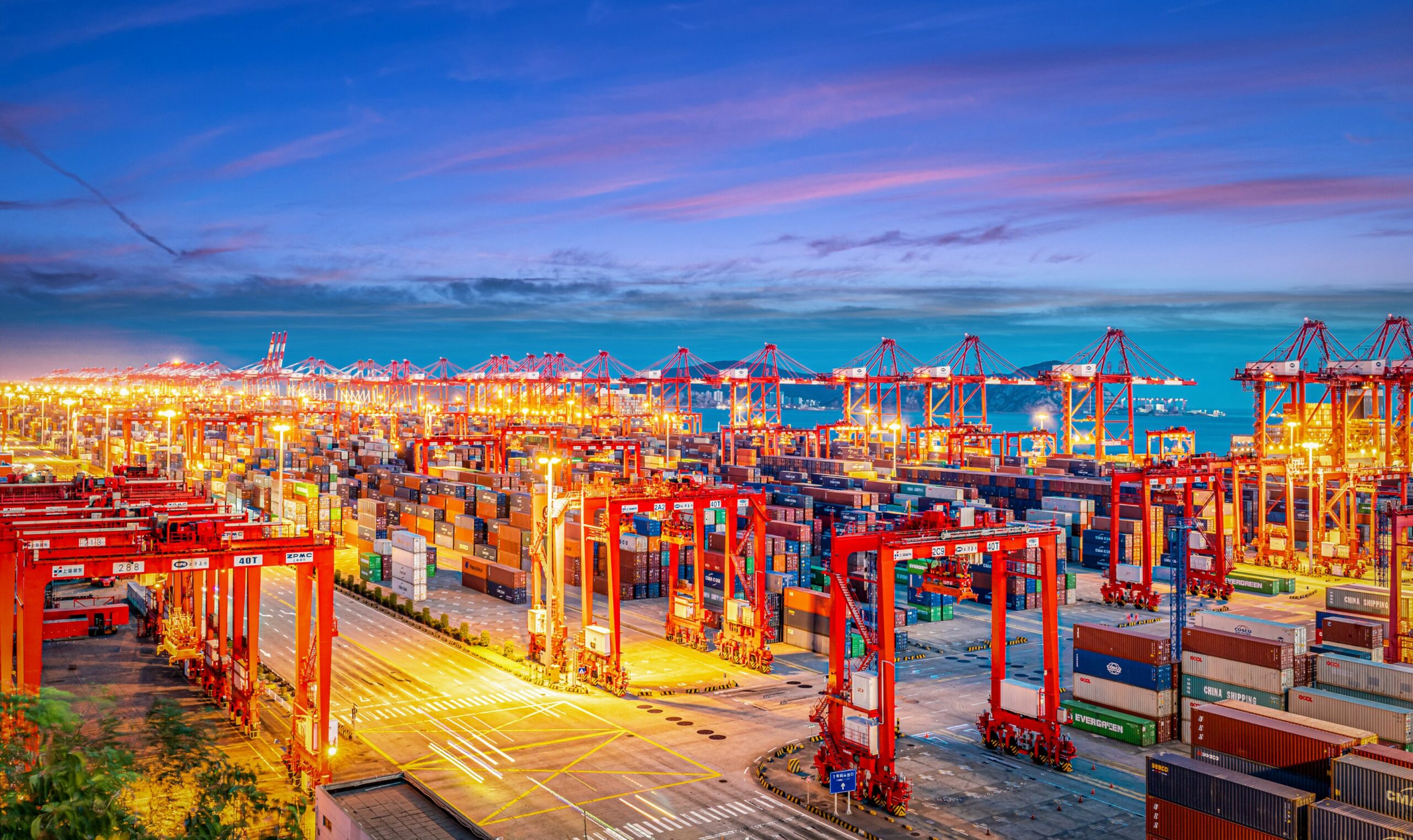
By Matija Šerić
The past year, turbulent, unstable, and unusual in many ways, has come to an end, and January is the time for accounting. Lines are drawn, and corporations analyze whether they operated at a profit or a loss last year. When it comes to container traffic, China is the world leader. This is entirely expected, as shipping is the primary way international trade is conducted, and in trade, no one can compete with the Chinese.
A Record Year for Shanghai Port
Special recognition goes to Shanghai Port, which has been the world’s largest container port for 16 consecutive years. The world’s top 10 container ports, alongside Shanghai, include Singapore, Ningbo-Zhoushan, Shenzhen, Qingdao, Guangzhou, Busan (South Korea), Tianjin, Dubai (UAE), and Klang (Malaysia). Notably, six of the top ten ports are in China, a clear indicator of China’s economic and transport dominance.
In 2025, Shanghai Port handled a total of 55.06 million TEUs, an increase of 6.9% compared to 2024. This result exceeded expectations, as port projections had forecast 53 million TEUs. The port is operated by Shanghai International Port Group (SIPG), a Chinese state-owned corporation.

Development in Line with China’s State Plans
The company highlighted its contribution to implementing the 14th Five-Year Plan for economic development set by the Chinese Communist Party for 2021–2025 and emphasized that it will continue taking steps to make Shanghai Port a global container hub. Overall traffic “demonstrates the resilience and stability of the port as a key node in the global supply chain,” SIPG stated. This underscores how Chinese communist leaders leave nothing to chance. In the People’s Republic of China, the state plays a primary role in the economy under the model of socialism with Chinese characteristics.
Components of Success
The port authority revealed that last year it accelerated digital transformation at container terminals. Automated systems, advanced computer programs, AI-based cargo stacking models, and smart warehouses increased productivity and reduced port maneuvering operations, including minimizing loading and unloading movements between trucks. Blockchain tracking for containers and other digital tools reduced logistics costs. Shanghai Port expanded its green initiatives and will be the first port to supply ships with green methanol produced in China. Use of shore-side electricity increased—ships connect to the electrical grid instead of running diesel generators—to reduce carbon emissions.
Ambitious Plans for Further Development
SIPG announced plans to increase port infrastructure as an international logistics hub for container transshipment, continue digital and green transformation, and strengthen cooperation with other ports in China and the region. “Focusing on international transshipment, the port will further expand global maritime networks, cabotage operations, and ship-to-ship transshipment, increasing the share of international transshipment cargo and consolidating its status as a key international hub in Northeast Asia,” the port’s annual report stated.
These plans must be seen in the context of China’s growing economic dominance through the Belt and Road Initiative, launched in 2013 by President Xi Jinping. Although the strategy emphasizes overland corridors, maritime routes are equally crucial. After all, over 80% of world trade is conducted by sea. In the first 11 months of 2025, China’s foreign container transport increased by 9.5% compared to the previous year, reaching 320 million TEUs.
Shanghai – China’s Most Important Port
Due to its strategic importance and technical capabilities, Shanghai Port is of crucial significance to the Chinese state and the Chinese people as a whole. Geographically, it is located along the East China Sea to the east and Hangzhou Bay to the south, encompassing the estuaries of the Yangtze, Huangpu (a tributary of the Yangtze), and Qiantang rivers. The port spans 3,500 square kilometers, including river terminals and deep-sea docks capable of receiving fully loaded post-Panamax ships exceeding 24,000 TEUs.
The port’s three main container areas—Wusongkou, Waigaoqiao, and Yangshan—have a combined quay length of over 13 kilometers, 43 berths, and 156 container cranes. Shanghai Port also has two bulk cargo terminals and three general cargo terminals located in Longwu, Luojing, and Wusong.

The Significance of Yangshan Terminal
The deep-sea Yangshan terminal, built on an offshore island in the East China Sea and connected to the mainland by the Donghai Bridge, significantly increases the port’s capacity for the world’s largest container ships. Phase four of Yangshan, opened in 2017, is the largest automated container terminal in the world, with a capacity of 6.3 million TEUs, 2.4 kilometers of quays, seven berths, 21 quay cranes, 108 rail-mounted gantry cranes, and 125 automated guided vehicles (AGVs).
Role in the Belt and Road Initiative
Shanghai Port plays a concrete role in the Belt and Road Initiative. Containers leaving the port by sea first go to Singapore, then pass along southern routes touching India and the Indian Ocean, arriving at the port of Mombasa in Kenya; they continue through the Red Sea and Suez Canal to the Mediterranean, where they branch toward Italy or northern Europe (Rotterdam, Antwerp, or other ports). Total revenue for the port in 2025 amounted to 39.4 billion yuan (USD 5.6 billion), with profits of 13.4 billion yuan (USD 1.9 billion).
Shanghai – The Port of the Future
Professor Zhen Hong of Shanghai Maritime University recently stated that the growth of China’s port capacities is expected to continue over the next five years, albeit at a slower pace than in previous years. He emphasized that “transport comes first” and noted that “proactive port infrastructure” is key to supporting hinterland development and expanding trade.
Similarly, in December, Zhu Xuyu, Deputy Director of the Water Transport Bureau of China’s Ministry of Transport, said: “The next step is to build a group of world-class ports—each with the capacity to handle more than 100 million tons of cargo or 10 million TEUs—equipped with digital intelligence and green technologies, to elevate China’s ports as global logistics hubs and enhance international shipping routes.” Shanghai Port will continue to have a decisive role for China, with all development projects affecting it directly or indirectly.