By Matija Šerić
Every weapon is unique and has emerged from a specific historical moment. This is not unusual. However, few weapons carry as many political connotations in their name as the Molotov cocktail. The iconic name, which has become legendary, was first coined by Finnish soldiers during the Winter War between Finland and the Soviet Union, fought from November 1939 to March 1940. In that war, the small nation of Finland found itself subjected to brutal aggression by the Soviet military machine. The Molotov cocktail emerged as a weapon of resistance, where the modern David (Finland) stood up to the modern Goliath (the USSR).
Finland – Target of the Soviet Empire
After the Nazi-Soviet non-aggression pact signed on August 23, 1939, known as the Hitler-Stalin Pact (Molotov-Ribbentrop Pact), the Soviet Union sought to expand its sphere of influence over Eastern European countries, including Finland. Soviet dictator Joseph Stalin wanted to create a protective buffer zone to defend against potential invasion from the West and expand the Soviet empire in pursuit of global dominance. During the autumn negotiations with the Finnish delegation, Stalin and his foreign minister, Vyacheslav Molotov, demanded substantial concessions from Finland: extending Soviet control over the Gulf of Finland and ceding all islands in the bay (the Bjorko Archipelago). The Soviets wanted to oversee the Gulf of Finland and protect Leningrad and its maritime route, requesting a naval base in the port of Hanko on the gulf’s northern side. They perceived the Soviet-Finnish border, only 32 kilometers northwest of Leningrad, as a potential threat to the USSR’s second-largest city. As Molotov stated in his speech on October 31, the Soviets were asking “only” to shift the border “by a few dozen kilometers,” while in return, Finland would receive a much larger area further north. The Finns, as expected, refused these demands, and on November 30, the Soviet invasion ensued.
Short history of Molotov cocktail
Spontaneous Creation
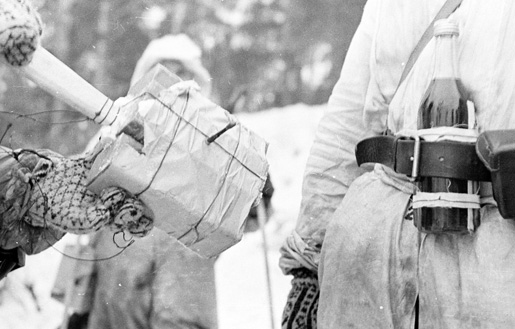
Faced with the brutal aggression of a military superpower, the Finns had to devise inventive ways to defend themselves. One of these improvised and simple methods was the Molotov cocktail. According to Merriam-Webster’s definition, the Molotov cocktail is “a crude bomb made of a bottle filled with a flammable liquid (such as gasoline) and usually fitted with a wick (such as a saturated rag) that is ignited just before the bottle is hurled.” The weapon’s name was actually a sarcastic mockery of Stalin’s close associate, Vyacheslav Molotov, who led a propaganda war. The Finns mocked Molotov because he announced over the radio that bomber flights over Finland were “humanitarian food deliveries for starving Finns.” This was, of course, a brazen lie, as it was a relentless bombing campaign that destroyed not only military infrastructure but also civilian areas. The Finns sarcastically called the Soviet cluster bombs “Molotov’s bread baskets” in response to his propaganda. When they developed homemade hand grenades to attack Soviet tanks, the Finns called them Molotov cocktails as the “drink that goes with the food.”
Use and Tactics
The Molotov cocktail worked by filling a glass bottle with flammable liquid; just before throwing, a piece of cloth was soaked in the liquid and served as a fuse. The fuse was lit before throwing the bottle, causing an explosion when the bottle hit its target. The Finnish government encouraged the mass production of Molotov bombs in state-owned distilleries, making it one of the few improvised weapons to undergo industrial production on a large scale. Molotov cocktails proved particularly effective against Soviet tanks, which, due to their size, had limited maneuverability on snowy terrain. The tanks became easy targets as Molotov cocktails could ignite fires inside the vehicle when the liquid entered through hatches or ventilation systems. The Finns developed tactical teams specializing in using Molotov cocktails against tanks and armored vehicles, inflicting significant damage on the Red Army. Undoubtedly, the Molotov cocktail played a crucial role in preventing Finland’s defeat. On March 12, 1940, a Soviet-Finnish peace treaty was signed, in which Finland lost 9% of its territory, inhabited by 12% of its population, but retained its status as a sovereign, independent state. Considering the balance of power, this was an impressive achievement.
A Weapon of Resistance
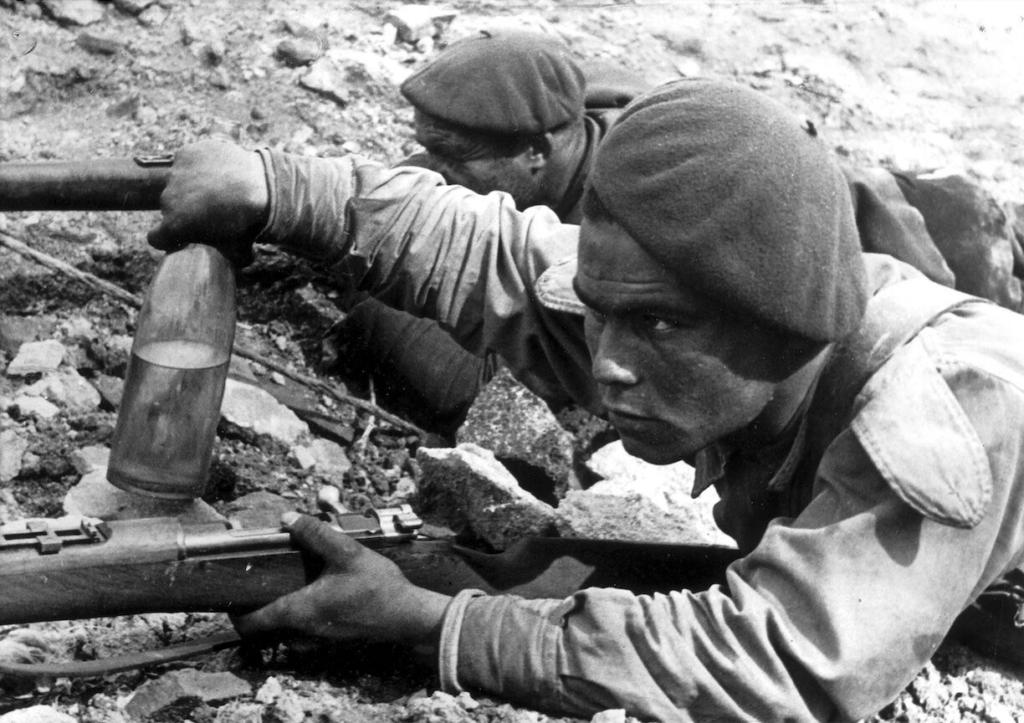
Although the Winter War has receded into history, the Molotov cocktail has remained in use to this day as a symbol of resistance by the disenfranchised against the powerful. During World War II, it was used in numerous battles. Resistance movements, whether urban guerrillas or partisan units in rural areas, frequently utilized it. The Molotov cocktail caused significant issues for German military forces. It remained in use throughout the latter half of the 20th century and into the 21st century. Protesters across Europe, Latin America, the Middle East, and Asia have used it in confrontations with oppressive totalitarian and autocratic regimes.
Modern Use
In urban conflicts, Molotov cocktails are used to attack police vehicles, checkpoints, and symbols of state power, such as government buildings. The purpose of their use is to deter regime security forces. Due to its flammable nature, the weapon creates fires that can limit the movement of enemy forces. For instance, during the Arab Spring, protests in Egypt, Tunisia, and Libya included the use of Molotov cocktails, symbolizing defiance against repression. The weapon was also used in recent civil unrest in Latin America (Chile, Colombia, Ecuador, Argentina) and Europe (Ukraine, Greece, France, Belgium), where it served as a tool of resistance against government measures and police actions.
Legal Bans
Although modern weapons like drones, ballistic and cruise missiles, and precision snipers may be hundreds or thousands of times more advanced, the Molotov cocktail is a primitive yet effective weapon. As such, many countries have legally banned and criminalized its use in protests. In the United States, the Molotov cocktail is an illegal weapon under federal explosives control laws, and its possession and use can lead to long prison sentences. In the European Union, the use of Molotov cocktails is treated as a criminal offense, and countries like Germany, France, and Spain have strict laws regulating the possession of incendiary devices. Despite these bans, it is undeniable that individuals and groups will continue to use the Molotov cocktail in the future. Why? Because it symbolizes resistance against repression, embodying the fight for freedom and justice.
Featured image: Unsplash