By Ivan Toth
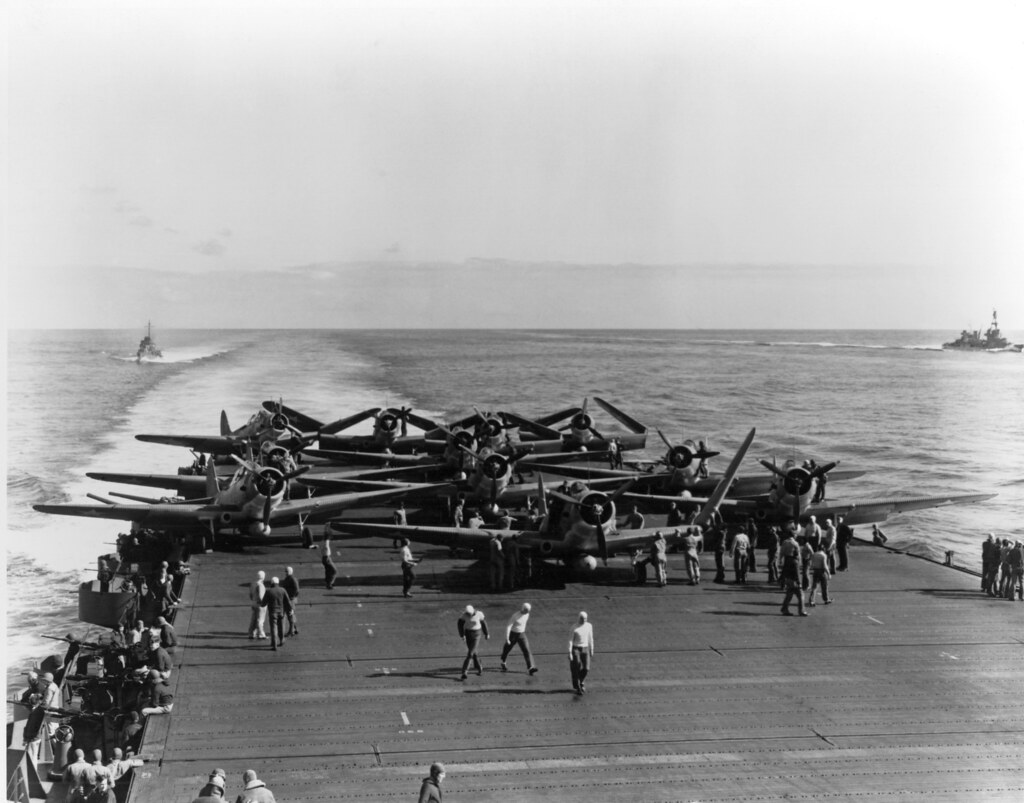
The Americans had the element of surprise and luck on their side. On June 4, they discovered the Japanese fleet, led by Vice Admiral Chuichi Nagumo, northeast of Midway. The Americans dispatched six TBF Avenger bombers and four B26 bombers armed with torpedoes. The Americans kept their fighter aircraft to defend Midway, leaving the torpedo squadron to fend for itself (according to standard rules, aircraft should enter combat accompanied by fighter escorts; the bombers went into battle uncoordinated and without fighter cover).
Soon after, the air battle began. On their way, they encountered a coordinated Japanese strike consisting of 36 Aichi D3A dive bombers, 36 Nakajima B5N torpedo bombers, and 36 Mitsubishi A6M Zero fighters. The Japanese flew in coordination—unlike the Americans—launching 108 combat aircraft in just 10 minutes.
Hell in the skies over the Pacific
The Japanese passed the American bombers without attacking them, while another squadron of Japanese fighters remained circling above their carriers, waiting to shoot down the American bombers. The Japanese had the advantage in aircraft; their Zero fighters were 80 km/h faster than the Avengers, reaching a maximum speed of 528 km/h. The Zero had two 20 mm cannons on the wings and two 7.7 mm machine guns mounted in the nose. The Japanese pilots were highly disciplined, experienced, and held an advantage over the American pilots. Without air support, the American bombers were easy prey for the Japanese fighters, and the squadron quickly broke apart. The surviving pilots soon tried to return to base.
Storm over Midway
Meanwhile, the Japanese group of 108 aircraft approached Midway. They had the element of surprise and managed to corner the Americans with their Zero fighters. Midway was bombed both horizontally and in dive-bombing attacks. After the raid, Japanese aircraft returned to their carriers to refuel and rearm; at the same time, Admiral Nagumo was already planning a second strike on Midway to allow ground forces to land on the island. Of the ten aircraft the Americans had sent, only one returned. The Japanese had crippled Midway with the first attack, and Nagumo wanted to finish the job with the second. What they did not know was that the Americans had broken Japanese codes and were preparing a counterstrike. The Americans had positioned their three aircraft carriers—USS Yorktown, Enterprise, and Hornet—280 kilometers northeast of Midway.
Admiral Nimitz’s plan and the Americans’ first moves
Commander of U.S. Pacific operations Admiral Chester Nimitz planned to launch an attack as soon as Japanese carriers were within range. U.S. intelligence placed the Japanese fleet between 370 and 460 kilometers northwest of Midway, but without radar, they could not pinpoint the exact location. The Americans decided to send out aircraft in hopes of locating and bombing the Japanese carriers. Because there were many aircraft on the flight deck and due to the inexperience of U.S. pilots, they could not launch all planes within 10 minutes (as the Japanese could) and instead had to launch in two waves. The Americans used Douglas SBD Dauntless aircraft, ideal for dive-bombing. The design and armament of these bombers were superior to other types, enabling precise targeting during steep, high-speed dives.
The American search and Nagumo’s fatal decision
While circling in search of the carriers, the Americans lost valuable time, the element of surprise, and fuel. Upon reaching the expected location, they found the Japanese fleet was not there, and the attack failed. Meanwhile, the Japanese planned a second strike to finish off Midway’s defenses and then land forces to seize the island. During the first attack, Admiral Nagumo had kept some reserve aircraft in case the American fleet was located. When it was time for the second strike, he ordered the planes to be armed for an attack—but first, they had to be rearmed with bombs instead of torpedoes. This order affected only the torpedo planes aboard Akagi and Kaga, requiring the removal of torpedoes, equipment changes, and the mounting of 800 kg bombs beneath the aircraft. On the carriers Soryu and Hiryu, no such rearming was taking place.
Because of this, Nagumo’s planes were out of action for 30 minutes. He did not know that American dive-bombers were already searching for his fleet. The Americans were still unable to find the Japanese, running dangerously low on fuel. Taking a risk, they veered northwest in search. Some planes ran out of fuel and were forced to ditch in the ocean. Just when it seemed the U.S. would suffer another failure, they spotted a Japanese destroyer and followed it to the carriers.
Bombs on deck and the Americans’ arrival
At this time, the Japanese carriers were busy preparing for the second strike on Midway. On Akagi and Kaga, torpedo planes—designed to attack ships—were being rearmed with bombs. On the other two carriers, the decks were occupied with landing and refueling returning aircraft. Believing the U.S. carriers were still in Pearl Harbor, Admiral Nagumo felt safe from attack. Having removed the torpedoes from the planes, the Japanese left bombs lying in the hangars instead of storing them in bomb magazines. This meant large quantities of ammunition were exposed in the hangar decks, turning Akagi and Kaga into floating bombs.
When they spotted American bombers, the Japanese panicked: if the carriers were hit while bombs were on deck, both could be destroyed. Nagumo’s plan was unraveling. Learning the Americans were approaching, he tried to halt preparations for a land strike and switch back to weapons for attacking U.S. carriers.
The five minutes that changed the war: U.S. strike and Japanese counterattack
At 10:00 a.m., two squadrons of Dauntless dive-bombers from USS Enterprise approached the Imperial Fleet. The first struck the carrier Kaga, which was packed with aircraft being rearmed, fuel lines, and ammunition. Next, Akagi was hit, followed by Soryu, struck by dive-bombers from USS Yorktown. In just five minutes, the course of the Pacific War was changed. Seeing Akagi and Kaga destroyed, Admiral Nagumo transferred his flag to Hiryu, the last remaining Japanese carrier.
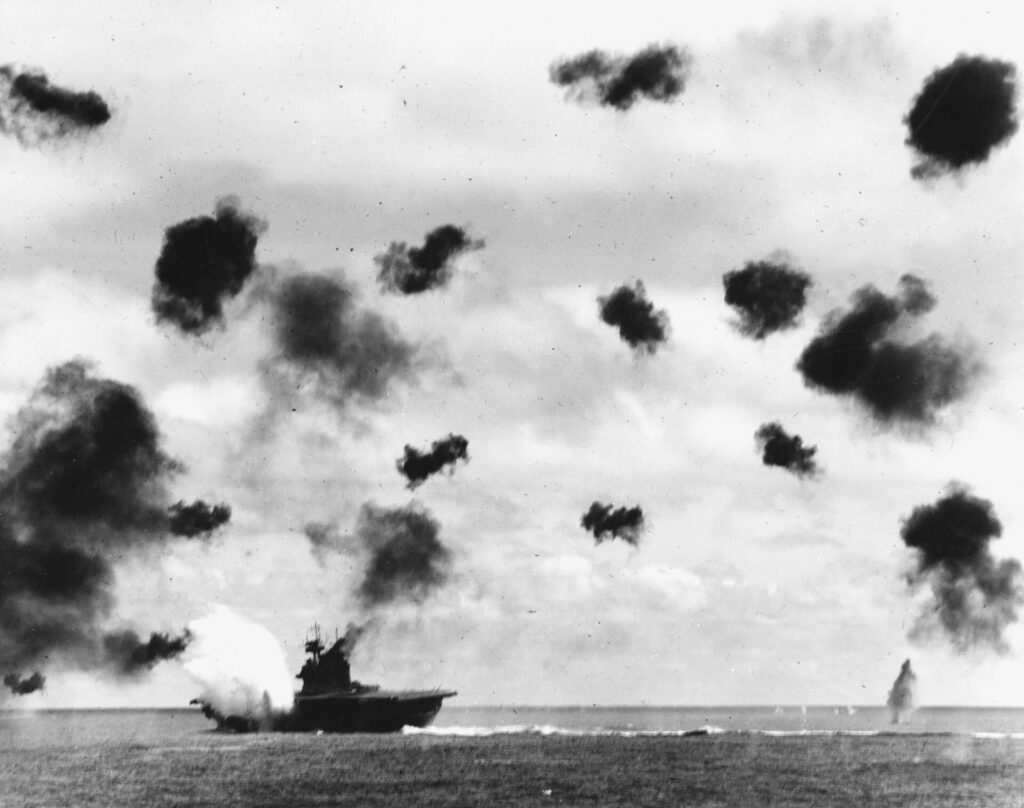
Seeking to strike back, Nagumo knew the only way to find the American carriers was to follow the returning dive-bombers. Instead of making evasive maneuvers to avoid being tracked, the Americans—low on fuel—headed straight back to their carriers, thus revealing the positions of USS Yorktown and Enterprise. Eighteen dive-bombers from Hiryu appeared over the U.S. carriers. USS Yorktown was hit, set ablaze, and damaged by explosions of fuel and ammunition, forcing its aircraft to land on USS Enterprise.
The fall of Hiryu and the end of the battle
Meanwhile, a second wave of Japanese planes headed for Yorktown, but on their way encountered another undamaged U.S. carrier. Seeing this, the Japanese launched torpedo planes armed with deadly aerial torpedoes. Two torpedoes struck Yorktown, disabling her. At 14:30, an American scout plane found the Japanese fleet and spotted the last carrier, Hiryu. U.S. dive-bombers attacked, hitting Hiryu, which sank during the night of June 5. Later that afternoon, the Americans sank a fourth carrier, though the Japanese heavily damaged USS Yorktown in return.
On June 6, Japanese submarine I-168 torpedoed the crippled Yorktown, which sank the next day, along with the destroyer USS Hammann. That same day, U.S. forces sank the Japanese heavy cruiser Mikuma. Facing catastrophic losses, the Japanese began withdrawing on the night of June 4–5, abandoning their plan to seize Midway.
Battle of Midway Tactical Overview
Conclusion
Six months after the attack on Pearl Harbor, the U.S. defeated Japan in one of the decisive naval battles of the Pacific War. The Doolittle Raid on Japan in April 1942 had shattered Japan’s belief that its homeland was immune to enemy air attacks. Realizing they needed to extend their defensive perimeter eastward to protect the Japanese mainland from U.S. raids, the Japanese sought to seize Midway, an island about a thousand miles from Hawaii. The battle for Midway was fought almost entirely in the air. In it, the U.S. destroyed most of Japan’s carrier fleet and many of its veteran pilots. Along with the Battle of Guadalcanal, Midway marked the end of Japan’s threat in the Pacific.
All four Japanese carriers—Akagi, Kaga, Soryu, and Hiryu—part of the six-carrier task force that had attacked Pearl Harbor six months earlier, along with a battleship, were sunk. The U.S. lost only USS Yorktown and a destroyer. After Midway and the grueling Solomon Islands campaign, Japan’s ability to replace lost ships and crews proved insufficient compared to its mounting material and personnel losses, while the U.S., with its vast industrial and manpower resources, could easily replace its losses. The Battle of Midway is considered the turning point in the Pacific War.
Ivan Toth is a distinguished Croatian lawyer and social affairs analyst.